
Can you haul a lowered car on a tilt-deck trailer without cracking an expensive carbon fiber splitter or high-centering the chassis? If you've ever spent frustrating minutes stacking hazardous 2x6 wooden boards in a driveway just to gain an extra inch of clearance, you know that sickening feeling. Traditional trailer ramps create steep incline angles between 14 and 22 degrees, turning standard loading into an unnecessary gamble with your front bumper and exhaust.
Tilt-deck trailers eliminate those fragile breakover points by angling the entire bed rather than relying on detached ramps. By cutting the approach angle down to 8 to 12 degrees, a proper tilt deck lets slammed street cars and track builds roll on smoothly without scrape marks. You'll discover how tilt decks accommodate low-clearance vehicles safely, learn critical winching and tire-strap techniques, and verify how to select the right trailer configuration for hauling around Omaha and Council Bluffs.
Key Takeaways
- Discover how hydraulic tilt mechanisms replace steep ramps with a continuous, low-angle slope that protects fragile splitters and exhaust systems.
- Learn why the answer to "Can You Haul a Lowered Car on a Tilt-Deck Trailer?" depends on pairing your vehicle's front overhang geometry with a sufficiently long deck.
- Master safe winching protocols and four-point tire strap techniques that secure low chassis without bending delicate suspension components.
- Calculate your exact towing setup using GCWR, hitch ratings, and vehicle payload rather than relying on generic truck classes.
- Identify the core trailer dimensions required for wide-body builds across the Omaha metro, including full 102-inch widths and drive-over fenders.
Understanding Tilt-Deck Mechanics and Low-Clearance Vehicle Geometry
Traditional flatbeds depend on separate ramps that hook onto the tail. That setup creates two sharp angles: one at the ground and another at the trailer lip. A hydraulic tilt hauler solves this by pivoting the entire trailer bed on a central subframe, lowering the tail directly to the asphalt. When asking, can you haul a lowered car on a tilt-deck trailer, the mechanical advantage comes down to creating a single, uninterrupted plane that protects delicate bodywork.
Calculating Your Vehicle Approach and Breakover Angles
Before loading, measure your vehicle's three primary clearance points:
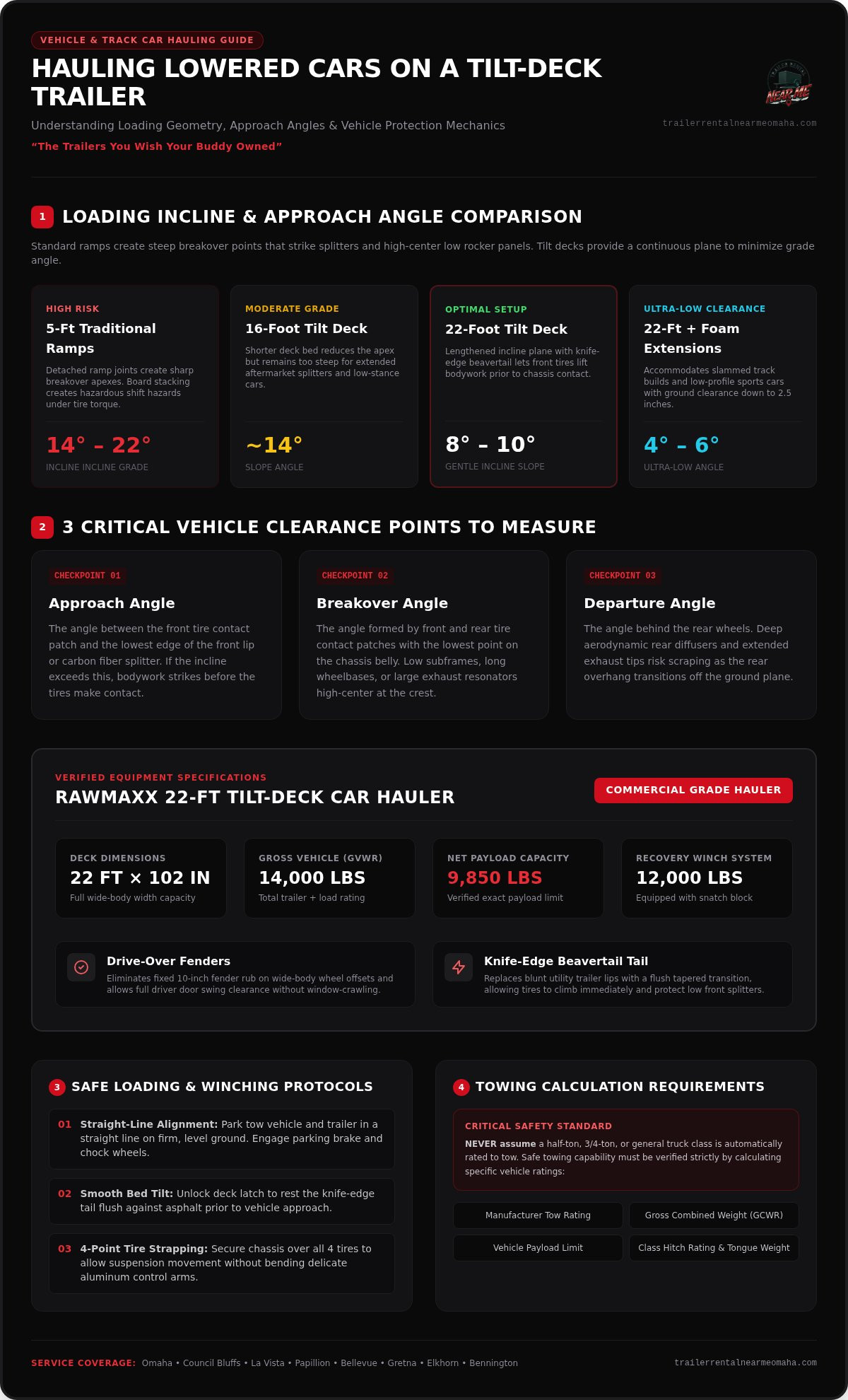
- Approach Angle: The angle between the front tire contact patch and the lowest edge of your front lip or carbon splitter. If the trailer's incline exceeds this angle, bodywork strikes before the tires make contact.
- Breakover Angle: The angle formed by the front and rear tire contact patches with the lowest point on the chassis belly. Cars with low subframes, long wheelbases, or large aftermarket exhaust resonators easily high-center at the crest.
- Departure Angle: The angle behind the rear wheels. Deep rear diffusers and exhaust tips risk scraping as the rear overhang exits the ground.
For vehicles equipped with air suspension, set your ride height to the exact trailering pressure before taking measurements rather than relying on a parked stance.
Why Traditional Ramps Fail Low-Profile Sports Cars
Standard five-foot utility ramps force steep loading angles between 14 and 22 degrees. At that incline, low front splitters collide with the metal before the front tires can climb. Stacking untreated 2x6 wooden boards under the ramp feet is a common weekend fix, but loose boards can shift or shoot out under tire torque, dropping the car directly onto the steel frame. Even when boards provide enough ground clearance, the abrupt peak where detached ramps hook to the trailer deck creates an apex that frequently damages rocker panels. Choosing a purpose-built tilt-deck car trailer rental removes detached ramp joints entirely, offering a continuous deck surface that preserves low-profile bodywork.
Critical Trailer Factors for Hauling Low-Clearance Cars
Platform geometry separates a smooth haul from cracked fiberglass. Answering can you haul a lowered car on a tilt-deck trailer without incident requires looking past the hydraulic cylinder and evaluating the deck's physical dimensions. Deck length, overall width, and fender designs dictate whether a chassis clears cleanly. A structural knife-edge or tapered beavertail tail eliminates the blunt lip found on basic utility trailers, helping the front tires lift the chassis before the bumper touches steel.
How Deck Length Controls the Tilt Slope
Deck length directly controls your approach angle through basic slope geometry. A short 16-foot tilt bed creates an incline around 14 degrees, which remains too steep for extended splitters or slammed track cars. Stepping up to a 22-foot platform lengthens the incline plane, dropping that angle down to 8 to 10 degrees. That gentler grade gives front bodywork the clearance it needs to rise as the front tires make contact. Combining a 22-foot deck with auxiliary foam extensions drops the angle even further to 4 to 6 degrees, easily accommodating vehicles with ground clearance as low as 2.5 inches.
Fender Clearance and Driver Door Access
Standard car haulers feature fixed 10-inch fenders that create constant clearance headaches for lowered platforms. Wide-body kits and aggressive aftermarket wheel offsets often rub the inner fender walls. More importantly, standard fender heights trap the driver inside the car, forcing you to crawl through a window or kill the clutch while trying to line up the deck.
Reinforced drive-over fenders solve both issues. Paired with a full 102-inch deck width, drive-over fenders allow wide track setups to roll directly over the wheel wells without tire rub. Lower profile fenders also provide enough door swing clearance to open the driver door over the top. You can compare specs across different trailer rental fleet options to confirm bed dimensions and fender configurations before scheduling a haul.
Step-by-Step Guide to Loading a Lowered Car on a Tilt Deck
Preparation prevents body damage. Park your tow vehicle and trailer in a straight line on firm, level ground. Engage the tow vehicle parking brake and chock the trailer wheels. Unlock the deck latch and allow the bed to tilt smoothly until the knife-edge tail rests firmly against the ground. Inspect the full approach path for debris or gravel mounds before moving the car into position.
When asking, can you haul a lowered car on a tilt-deck trailer without risking body damage, following a disciplined loading sequence makes all the difference:
- Align the Track: Line up the car perfectly straight with the trailer deck, centering the tires between the outer rub rails.
- Position a Spotter: Place a spotter on the driver side to monitor the front lip, side skirts, and exhaust clearance continuously.
- Control the Ascent: Pull the vehicle onto the incline at a slow walking pace, pausing if clearance drops below a half inch.
- Level the Deck: As the front axle crosses the trailer pivot center, the deck lowers smoothly into its flat, horizontal position.
- Lock the Latches: Secure the mechanical travel latches before unhooking winching cables or rigging tie-downs.
Winching Versus Driving Up the Incline
Driving up an incline risks sudden wheel slip, clutch overheating, and accidental throttle spikes that shove bodywork into the deck. Using a 12,000-lb winch with a snatch block delivers controlled, millimeter-level loading speed. Connect the recovery hook to factory tow hooks or rated chassis loop points. A spotter can monitor front splitter clearance from ground level while you control the winch remote, pausing the climb if clearances get tight.
Tie-Down Techniques for Sensitive Suspensions
Never crank ratchet straps down over delicate suspension links, steering rods, or lightweight aluminum control arms. Pulling down on chassis points compresses performance coilovers or air-ride struts against trailer D-rings, causing straps to loosen whenever the trailer hits a bump on the highway. Instead, secure all four corners using over-the-tire basket straps or lasso straps directly around the rubber. Tire straps allow the car's suspension to cycle naturally over pavement seams without putting tension on fragile steering knuckles. Check our car trailer hauling guide for proper tongue weight distribution and axle loading guidelines.
Choosing the Right Tilt Car Hauler in the Omaha Metro
Renting the wrong trailer turns an afternoon project into an expensive headache. If you're asking can you haul a lowered car on a tilt-deck trailer safely, the answer depends entirely on trailer specifications and verified tow ratings. Choosing equipment built specifically for lowered vehicles ensures you aren't forced into risky roadside modifications.
Evaluating the RawMaxx 22-Foot 14k Tilt-Deck Capabilities
Standard car trailers often leave wide builds pinched between narrow fenders. The RawMaxx tilt deck solves this with a full 22-foot by 102-inch deck, operating at the legal highway width limit across Nebraska and Iowa without oversized permits. Its 14,000-lb Gross Vehicle Weight Rating (GVWR) delivers a verified 9,850-lb payload capacity, handling everything from lightweight track coupes to heavy electric sedans.
Drive-over fenders eliminate clearance worries for wide tire offsets, while the integrated 12,000-lb winch with snatch block provides smooth pulling power for non-running project builds. If you have an upcoming track day or show, booking a tilt-deck car trailer rental in advance secures the right platform for low-profile transport.
Verifying Tow Vehicle Compatibility and Omaha Metro Logistics
Never assume a half-ton or three-quarter-ton truck is automatically rated to pull a loaded tilt deck. Towing suitability never relies on generic truck classes. It depends strictly on your truck's specific Gross Combined Weight Rating (GCWR), manufacturer maximum tow rating, hitch receiver rating, and available payload capacity after accounting for tongue weight and passengers. Nebraska law (Neb. Rev. Stat. § 60-6,246) and Iowa regulations both require functional trailer brakes and an operational emergency breakaway switch for trailers in this weight class.
Trailer Rental Near Me operates out of La Vista, providing dependable equipment to builders across Omaha, Papillion, Bellevue, Gretna, Elkhorn, Bennington, and Council Bluffs. We deliver “The Trailers You Wish Your Buddy Owned,” thoroughly inspected and ready for demanding work. Explore our complete selection on our trailer fleet page to confirm dimensions and hitch compatibility before your next haul.
Safeguard Your Build on Your Next Transport
When asking, can you haul a lowered car on a tilt-deck trailer, the answer comes down to choosing the right platform geometry and disciplined loading methods. Ditching detached wooden ramps removes unpredictable breakover hazards. At the same time, winching at a controlled crawl and securing all four wheels with basket straps preserves both delicate bodywork and performance suspension setups.
Selecting equipment engineered for low-profile vehicles protects your investment from your garage to the destination. A massive 22'x102" deck provides the shallow incline angle needed to clear aggressive aero, supported by a heavy-duty 14,000-lb GVWR with a verified 9,850-lb payload capacity. Standard features like drive-over fenders and an included 12,000-lb winch with snatch block and straps eliminate the usual trailering headaches across the Omaha metro.
Load with total confidence and keep your front splitter intact from start to finish.
Frequently Asked Questions
Can any lowered car load onto a tilt-deck trailer without scraping?
Not every vehicle clears automatically without checking dimensions first. Whether you can haul a lowered car on a tilt-deck trailer cleanly depends on your front overhang distance and ride height. While an 8 to 12-degree tilt slope clears most lowered street cars, aggressive chassis setups with extended splitters and ground clearance under three inches may still require low-profile helper ramps at the deck tail to prevent contact.
Do I need extra ramps if I use a 22-foot tilt-deck trailer?
Most lowered vehicles do not require auxiliary ramps on a 22-foot deck. The longer 22-foot platform naturally flattens the incline slope compared to shorter utility beds. However, if your track car runs an aggressive front air dam or sits lower than three inches off the ground, placing engineered foam helper ramps against the knife-edge tail helps drop the approach angle below six degrees for seamless clearance.
How do I secure a lowered car without damaging its alignment?
Always secure lowered vehicles by the wheels rather than the chassis. Use four-point over-the-tire basket straps or lasso straps wrapped directly across the rubber tread. Anchoring to steering arms or sway bars pulls against delicate alignment settings and bends aluminum components. Strapping the tires locks the car to the trailer deck while allowing the vehicle's suspension to cycle naturally over highway joints without slacking the tie-downs.
Can a half-ton pickup tow a 14,000-lb GVWR tilt-deck car hauler?
You cannot assume any half-ton or three-quarter-ton truck is rated to tow this trailer. Suitability depends entirely on your vehicle's specific manufacturer tow rating, available payload capacity, Gross Combined Weight Rating (GCWR), and receiver hitch class. A 14,000-lb GVWR trailer carrying a vehicle generates substantial tongue weight. You must calculate your actual loaded weights against the truck's door jamb placard specifications before hitching up.
Why is a winch recommended when loading a low-clearance track car?
Winching eliminates the sudden throttle surges, clutch overheating, and tire spin that often happen when driving a performance car up an incline. Using an integrated 12,000-lb recovery winch lets you pull the vehicle onto the deck at a controlled walking pace. This steady speed gives your spotter time to confirm body clearances and allows you to stop instantly if a splitter gets too close to the steel.
Where can I rent a tilt-deck car hauler in the Omaha area?
Trailer Rental Near Me rents commercial-grade tilt-deck haulers from La Vista, Nebraska. We serve drivers across Omaha, Bellevue, Papillion, Ralston, Bennington, Gretna, Elkhorn, and Council Bluffs. Our 22-foot by 102-inch car trailers feature a 14,000-lb GVWR, a verified 9,850-lb payload capacity, drive-over fenders, and an included 12,000-lb winch with snatch block and straps, delivering “The Trailers You Wish Your Buddy Owned.”

Article by
Chuck Crom
Chuck Crom is the owner of Trailer Rental Near Me, serving Omaha, La Vista, Papillion, Bellevue, Gretna, Elkhorn, and the surrounding Nebraska and western Iowa communities. With years of hands-on experience towing, hauling, and helping customers choose the right trailer for the job, Chuck specializes in making trailer rentals simple, safe, and stress-free.
He writes practical, no-nonsense articles covering trailer safety, towing tips, weight ratings, loading techniques, equipment transport, landscaping projects, home renovations, vehicle hauling, and everything in between. His goal is to help renters avoid common mistakes, stay safe on the road, and get their projects done with confidence.
When he's not helping customers or creating educational content, Chuck is focused on growing a locally owned business built on honest advice, quality equipment, and exceptional customer service.


