

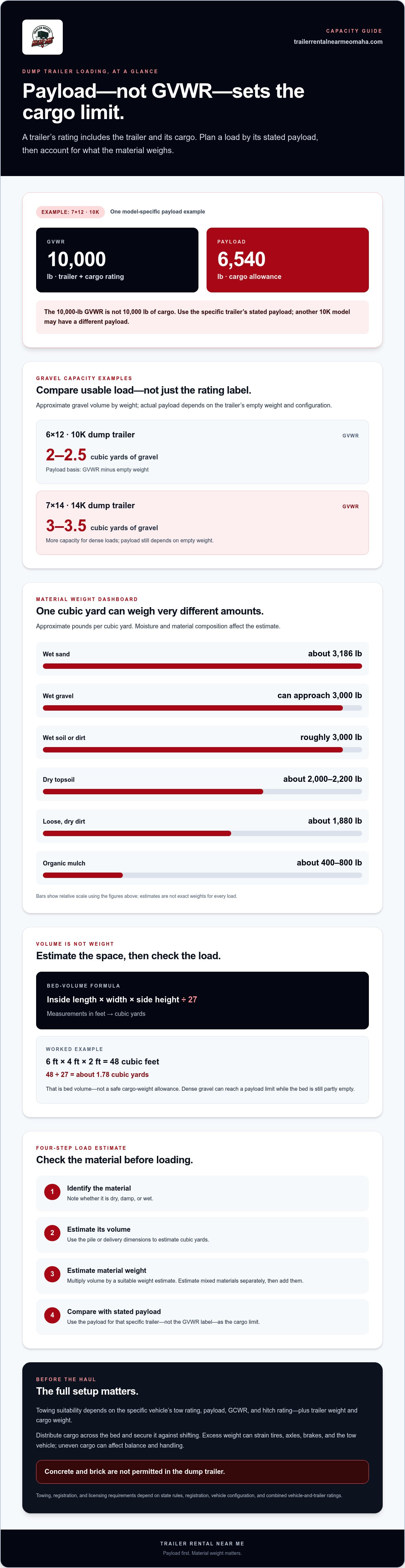
A 10,000-lb rating doesn’t mean a dump trailer can carry 10,000 pounds of material. What a 10K dump trailer can haul depends on its payload capacity and the cargo’s weight. A 7x12 model with a 6,540-lb payload can carry up to 6,540 pounds of cargo. Gravel, sand, and wet soil can use that capacity quickly, while lighter debris may fill more of the bed first.
For projects around La Vista and Omaha, choosing between a 10K and 14K trailer means matching payload to the material, load size, and your specific vehicle setup. A higher rating isn’t automatically the better fit.
This guide compares trailer capacities, explains how gravel, sand, soil, and debris affect payload, and shows why bed volume and cargo weight are different limits. You’ll get a practical way to estimate a suitable trailer size before planning your haul.
Key Takeaways
- Separate payload from bed volume: a trailer can run out of weight capacity before the bed looks full.
- Estimate material weight before loading, especially for wet gravel, sand, and soil.
- Compare 10K and 14K trailers by usable payload, not just their GVWR labels.
- Match the loaded trailer to your specific vehicle’s tow rating, payload, GCWR, and hitch rating.
- Use the decision guide to narrow down a trailer size that fits your material and hauling setup.
10,000 Lb vs 14,000 lb Dump Trailer: Which Size Do You Need?
Choose a trailer based on usable payload and material weight, not the GVWR label alone. Bed volume tells you how much space cargo takes up, but not whether the trailer can safely carry its weight.
Payload Capacity and Bed Volume
Payload is the cargo weight a trailer can carry within its rating. Bed volume is the space available for that cargo. Dense gravel may reach the payload limit while the bed is still partly empty; lighter debris can take up more space before reaching the limit.
6X12 10K Trailer Capacity
A 6x12 10K dump trailer can carry roughly 2 to 2.5 cubic yards of gravel by weight. Its precise payload depends on the trailer’s empty weight, so the 10,000-lb GVWR is not its cargo allowance. Use the trailer’s stated payload as the limit, then estimate the material’s weight before loading. Wet gravel can approach 3,000 pounds per cubic yard, making volume alone a poor loading guide.
A 7x14 14K dump trailer can carry roughly 3 to 3.5 cubic yards of gravel by weight. It offers more capacity for dense loads, but its payload still depends on empty weight. Compare both trailers using the same material and load plan:
| Option | GVWR | Gravel by weight | Payload basis |
|---|---|---|---|
| 6x12 dump trailer | 10,000 lb | 2 to 2.5 cubic yards | GVWR minus empty weight |
| 7x14 dump trailer | 14,000 lb | 3 to 3.5 cubic yards | GVWR minus empty weight |
Dump-Bed Capacity in Cubic Yards
To estimate bed volume, multiply its inside length, width, and side height in feet. Divide the cubic-foot result by 27 to convert it into cubic yards. For example, a bed measuring 6 feet long, 4 feet wide, and 2 feet high holds 48 cubic feet, or about 1.78 cubic yards. That is volume, not a safe cargo-weight allowance.
Wet sand weighs about 3,186 pounds per cubic yard. An example 10K trailer can carry 2.037 cubic yards of wet sand without overloading its frame or axles. Do not assume every bed can carry that amount; compare the planned load weight with the trailer’s payload. See the dump trailer setup and specifications for a 7x12 10K example.
U.S. towing, registration, and licensing: Requirements depend on state rules, registration, vehicle configuration, and the combined vehicle-and-trailer ratings. Towing suitability depends on the vehicle’s tow rating, payload, GCWR, hitch rating, trailer weight, and cargo weight.
Empty weight varies by trailer model and construction.
Overloading and load security: Excess weight can strain tires, axles, brakes, and the tow vehicle. Uneven cargo can also affect balance and handling. Distribute cargo across the bed and secure it against shifting. Concrete and brick are not permitted in the Dump Trailer.
Choose the 10K option for smaller loads within its payload; choose 14K when the load requires more capacity and the tow setup supports it.
Gravel, sand, soil, and debris weights
Knowing what a 10K dump trailer can haul starts with identifying the material and its condition. Moisture can change the estimate substantially: wet soil may weigh roughly 3,000 pounds per cubic yard.
- Loose dry dirt: about 1,880 pounds per cubic yard.
- Dry topsoil: approximately 2,000 to 2,200 pounds per cubic yard.
- Wet topsoil or dirt: roughly 3,000 pounds per cubic yard.
- Organic mulch: approximately 400 to 800 pounds per cubic yard.
Material type matters, even within the same load category. Brush and packaging take up space differently from compacted demolition scraps. Wet soil can weigh much more than dry soil, so reassess an estimate made before rain. Concrete and brick are not permitted in the Dump Trailer.
Sand estimates also vary with moisture and material composition. For what a 10K dump trailer can haul on a particular sand job, use the supplier’s material description and consider whether the load is wet. Those figures are estimates, not exact weights for every delivery.
Use this sequence to estimate a load before hauling:
- Identify the material and whether it is dry, damp, or wet.
- Estimate its volume in cubic yards using the pile or delivery dimensions.
- Multiply the volume by a suitable weight estimate for that material.
- Compare the estimated cargo weight with the specific trailer’s payload.
That contrast shows why estimating what a 10K dump trailer can haul requires both a volume estimate and a material-weight estimate. Mixed loads need separate estimates for each material before adding the totals.
If your project includes different hauling tasks, compare trailer options for material and equipment hauling after estimating the load. Material, moisture, and total volume help determine which option fits the job.
Payload estimates for 10,000 lb and 14,000 lb dump trailers
A trailer’s payload rating, not its GVWR label alone, sets the cargo amount to plan around.
How much payload can a 10K dump trailer legally and safely carry? The legal cargo limit depends on the trailer’s assigned ratings and applicable registration rules; a 10K GVWR label does not mean 10,000 pounds of cargo. For safe loading, stay within the trailer’s stated payload and account for the tow vehicle’s ratings, payload, GCWR, hitch rating, trailer weight, and cargo weight.
A 7x12 10K dump trailer with a 6,540-pound payload provides a clear example. That figure is the cargo allowance, not the total weight of trailer and cargo combined. A different 10K trailer can have a different payload because its empty weight and configuration differ. For any specific trailer, use its stated payload rather than assuming that every model shares one figure.
That estimate shows the general relationship between GVWR and empty weight. It is not a universal rating for every 14K trailer. Added equipment and model construction affect the actual empty weight and, in turn, available cargo capacity.
Use this calculation to understand the relationship: GVWR minus empty trailer weight equals maximum payload. Compare the planned cargo weight with that payload. Dense material can reach the cargo limit before the bed is full. Bulky, lighter debris may take up more space while staying below the weight limit, but volume does not increase the trailer’s rated payload.
Before loading, identify the trailer and find its GVWR, empty weight, and payload information. Estimate the load’s weight from its material and volume, leaving enough room to stay within the payload limit. For mixed loads, estimate each material separately and add the figures. A rough volume estimate is not a scale reading.
Then assess the complete towing combination. The tow vehicle’s manufacturer tow rating, payload, GCWR, and hitch rating all matter alongside the loaded trailer weight. A load can fit within the trailer’s payload and still exceed a vehicle or hitch limit. Match every rating to the actual load before hauling.
What does 10K mean for a dump trailer: GVWR or payload capacity?
“10K” refers to a dump trailer’s 10,000-pound gross vehicle weight rating, or GVWR. GVWR covers the trailer’s total loaded weight, including the trailer itself and its cargo. It does not mean the trailer can carry 10,000 pounds of material.
Payload is the cargo capacity available within that GVWR. A trailer’s empty weight uses part of its total rating, leaving the remaining capacity for material. Use that specific payload rather than treating “10K” as the cargo limit.
The distinction matters because two trailers with the same 10,000-pound GVWR can have different payloads. If one model weighs more empty, less capacity remains for its load. Bed dimensions don’t change the rating either. A taller sidewall may provide room for more material, but it doesn’t increase the GVWR or payload.
A 14,000-pound GVWR model follows the same principle. That example illustrates the calculation, not a universal rating for every 14K trailer. The exact payload depends on the individual trailer’s stated specifications.
Use these steps to read a trailer’s rating accurately:
- Find the GVWR on the trailer’s identification label or documentation.
- Find the empty weight and the stated payload for that specific model.
- Compare the planned cargo weight with the stated payload, not the GVWR.
- Include the trailer’s actual load in your towing calculations, then consider the tow vehicle’s manufacturer tow rating, payload, GCWR, and hitch rating.
For instance, if a load estimate exceeds a 10K trailer’s stated payload, a partly empty bed doesn’t make that load acceptable. Reduce the cargo or select a trailer with a suitable payload. Conversely, a light material may fill more of the bed while remaining within the payload. Capacity is governed by weight and ratings, not appearance alone.
GVWR is also part of assessing the full towing combination. The tow vehicle’s tow rating, payload, GCWR, and hitch rating each limit what the combination can handle. A trailer payload within its own rating does not establish that the tow vehicle can handle the loaded trailer.
Trailer Rental Near Me: 22'x102 14k Tilt Deck Car Hauler Rental
Trailer Rental Near Me offers a 7x12 RawMax 10K dump trailer for material hauling, with a 6,540-pound payload, hydraulic scissor lift, spreader gate, ramps, and tarp. For projects around La Vista and Omaha, compare the load plan with the trailer’s capacity before choosing your setup.
For vehicle transport, the 22'x102 14K tilt-deck car hauler has a 9,850-pound payload and a 12,000-pound winch with a snatch block and drive-over fenders. The right option depends on the job and your vehicle’s towing setup. The Trailers You Wish Your Buddy Owned.
Explore trailer options for material hauling and vehicle transport to match your equipment to the task.
Plan Your Next Haul with Confidence
A sound trailer choice starts with a clear load plan. Estimate the material or equipment weight, identify how much space it needs, and compare those needs with the trailer’s payload and your vehicle’s ratings. That gives you a practical starting point for deciding what a 10K dump trailer can haul on your project, rather than relying on how full the bed looks.
Trailer Rental Near Me offers the 7x12 RawMax 10K Dump Trailer Rental for material hauling, plus the 22'x102 14K Tilt Deck Car Hauler Rental and 22'x102 14K Car Trailer Rental for vehicle transport. Match the trailer type to the job, then plan around the load and towing setup.
Use the load plan to compare trailer options for your next project.
With the right match, you can plan the haul confidently and get on with the work.
Frequently Asked Questions
How much does the cargo I’ll be hauling weigh?
Estimate cargo weight using the material, moisture, and volume. A supplier’s load ticket can provide a useful starting point for delivered gravel or soil. For debris, separate dense items from light waste before estimating: roofing scraps and branches won’t weigh like wet soil. Compare the total estimate with the trailer’s payload, and include any material already in the bed.
How much space does my cargo need in my dump-bed?
Measure the load’s length, width, and height, then compare its shape with the bed’s inside dimensions. A compact soil pile may fit neatly, while brush and demolition debris leave air gaps and take up more room. For loose material, estimate the pile as a box, then adjust for an uneven or sloped top. Keep both the space estimate and cargo weight in mind.
What might I haul (that I need to make sure the trailer can handle)?
Common dump-trailer loads include mulch, yard waste, brush, dirt, sand, gravel, and mixed construction debris. Consider more than the material name: wet soil differs from dry leaves, and long branches may need more bed space than compacted sod. Check the trailer’s permitted uses and ratings for your planned load. Concrete and brick are not permitted in the Dump Trailer.
How many cubic yards can a 10K dump trailer hold?
There isn’t one cubic-yard capacity for every 10K dump trailer; bed dimensions and side height change its volume. One example 5-by-10-foot bed has a total volume of 3.7 cubic yards, but that figure describes space, not the amount of heavy cargo it can carry. Gravel, wet sand, and soil can reach the weight limit before filling the bed.
How much do common materials weigh per cubic yard, including gravel, dirt, sand, and mulch?
Weight varies with material and moisture. Loose dry dirt is about 1,880 pounds per cubic yard; dry topsoil is roughly 2,000 to 2,200. Wet dirt can reach about 3,000. Crushed gravel and sand are estimated at 2,400 to 2,900, while sand is also listed at 3,100. Organic mulch is much lighter, around 400 to 800 pounds per cubic yard.
How many cubic yards of gravel or dirt can a 10K dump trailer haul?
A 6-by-12-foot 10K dump trailer can carry roughly 2 to 2.5 cubic yards of gravel by weight. Dirt capacity depends on its moisture and the trailer’s stated payload: dry, loose dirt weighs less per cubic yard than wet soil. Estimate the material weight first, then compare the total with the specific trailer’s payload instead of assuming its bed can be filled.

Article by
Chuck Crom
Chuck Crom is the owner of Trailer Rental Near Me, serving Omaha, La Vista, Papillion, Bellevue, Gretna, Elkhorn, and the surrounding Nebraska and western Iowa communities. With years of hands-on experience towing, hauling, and helping customers choose the right trailer for the job, Chuck specializes in making trailer rentals simple, safe, and stress-free.
He writes practical, no-nonsense articles covering trailer safety, towing tips, weight ratings, loading techniques, equipment transport, landscaping projects, home renovations, vehicle hauling, and everything in between. His goal is to help renters avoid common mistakes, stay safe on the road, and get their projects done with confidence.
When he's not helping customers or creating educational content, Chuck is focused on growing a locally owned business built on honest advice, quality equipment, and exceptional customer service.


