
Saving a few dollars on a two-wheel tow dolly can turn into an expensive transmission rebuild before you even reach the interstate. When you weigh a Car Trailer vs Tow Dolly: Which Is Better? the right answer comes down to your vehicle's drivetrain, your route, and how much mechanical risk you are willing to take on Omaha roads.
You shouldn't have to dread tight turns in older neighborhoods because a dolly cannot back up, nor should you have to guess whether your load exceeds safe axle capacities. You want your vehicle to arrive in pristine condition, with zero loading headaches and complete peace of mind. In this practical guide, you will discover the critical differences between car trailers and tow dollies so you can choose the safest, most efficient way to transport your vehicle. We cover drivetrain mechanics, weight ratings, ease of loading, and legal towing standards across Nebraska and Iowa.
Key Takeaways
- Evaluate your drivetrain first: all-wheel drive, four-wheel drive, and electric vehicles require complete isolation from the road to prevent severe transmission damage, making drivetrain type the deciding factor in Car Trailer vs Tow Dolly: Which Is Better?
- Understand reversing limits: tow dollies cannot back up due to dual articulation points, whereas a dual-axle car trailer reverses predictably into tight driveways and job sites.
- Comply with regional safety laws: Nebraska and Iowa statutory codes require auxiliary brakes on setups weighing 3,000 lbs. or more, favoring trailers equipped with independent braking systems.
- Eliminate loading friction: hydraulic tilt decks remove the risk of high-centering low-profile vehicles, while an onboard 12,000-lb winch handles disabled or non-running vehicles safely.
- Verify tow vehicle specs: determine towing suitability using your tow vehicle's specific GCWR, hitch rating, and payload capacity rather than relying on generic truck size categories.
Car Trailer vs. Tow Dolly: Defining the Two Methods
Choosing the right transport equipment starts with understanding how each tool interacts with your vehicle. A tow dolly is a lightweight, two-wheeled unit designed to lift only the front axle off the ground, leaving the rear tires rolling freely on the roadway. In contrast, a full car trailer carries the entire vehicle on a flat platform, keeping all four wheels completely off the pavement. Deciding between a Car Trailer vs Tow Dolly: Which Is Better? comes down to mechanical compatibility, travel distance, and physical wear on your equipment.
How a Tow Dolly Works
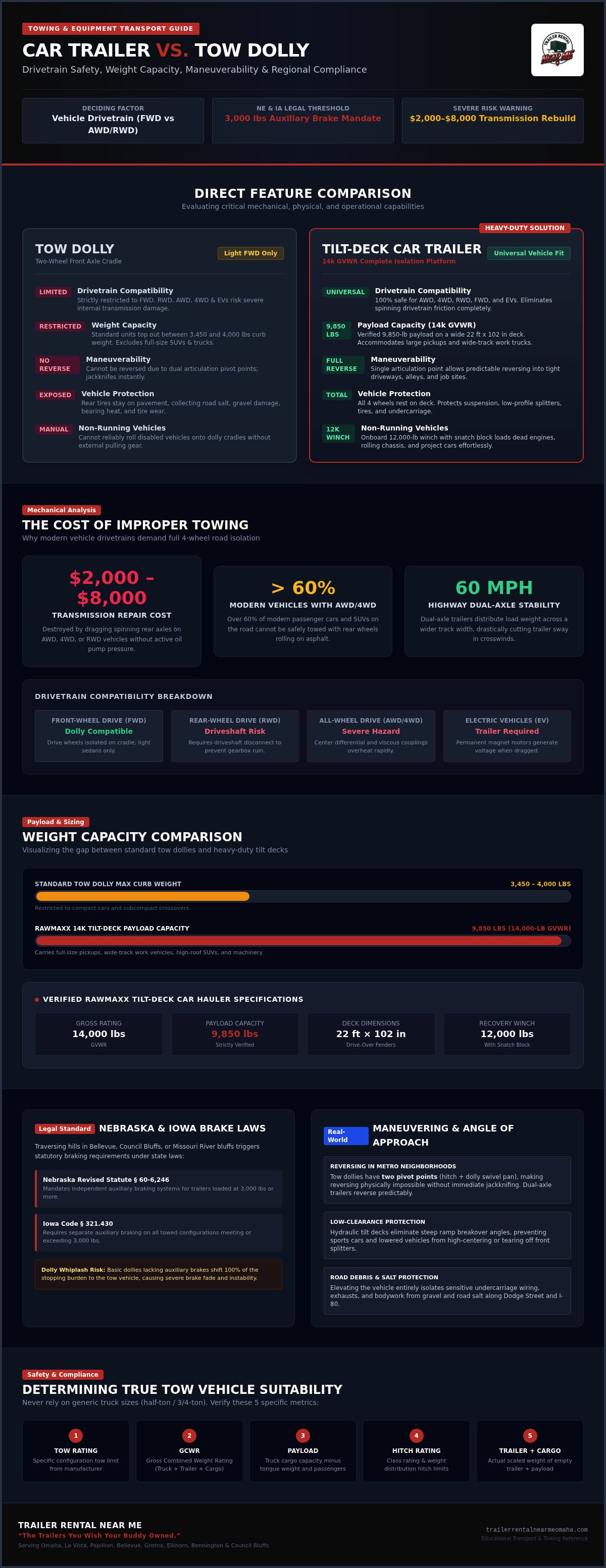
Tow dollies secure a vehicle by strapping its front tires into cradles mounted on a small axle. Because the drive wheels must remain off the asphalt, dollies are practically restricted to front-wheel-drive (FWD) cars. If you attempt to tow a rear-wheel-drive (RWD) vehicle on a dolly without disconnecting the driveshaft, the spinning rear axle turns the transmission output shaft without pumping vital fluid, causing catastrophic friction damage within miles. Industry data shows that repairing an AWD, 4WD, or RWD transmission destroyed by improper towing costs between $2,000 and $8,000. For short, local moves involving light FWD sedans, dollies get the job done, but their drivetrain limitations are severe.
The Advantages of a Full Car Trailer
Full car trailers isolate the transported vehicle from road hazards entirely. When weighing a Car Trailer vs Tow Dolly: Which Is Better? for reliability, trailers provide several distinct functional advantages:
- Complete Suspension Protection: All four wheels rest securely on the trailer bed, preventing tire wear, bearing heat, and suspension fatigue caused by rough roadways.
- Recovery Capability: Disabled or non-running cars cannot roll onto a dolly reliably. A dedicated platform like a tilt deck car trailer equipped with a 12,000-lb winch pulls rolling chassis and broken-down project cars effortlessly onto the deck.
- Highway Stability: Dual axles distribute weight across a wider track width, drastically reducing trailer sway during 60 mph highway hauls and sudden crosswinds along open Nebraska corridors.
For high-value passenger cars, trucks, or long-distance moves, trailers deliver total mechanical protection that two-wheel dollies simply cannot match.
Comparing Performance: Stability, Capacity, and Vehicle Protection
Weight ratings and physical control draw the clearest line between equipment options. Standard tow dollies top out at curb weights between 3,450 and 4,000 lbs., leaving no room for modern trucks, large SUVs, or heavy electric platforms. An industrial hauler built with a 14,000-lb GVWR and a wide 102-inch deck easily accommodates wide-track pickups and full-size work vehicles that physically overhang dolly fenders. If you don't isolate all four wheels on the pavement, road salt and gravel kicked up along Dodge Street or I-80 will chew up your undercarriage. When evaluating a Car Trailer vs Tow Dolly: Which Is Better? for real-world demands, platform capacity and structural balance settle the debate quickly.
Braking and Control on Omaha Hills
Steep grades across Bellevue, Council Bluffs, and the Missouri River bluffs expose the handling faults of light equipment. Under Nebraska Revised Statute § 60-6,246 and Iowa Code § 321.430, trailers loaded at 3,000 lbs. or more require independent auxiliary braking systems. Basic tow dollies frequently lack dedicated braking units, pushing the entire stopping burden onto your tow vehicle and triggering an unstable "whiplash" surge during sudden stops. A dual-axle platform with a 14,000-lb GVWR provides a much higher safety margin and structural stability when slowing heavy SUVs or work trucks down steep inclines.
Transmission Safety and Tire Wear
Spinning drivetrain components without active engine oil pressure remains a severe mechanical hazard on two-wheel dollies. Over 60% of modern passenger vehicles feature AWD or 4WD systems that suffer extreme internal heat when dragged with rear wheels down. Hauling across longer stretches to Lincoln or outstate Nebraska on a flat deck ensures uniform tire condition and completely eliminates drivetrain friction. Read our guide on Why Tilt Deck Trailers are Safer for Low-Clearance Cars to see how deck angles protect sensitive splitters and exhaust systems. If your transport project demands dependable gear, check out our full lineup of heavy-duty rental trailers engineered for demanding regional jobs.
Operational Reality: Loading and Maneuvering in the Omaha Metro
Loading mechanics and street navigation expose the practical friction of each setup. Aligning a vehicle onto narrow dolly trays requires pinpoint steering accuracy, tight clearances, and crawling on pavement to secure ratchet straps around the front tires. When evaluating a Car Trailer vs Tow Dolly: Which Is Better? for local operations, the ease of loading and real-world maneuverability make all the difference.
The Tilt Deck Advantage for Low-Clearance Cars
Steep loading angles present an immediate threat to modern vehicles. Tow dollies rely on short, steep ramps that routinely catch front bumpers, damage plastic splitters, and high-center lower rockers. A RawMaxx 22ft tilt-deck hauler eliminates separate ramps entirely by tilting the entire deck down for a gradual, seamless approach angle. For broken-down project cars or Copart auction pickups that cannot drive themselves, an integrated 12,000-lb winch with a snatch block acts as a crucial safety net, pulling rolling chassis cleanly onto the deck without manual shoving.
Navigating Omaha Traffic and Parking
Backing up is where tow dollies fail completely. A dolly creates dual articulation points at both the hitch ball and the wheel swivel pan, making controlled reversing virtually impossible. If you enter a dead-end residential street in Dundee or a tight parking lot in Elkhorn, you cannot back out. You must unstrap the car, back it off the dolly, maneuver the tow rig, and reload. A 22ft dual-axle trailer tracks directly behind your vehicle, turning predictably and reversing smoothly into driveways or garage bays. Review our Car Trailer Rental Omaha: Your 2026 Buying & Hauling Guide for detailed tips on managing equipment dimensions across town.
The Professional Choice: Why a 14k Tilt Deck Trailer Wins
Transporting full-size utility trucks, heavy electric platforms, or customized off-road rigs requires equipment built far beyond the limits of lightweight rental hardware. for demanding regional projects, industrial deck specs decide the matter. A heavy-duty tilt-deck car hauler provides the structural backbone, deck width, and mechanical leverage necessary to handle loads that would instantly overload a light dolly axle.
Specifications of the RawMaxx 22'x102" Hauler
Positioned locally across Omaha and La Vista as "The Trailer You Wish Your Buddy Owned," the RawMaxx tilt deck delivers commercial-grade utility through verified specs:
- 22 ft x 102 in Deck: Full width matches the Nebraska legal limit without special hauling permits, while rugged drive-over fenders comfortably accommodate wide-track trucks and aftermarket off-road wheel packages.
- 14,000-lb GVWR: Heavy dual axles and a rigid steel chassis prevent structural fatigue under concentrated vehicle loads.
- 9,850-lb Payload: This verified net carrying capacity easily supports heavy work pickups, electric SUVs, and service vans without pushing axles to their mechanical ceiling.
- 12,000-lb Winch with Snatch Block: Standard equipment that allows single-operator recovery of rolling chassis, locked-up drivetrains, or non-running restoration projects.
For jobs requiring maximum clearance and effortless loading, a 22ft tilt-deck car trailer rental removes the guesswork from securing heavy rolling assets.
Determining Your Vehicle's Towing Suitability
Never assume a general vehicle class can automatically tow a 14,000-lb trailer setup safely. Towing suitability never relies on a truck label; it depends strictly on your tow vehicle's specific configuration, manufacturer tow ratings, curb payload, hitch receiver class, Gross Combined Weight Rating (GCWR), and total loaded cargo weight. Contractors and DIY haulers across Papillion, Gretna, and Council Bluffs should always verify axle loads at local commercial scale houses before heading onto regional highways.
Choose Confidence for Your Next Vehicle Haul
Taking shortcuts with towing equipment doesn't pay off when your drivetrain is on the line. When deciding between a Car Trailer vs Tow Dolly: Which Is Better? for hauling across the Omaha metro, isolating your vehicle on a rugged dual-axle platform is the smartest call. You eliminate drivetrain stress, avoid the nightmare of being unable to reverse, and gain full legal compliance across Nebraska and Iowa highways.
With a verified 9,850-lb payload capacity and an onboard 12,000-lb winch included, a heavy-duty tilt deck handles everything from low-slung project cars to full-size work trucks. Backed by dependable local Omaha support, you get reliable commercial-grade equipment built to finish demanding jobs without friction.
Hit the road knowing your vehicle is completely isolated from highway hazards and ready to roll off at your destination.
Frequently Asked Questions
Can I tow an all-wheel-drive (AWD) vehicle on a tow dolly?
No, you should never tow an all-wheel-drive or permanent four-wheel-drive vehicle on a two-wheel tow dolly without removing the driveshaft. Leaving the rear wheels spinning on the pavement while the front axle sits elevated turns the center differential and transmission without active lubrication. Doing so can cause catastrophic mechanical failure within just a few miles. Always load an AWD vehicle onto a full trailer deck to keep all four wheels elevated.
Is it harder to back up a car trailer or a tow dolly?
Backing up a tow dolly is nearly impossible and explicitly prohibited by manufacturers. A dolly introduces two separate articulation points: the hitch ball and the wheel swivel pan. When you shift into reverse, the setup immediately jackknifes, risking body and fender damage. In contrast, a dual-axle car trailer pivots predictably from the hitch ball, allowing you to back into driveways and parking stalls throughout Papillion and Council Bluffs with confidence.
What is the maximum weight a 14k car trailer can actually carry?
A heavy-duty 14,000-lb GVWR tilt-deck hauler provides a verified net payload capacity of 9,850 lbs. GVWR represents the total combined weight of the trailer frame and the load. Subtracting the trailer chassis weight leaves exactly 9,850 lbs for your vehicle. In the debate of Car Trailer vs Tow Dolly: Which Is Better?, this structural capacity easily accommodates full-size work pickups and electric SUVs that far exceed a dolly's 4,000-lb limit.
Do I need a special license to rent a car trailer in Nebraska?
No special commercial driver's license (CDL) is required for personal, non-commercial vehicle hauling in Nebraska. A standard driver's license is completely sufficient as long as the combined setup stays under commercial regulatory thresholds. However, you must confirm that your specific tow vehicle features an adequate manufacturer tow rating, payload capacity, and hitch class rating. Safe towing depends on exact vehicle ratings rather than generic truck size categories.
What happens if my car doesn't run? Can I still use a tow dolly?
Using a tow dolly for an inoperable car is exceptionally difficult and hazardous. Dollies require a vehicle that can steer, drive up steep ramps under power, and hold air in all tires. Winching a dead vehicle onto narrow dolly trays is awkward and unstable. A dedicated tilt deck equipped with a 12,000-lb winch pulls disabled projects, rolling chassis, and auction buys directly onto the bed with minimal physical effort.
Are trailer brakes required for hauling a car in the Omaha area?
Yes, auxiliary trailer brakes are legally required on trailers with a gross loaded weight of 3,000 lbs. or more under Nebraska Revised Statute § 60-6,246 and Iowa Code § 321.430. State regulations also require an automatic breakaway system to stop the trailer if it uncouples. When considering Car Trailer vs Tow Dolly: Which Is Better? for driving across the I-80 Missouri River bridge, a car trailer with electric brakes ensures complete legal compliance.

Article by
Chuck Crom
Chuck Crom is the owner of Trailer Rental Near Me, serving Omaha, La Vista, Papillion, Bellevue, Gretna, Elkhorn, and the surrounding Nebraska and western Iowa communities. With years of hands-on experience towing, hauling, and helping customers choose the right trailer for the job, Chuck specializes in making trailer rentals simple, safe, and stress-free.
He writes practical, no-nonsense articles covering trailer safety, towing tips, weight ratings, loading techniques, equipment transport, landscaping projects, home renovations, vehicle hauling, and everything in between. His goal is to help renters avoid common mistakes, stay safe on the road, and get their projects done with confidence.
When he's not helping customers or creating educational content, Chuck is focused on growing a locally owned business built on honest advice, quality equipment, and exceptional customer service.


