
Relying on guesswork to pick a car trailer is the fastest way to tear off a front bumper or overload an axle. If you are asking yourself, "What size trailer do I need to haul a car?", you already know that loading a vehicle involves far more than matching bumper-to-bumper length. You want to be certain your track width clears standard fenders, your usable payload fits within the trailer Gross Vehicle Weight Rating (GVWR), and your bodywork survives the ramp angle intact.
Safe hauling requires balancing deck dimensions and verified weight capacities, not taking chances. In this guide, you will learn how to match your vehicle's wheelbase, curb weight, and ground clearance to the correct trailer size and payload capacity. We break down the math behind safe tow limits, examine deck measurements for cars and trucks, and explore why equipment like tilt decks and drive-over fenders guarantees a damage-free haul.
Key Takeaways
- Answering "What size trailer do I need to haul a car?" requires measuring total vehicle length and track width to leave adequate margin for tongue-weight balancing.
- Usable payload must be calculated by subtracting the trailer's empty weight from its GVWR to ensure your vehicle's curb weight does not exceed axle ratings.
- Tilt decks and drive-over fenders eliminate steep ramp transitions, protecting low-profile front bumpers, rocker panels, and wide tires from loading damage.
- Tow vehicle suitability depends entirely on manufacturer tow ratings, hitch capacity, and Gross Combined Weight Rating (GCWR), not generic truck classifications.
Essential Dimensions: Determining Trailer Length and Width for Cars
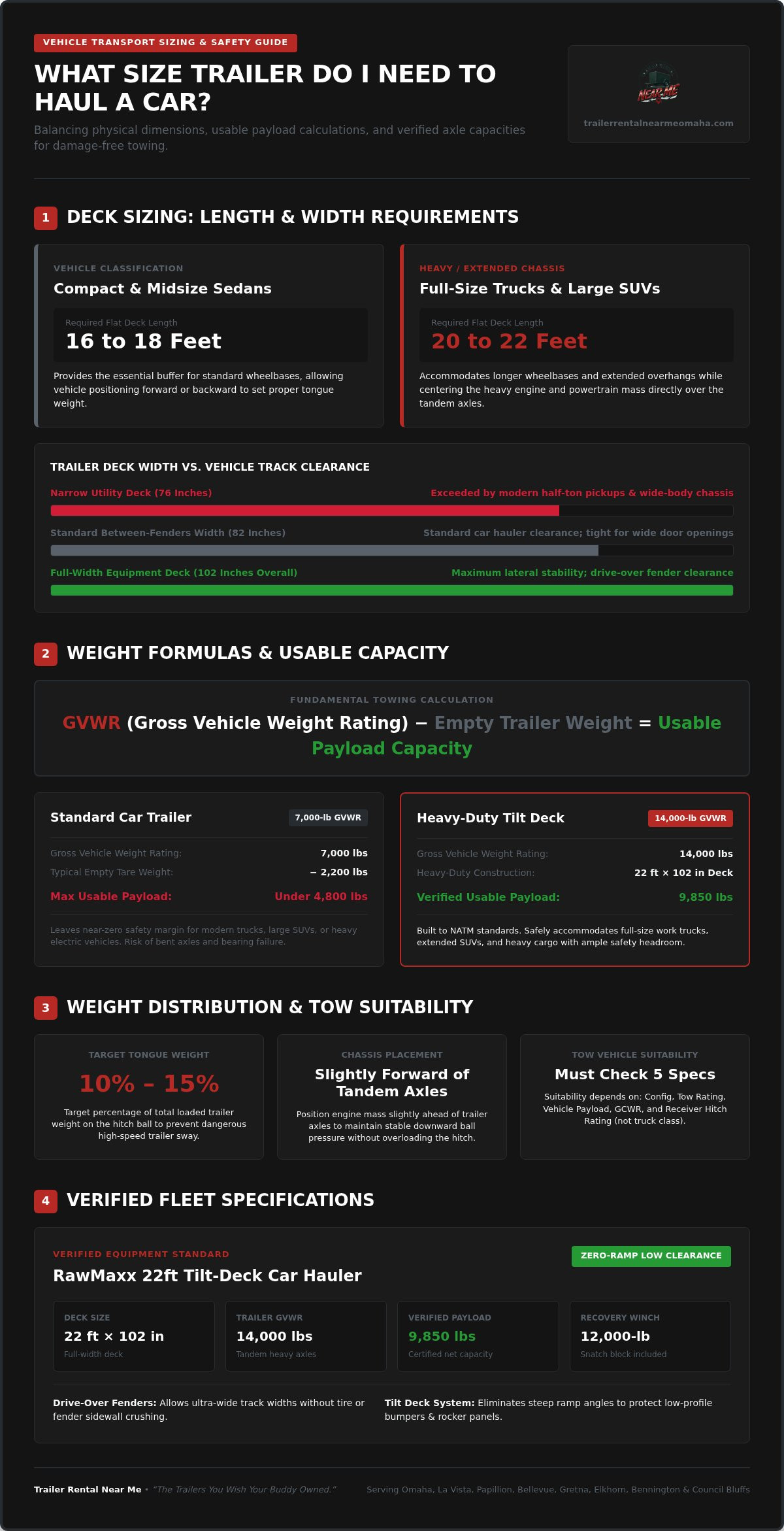
Selecting the right platform begins with physical measurements. When figuring out, "What size trailer do I need to haul a car?", many drivers mistakenly match the trailer deck length directly to the vehicle's bumper-to-bumper measurement. That mistake leaves no margin for load balancing. You need extra deck space to roll the vehicle forward or backward, which lets you achieve the essential 7% to 12% tongue weight required for highway stability. You can consult our car trailer rental Omaha guide to evaluate regional equipment platforms. In broad terms, a purpose-built car carrier trailer must accommodate the following baselines:
- Compact and midsize sedans: Require 16 to 18 feet of usable flat deck length.
- Full-size trucks and large SUVs: Require 20 to 22 feet of deck length to center the heavy powertrain over the axles.
- Usable width: Must clear the vehicle's track width while providing safe mirror clearance past trailer side rails.
Measuring Overall Length, Wheelbase, and Overhang
Measure your vehicle from the outermost tip of the front bumper to the trailing edge of the rear bumper. Next, measure the wheelbase from the center of the front wheel to the center of the rear wheel. Wheelbase determines where the vehicle tires sit relative to the trailer's tandem axles, which directly dictates axle weight distribution. Long front splitters or extended rear overhangs require extra deck buffer so body panels do not hit trailer framing, tongue jacks, or rock shields during transit.
Width Considerations: Deck Width vs. Fender Clearance
Most standard utility and car haulers provide roughly 82 inches between the inside edges of fixed fenders. Wide-body sports cars, modern half-ton pickups, and full-size SUVs often exceed narrower 76-inch decks or crowd standard fenders, making exiting the vehicle nearly impossible. Choosing an equipment deck measuring 102 inches in overall width maximizes lateral stability on high-speed interstate corridors like I-80. When moving wider chassis, look for drive-over fenders or reserve a tilt-deck car trailer with low-profile clearance so you don't crush door bottoms during loading.
Weight Capacity Formulas: Calculating GVWR, Curb Weight, and Payload
Deck dimensions only solve half the equation. To answer "What size trailer do I need to haul a car?", you must run the weight numbers. Gross Vehicle Weight Rating (GVWR) represents the absolute maximum operating weight of the trailer, combining the empty trailer weight (tare weight) and cargo. Usable payload is whatever remains after deducting empty weight from GVWR. A standard 7,000-lb GVWR car trailer often weighs 2,200 lbs empty, leaving under 4,800 lbs of usable capacity. That leaves zero safety margin for modern trucks or electric vehicles. Choosing a heavy-duty platform like a 14,000-lb GVWR trailer provides a verified 9,850-lb payload capacity, built to standards promoted by the National Association of Trailer Manufacturers (NATM).
Vehicle Curb Weight vs. Trailer Payload Capacity
Open the driver door jamb of the vehicle you plan to haul. Check the federal certification label for the exact curb weight rather than guessing based on online averages. Add the weight of full fuel tanks, aftermarket bumpers, winches, or spare parts stored inside the cabin. Never exceed the trailer's rated payload capacity. Exceeding rated capacity bends axles, overheats bearings, and causes structural frame failure at highway speeds.
Tow Vehicle Capabilities: GCWR, Payload, and Hitch Ratings
Safe transport demands a capable tow vehicle. Never assume a half-ton or 3/4-ton truck can safely tow any trailer by default. Suitability strictly depends on your specific vehicle configuration, manufacturer tow ratings, vehicle payload capacity, Gross Combined Weight Rating (GCWR), and receiver hitch class. Review your hitch rating sticker to confirm the maximum tongue weight allowed. Inspect our Omaha flatbed trailer guide to cross-reference equipment ratings before booking, or check out our full selection of heavy-duty rental trailers to match your load.
Tongue Weight Dynamics and Axle Weight Distribution
Proper balance prevents dangerous trailer sway on the road:
- Target range: Aim for 10 to 15 percent of the total loaded trailer weight on the hitch ball.
- Chassis placement: Position the vehicle's engine mass slightly forward of the trailer's tandem axles.
- Sway prevention: Placing the vehicle too far back unloads the tow vehicle's rear axle, causing severe loss of steering control and dangerous fishtailing.
Deck Style and Loading Equipment: Matching Trailers to Cars
Trailer dimensions and payload ratings only protect your cargo if you can safely get the vehicle onto the deck. When asking, "What size trailer do I need to haul a car?", you must also consider the deck design and loading style. Steep transition angles, fixed fender walls, and rolling dead-weight chassis quickly turn a simple haul into an expensive repair bill if your equipment does not match the vehicle profile.
Tilt Deck vs. Traditional Slide-In Loading Ramps
Traditional steel slide-in ramps present steep incline angles. Sports cars, lowered sedans, and modern performance cars with extended front splitters often scrape or bottom out before their front tires touch the trailer. A hydraulic tilt deck changes the math entirely. The entire bed pivots down to ground level, creating a continuous, low-incline gradient. Eliminating slide-in ramps also removes heavy lifting, pinched fingers, and the danger of loose ramps kicking out under heavy drive wheels.
Drive-Over Fenders and Winch Recovery Capabilities
Standard trailer fenders stand 8 to 10 inches above the deck surface. That height blocks low vehicle doors, trapping the driver inside once the car sits between the wheels. Heavy-gauge drive-over fenders solve this completely. They withstand vehicle wheel loads, allowing wide tracks to ride directly over the tops while keeping door paths clear. When moving inoperable project cars or collision damage, human muscle won't cut it. An integrated 12,000-lb winch paired with a snatch block delivers controlled mechanical recovery without straining your back or damaging suspension points.
Matching your vehicle to the right deck configuration ensures safe transport every time.
Selecting and Securing Your Car Hauler in the Omaha Metro
Matching deck dimensions to your vehicle solves the first half of the puzzle. Answering "What size trailer do I need to haul a car?" also requires knowing how to anchor the load once it is centered. Road vibration, emergency stops, and bridge expansion joints along Dodge Street or I-80 place heavy stress on your rigging. Before hitching up, make sure your tow vehicle has an operational electronic brake controller, an appropriately rated receiver hitch, and a working seven-pin RV electrical plug to run the trailer brakes and tail lights.
Executing Professional Four-Point Vehicle Securement
Never rely on a single winch cable or light tire straps to keep a vehicle in place. Use a dedicated four-point tie-down system to lock down all four corners independently:
- Solid connection points: Wrap axle straps around structural suspension components or solid axle tubes. Avoid steering linkages, sway bars, and brake fluid lines.
- Ratchet binders: Use heavy-duty ratchet straps rated for your vehicle weight to cinch each corner.
- Opposing tension: Cross the straps in an X-pattern front and rear. Pulling outward and downward stops side-to-side drift and forward slide under heavy braking.
- Mandatory stop: Pull over within the first five miles of travel. Straps settle into tire treads and axle curves during initial movement; re-tension all four ratchets before continuing.
Choosing Proven Equipment for Local Hauling Demands
If you need dependable local equipment, you can reserve a dedicated RawMaxx 22ft tilt-deck car trailer. Built with a 22 ft x 102 in deck, drive-over fenders, and a 12,000-lb winch with a snatch block, this hauler delivers a verified 9,850-lb payload capacity that easily handles full-size domestic pickups, heavy diesels, and EVs. Picking up your rental in La Vista offers quick, direct access whether you are operating in Omaha, Papillion, Bellevue, or crossing the Missouri River into Council Bluffs. Consult our Omaha trailer rental guide to review detailed pre-trip safety checklists before hitting the road.
Choose the Right Deck and Hit the Road Safely
You don't need to keep wondering, "What size trailer do I need to haul a car?" when you let verified measurements guide your setup. Matching deck length to your vehicle's wheelbase ensures proper tongue weight, while calculating usable payload guarantees you stay well within legal safety limits. Upgrading to a low-angle tilt deck protects sensitive bodywork and makes loading effortless.
Trailer Rental Near Me provides dependable equipment engineered for demanding hauls. Conveniently located in La Vista, we serve Omaha, Papillion, Bellevue, and Council Bluffs with rugged 22'x102" tilt-deck haulers. Built with a 14,000-lb GVWR, a verified 9,850-lb payload capacity, drive-over fenders, and an integrated 12,000-lb recovery winch with a snatch block, this platform handles your heaviest passenger vehicles without compromise.
Double-check your tow vehicle's hitch ratings, secure your four-point tie-downs, and transport your vehicle with total confidence.
Frequently Asked Questions
Can an 18-foot trailer haul a full-size pickup truck safely?
Rarely. Modern crew cab pickups measure between 19 and 20 feet bumper-to-bumper with wheelbases around 145 to 157 inches. An 18-foot deck leaves no room to adjust the truck forward or backward to balance the load over the tandem axles. Hauling full-size trucks safely requires a 20 to 22-foot deck to maintain correct tongue weight and prevent dangerous highway sway.
What is the difference between trailer GVWR and actual payload capacity?
Gross Vehicle Weight Rating (GVWR) is the maximum legal operating limit of the trailer and cargo combined. Payload capacity is the actual weight of the vehicle you can safely haul after deducting the empty trailer weight from the GVWR. For example, a heavy-duty hauler with a 14,000-lb GVWR delivers a verified 9,850-lb payload capacity, whereas a 7,000-lb GVWR trailer leaves under 4,800 lbs of usable payload.
Can my half-ton pickup safely tow a loaded 14k car trailer?
Not by default. Towing suitability never depends on broad vehicle classifications like half-ton or three-quarter ton. Safe towing strictly depends on your specific vehicle configuration, manufacturer tow rating, available payload, Gross Combined Weight Rating (GCWR), and receiver hitch capacity. A 14,000-lb GVWR trailer loaded to its maximum 9,850-lb payload exceeds the ratings of many light-duty trucks; check your door jamb sticker before hitching up.
What size trailer do I need for low-clearance sports cars?
When asking what size trailer do I need to haul a car with low clearance, deck style matters as much as length. A 20 to 22-foot deck provides adequate space, but a hydraulic tilt deck is critical. Tilt beds eliminate steep ramp breakover angles that scrape expensive front splitters. Drive-over fenders are also essential so you can open vehicle doors without denting rocker panels.
How wide does a car hauler trailer need to be?
A standard car hauler requires at least 82 inches between the inner fenders to fit common passenger vehicles. For modern full-size pickups, wide track widths, or performance cars, an overall deck width of 102 inches with drive-over fenders is ideal. That extra width maximizes highway stability on local routes like I-80 while preventing costly wheel and tire sidewall damage during loading.
Why is a winch recommended when renting a car trailer?
A winch provides controlled, single-person loading for inoperable project cars, barn finds, or collision-damaged vehicles. Pushing a dead 4,000-lb vehicle up ramps is dangerous and often impossible without a large crew. An integrated 12,000-lb winch with a snatch block allows operators across Omaha and Council Bluffs to pull dead weight onto the deck smoothly without risking runaway accidents.

Article by
Chuck Crom
Chuck Crom is the owner of Trailer Rental Near Me, serving Omaha, La Vista, Papillion, Bellevue, Gretna, Elkhorn, and the surrounding Nebraska and western Iowa communities. With years of hands-on experience towing, hauling, and helping customers choose the right trailer for the job, Chuck specializes in making trailer rentals simple, safe, and stress-free.
He writes practical, no-nonsense articles covering trailer safety, towing tips, weight ratings, loading techniques, equipment transport, landscaping projects, home renovations, vehicle hauling, and everything in between. His goal is to help renters avoid common mistakes, stay safe on the road, and get their projects done with confidence.
When he's not helping customers or creating educational content, Chuck is focused on growing a locally owned business built on honest advice, quality equipment, and exceptional customer service.


