
The ramp trailer you've used for years might be the biggest threat to your vehicle's front bumper. If you're moving a low-clearance car, standard 17-degree ramps often lead to expensive scrapes before the tires even hit the deck. Finding a reliable car trailer rental Omaha shouldn't involve crossing your fingers and hoping for the best. You need equipment that matches the technical requirements of your vehicle, whether you are hauling through Papillion or La Vista.
We agree that local hauling should be straightforward and secure, not a guessing game of payload capacities and GVWR. This guide provides the technical clarity you need to choose the right trailer and keep your cargo safe. We'll cover the specific advantages of tilt decks with their gentle 8-degree loading angles, essential Nebraska towing regulations like the 3,000-pound brake requirement, and professional methods for balancing your load for maximum stability on the road. You'll get the facts on local availability and safety tips to ensure your vehicle stays secure from pickup to drop-off.
Key Takeaways
- Learn why a dedicated car hauler is safer than a utility trailer and how renting saves on long-term maintenance costs.
- Discover why a 22'x102" tilt-deck design is the superior choice for low-clearance vehicles and wider payloads.
- Understand the technical difference between GVWR and payload capacity to select the right car trailer rental Omaha for your vehicle.
- Master the 60/40 weight distribution rule to ensure your trailer remains stable and secure during transport.
- Get a clear roadmap for booking equipment in La Vista and navigating the rental process across the Greater Omaha area.
Finding the Right Car Trailer Rental in Omaha
A car hauler is a specialized piece of equipment designed for a specific task. Unlike a standard utility trailer, it features reinforced frames, specific tie-down points, and either heavy-duty ramps or a tilting deck. This Wikipedia entry on What is a Car Carrier Trailer? explains how these designs differ from general freight trailers. When you search for a car trailer rental Omaha, you are looking for equipment that protects your vehicle and ensures road safety. Utility trailers often lack the width or structural integrity needed for automotive transport.
Renting makes sense for most projects. A professional-grade 22'x102" tilt deck trailer represents a significant financial investment. Beyond the purchase price, owners must deal with storage space, annual Nebraska registration, and the ongoing maintenance of axles and hydraulic systems. Renting allows you to access well-maintained, high-capacity equipment without the long-term overhead. It's an efficient solution for one-time moves or occasional transport needs.
The 2026 market in Eastern Nebraska shows a clear shift toward specialized equipment. Users are moving away from worn-out ramp trailers and opting for tilt-deck technology. This preference is driven by the need for better safety and reduced physical labor during loading. Working with a local provider ensures the equipment is inspected regularly. You get a trailer that is road-ready and capable of handling demanding hauls across the metro area.
Hauling Needs: DIY vs. Professional
Hauling requirements vary significantly. You might be moving a vintage car to a show in downtown Omaha or transporting a non-running project vehicle to a specialist in Sarpy County. Professional contractors also utilize these trailers for moving small machinery or wide-track vehicles. The 102-inch width is critical for modern trucks and equipment that standard trailers can't accommodate. It provides the necessary clearance to prevent tire and rim damage during the loading process.
Why Local Matters in La Vista and Bellevue
Renting near La Vista or Bellevue offers distinct logistical advantages. Quick access to the I-80 corridor means you spend less time in traffic and more time on the job. Local providers also understand Nebraska's specific towing laws. For example, any trailer with a gross weight over 3,000 pounds must have its own braking system. A local partner ensures your setup is legal and safe before you leave the lot. This support helps small businesses and residents keep their projects moving without unnecessary delays.
Tilt Deck vs. Traditional Ramps: Which Hauler Do You Need?
Selecting the right equipment for a car trailer rental Omaha depends entirely on the vehicle's ground clearance and your tolerance for physical labor. Traditional ramp trailers are a common sight, but they present specific challenges. Metal ramps can be heavy, cumbersome, and dangerous if they aren't seated perfectly on the trailer tail. In contrast, a tilt-deck trailer pivots the entire rear of the frame to the ground. This design eliminates the risk of a tire slipping off a narrow ramp during the loading process, which is a frequent concern when working alone or in tight spaces.
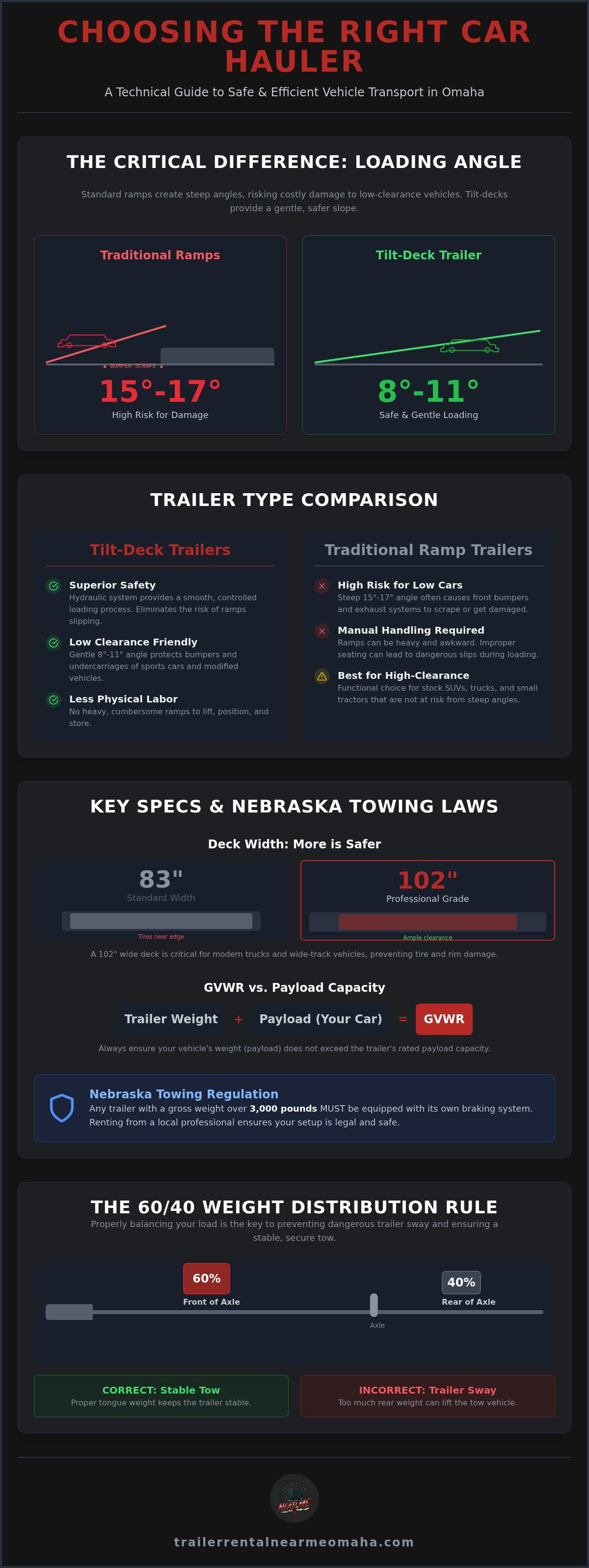
The 22'x102" tilt deck offers a significant advantage for modern vehicle sizes. Most standard car haulers are only 83 inches wide, which can be too narrow for full-sized trucks or wide-body sports cars. A 102-inch deck provides the necessary width to keep tires fully supported. When inspecting a tilt-deck rental, pay close attention to the hydraulic system. Check for clean fluid and ensure there are no visible leaks around the seals. A smooth, controlled descent is the hallmark of a well-maintained hydraulic cylinder, providing the stability required for high-value hauls.
The Safety Factor of Tilt-Deck Technology
Loading angles are the primary safety concern for any automotive transport. Traditional ramp trailers typically have a steep loading angle of 15 to 17 degrees. This incline is often too aggressive for low-clearance sports cars, leading to expensive bumper or undercarriage damage. Tilt trailers provide a much gentler slope, usually between 8 and 11 degrees. This reduced angle ensures that even the lowest vehicles can transition onto the deck without contact. For a more detailed breakdown of these benefits, see our guide on Why Tilt Deck Trailers are the Safest Choice for Omaha Hauls.
When to Choose a Traditional Ramp Trailer
Ramp trailers are a functional choice for high-clearance equipment like stock SUVs or small tractors. They are often simpler in design, which can appeal to users who don't want to manage a hydraulic system. However, they require more manual effort and space behind the trailer to deploy the ramps. Regardless of the trailer style you choose, you must adhere to federal standards on How to Secure and Load Your Vehicle. Proper securement is the only way to prevent shifting during transit. If you're ready to simplify your next project, consider a tilt deck car trailer rental to save time and protect your investment.
Essential Safety and Towing Specs for Omaha Hauls
Safety starts with a clear understanding of your equipment's limits. When you secure a car trailer rental Omaha, you'll encounter the term GVWR. This Gross Vehicle Weight Rating represents the maximum weight the trailer can safely weigh when fully loaded. It includes the weight of the trailer itself plus the weight of your vehicle. Exceeding this number isn't just a mechanical risk; it's a liability on Nebraska highways. If you're hauling a modern heavy-duty pickup or a classic steel-frame car, these numbers add up quickly. You need to know exactly what your setup can handle before you pull onto the road.
Nebraska law is specific about stopping power. Any trailer with a gross weight over 3,000 pounds must have its own braking system. Most professional-grade car haulers use electric brakes on both axles to ensure controlled stops. For these heavy hauls, you'll typically use a 2 5/16-inch ball hitch. This size is the standard for 10,000-pound trailers because it provides the structural integrity needed to manage high-stress loads. Using a smaller 2-inch ball on a 10k trailer is a major safety violation and will lead to equipment failure. Always verify that your hitch ball is rated for the specific weight of your trailer and cargo.
Calculating Your Payload Capacity
Many renters assume a 10k trailer can carry a 10,000-pound car. That's a dangerous mistake that can lead to blown tires or snapped axles. To find your actual payload capacity, you must subtract the weight of the empty trailer from the GVWR. If the trailer weighs 3,400 pounds and has a 10,000-pound GVWR, your actual payload is 6,600 pounds. This payload must account for the car, any spare parts in the trunk, and the weight of your tie-down chains. For more details on matching equipment to your specific vehicle, read our post on Equipment Trailer Rental Omaha: Choosing the Right Hauler for Your Project.
Towing Vehicle Requirements
Your truck needs to be as capable as the trailer. Check your vehicle's manufacturer tow rating, which is often found on a sticker inside the driver's side door jamb. Don't guess on these figures. A heavy-duty car hauler requires a functional brake controller in the cab to activate the trailer's electric brakes. This device allows you to adjust the gain or braking force to match your load. Without it, you're relying entirely on your truck's pads to stop thousands of extra pounds. Finally, ensure your 7-way lighting harness is clean and operational. It powers the signals, tail lights, and brakes that keep you visible to other drivers in Omaha traffic. Verify that your hitch receiver is rated for the weight you plan to tow, as Class III hitches are often insufficient for 10k loads.
How to Secure and Load Your Vehicle Safely
Loading a vehicle onto a trailer requires precision and a systematic approach. When using a car trailer rental Omaha, the tilt-deck design simplifies the physical labor involved. First, ensure the tow vehicle is in park with the emergency brake engaged. Position the trailer on a level, firm surface. Unlock the tilt mechanism and allow the rear of the deck to meet the ground. As you drive the vehicle forward, the weight will eventually pass the pivot point, causing the deck to level out. Once the deck is flat, engage the locking pins immediately. This mechanical lock is your primary safety feature during transit.
Weight distribution determines how the trailer handles at highway speeds. You must follow the 60/40 rule. This means 60% of the vehicle's weight should be positioned in front of the trailer's axles. Proper weight distribution places the correct amount of tongue weight on your hitch. If the vehicle is too far back, the trailer will sway uncontrollably, which is a leading cause of highway accidents. If it's too far forward, you risk overloading your truck's rear suspension and losing steering control. Finding that balance is the most critical part of the loading process.
Securing the Vehicle: 4-Point Tie-Downs
A secure load requires a 4-point tie-down system. We recommend securing your straps to the vehicle's axles or lower control arms rather than the frame. Securing to the frame allows the vehicle's own suspension to compress and rebound over bumps. This movement creates momentary slack in your straps, which can lead to a hook becoming unseated. Axle straps keep the vehicle's tires pulled tight against the deck, regardless of road conditions. Use heavy-duty ratchet straps with a working load limit that exceeds the vehicle's weight. After the first 10 miles of driving, pull over and re-tension every strap. Straps often settle or stretch slightly during the initial miles of a haul.
Loading Non-Running Vehicles
Transporting a project car or a vehicle with mechanical failure requires a winch. When winching a vehicle onto a tilt deck, maintain a slow, steady pace. Pay close attention to the break-over point. This is the moment the front wheels move from the incline to the flat portion of the deck. If the vehicle has low clearance, this is where the undercarriage is most likely to scrape. A tilt deck's shallow angle minimizes this risk compared to traditional ramps. Never stand directly behind or in front of a vehicle while it's being winched. If a cable snaps, the tension can cause serious injury. If you need a reliable haul, book a 22' tilt deck car trailer to ensure your vehicle reaches its destination without a scratch.
Renting Locally in La Vista and the Greater Omaha Area
Local logistics matter when you are on a strict deadline. Finding a car trailer rental Omaha that is situated near major routes like I-80 saves significant time during pickup and return. Trailer Rental Near Me serves the entire metro area, providing equipment to residents in Papillion, Bellevue, and across the river in Council Bluffs. Our location in La Vista is specifically chosen for its accessibility to the core of the city. Whether you need the trailer for a quick cross-town move or a week-long transport project, we offer flexible rental periods. You can choose from daily, weekend, or weekly rates to match your specific schedule.
Reliability is our priority. We maintain our fleet to professional standards so you don't have to worry about mechanical failures during your haul. When you arrive for pickup, you will need a valid driver's license and proof of insurance for the tow vehicle. We also verify that your truck is equipped with the correct hitch and wiring harness to ensure a safe departure. This no-nonsense approach ensures that every customer leaves our lot with equipment that is road-ready and capable of handling demanding tasks.
The Convenience of Online Booking
Efficiency is built into our process. You can check real-time availability for our 22'x102" Tilt Deck Car Trailer through our online system. This allows you to secure your rental dates in advance, which is essential during the busy summer hauling season in Nebraska. Our pricing is transparent. You see the total cost upfront without worrying about hidden "Omaha" surcharges or last-minute fees. This straightforward approach respects your time and your budget, allowing you to plan your project with confidence.
Preparing for Your Rental Pickup
A successful haul starts before you leave the lot. Verify your hitch height to ensure the trailer sits level when attached to your truck. An unlevel trailer affects weight distribution and tire wear. During pickup, a manager will conduct a thorough walk-around with you. We check the tires, lights, and the hydraulic tilt system together. Use this time to verify your final checklist:
- Straps: Ensure you have high-quality ratchet straps and axle straps.
- Winch: Verify the winch remote is present and the battery is charged.
- Connections: Check safety chains and the emergency breakaway cable.
- Electronics: Test the 7-way plug functionality and light synchronization.
Taking these few extra minutes at the start prevents delays on the road. We are committed to providing the mechanical integrity you need for a professional-grade haul. By choosing a local partner in the Omaha area, you get the expertise and equipment necessary to complete your vehicle transport safely and efficiently.
Get Your Vehicle Moving Safely Across Omaha
Successful vehicle transport requires the right gear and a solid plan. You now understand the safety advantages of tilt-deck technology over traditional ramps and how to calculate actual payload capacity. Proper weight distribution and secure 4-point tie-downs are non-negotiable for highway safety. Choosing a local partner for your car trailer rental Omaha ensures you get equipment that is maintained to professional standards and ready for the road.
Our 22'x102" Tilt Deck Car Trailer handles wide loads and low-clearance vehicles with ease. Based conveniently in La Vista, we serve the entire metro area with a focus on mechanical integrity and customer efficiency. You can skip the phone calls and secure your equipment through our easy online booking system. We prioritize the technical details so you can focus on the task at hand.
Book Your 22ft Tilt Deck Car Trailer in Omaha Today and get your project moving with confidence. We're here to provide the rugged reliability your haul deserves.
Frequently Asked Questions
Do I need a special license to rent a car trailer in Omaha?
No special license is required for standard private vehicle transport in Nebraska. A Class O operator's license is sufficient for towing trailers as long as the Gross Combined Weight Rating (GCWR) stays below 26,001 pounds. If your truck and loaded trailer exceed this limit, you may enter commercial driver's license (CDL) territory. Always verify your total weight before departure to stay compliant with state laws.
Will my truck be able to tow a 22ft tilt-deck trailer?
Your truck's ability depends on its specific manufacturer tow rating and the weight of your cargo. A 22ft tilt-deck trailer with a 10,000-pound GVWR typically requires a half-ton truck at minimum, though a three-quarter-ton truck provides better stability for heavier hauls. Check the door jamb sticker on your vehicle to confirm its maximum towing capacity and tongue weight limits before you book.
Does the rental include tie-down straps and a winch?
Equipment inclusions vary by provider, so you should confirm these details during the booking process. Professional car trailer rental Omaha services often provide a mounted winch for recovery tasks on their tilt-deck models. However, many renters choose to use their own heavy-duty ratchet straps to ensure they meet the specific weight requirements of their vehicle. Always ask for a list of included accessories before you arrive for pickup.
Can I tow a car trailer from Omaha to another state?
Most local rental agreements allow for interstate travel, provided you return the equipment to the original location in La Vista or Omaha. You are responsible for following the towing laws of every state you enter, such as specific speed limits and braking requirements. Verify your contract terms to ensure there are no geographic restrictions or additional mileage fees for long-distance hauls.
What happens if I get a flat tire on the rental trailer?
Contact the rental manager immediately to report the issue and receive instructions. Most well-maintained trailers are equipped with a spare tire and the necessary mounting hardware. Do not attempt to tow a trailer on a flat tire, as this can cause permanent damage to the rim and axle. Professional providers prioritize mechanical integrity and will guide you through the repair or replacement process quickly.
How do I calculate the tongue weight for a car hauler?
Proper tongue weight should be between 10% and 15% of the total loaded trailer weight. For a 7,000-pound loaded trailer, you want 700 to 1,050 pounds of pressure on the hitch. You can measure this using a dedicated tongue weight scale or a commercial scale at a local truck stop. Correct tongue weight is essential for preventing dangerous trailer sway at highway speeds on I-80.
Is insurance required for renting a trailer in Nebraska?
You must provide proof of insurance for the tow vehicle before picking up your rental. In Nebraska, the liability coverage from your auto policy typically extends to the trailer while it is hitched to your truck. This often does not cover physical damage to the trailer itself or the cargo inside. Check with your insurance agent to see if you need a temporary rider for comprehensive coverage during your haul.
What is the difference between a car dolly and a car trailer?
A car dolly only lifts the front wheels of the vehicle off the ground, while a car trailer carries the entire vehicle on its deck. Trailers are the safer choice for long distances, all-wheel-drive vehicles, or non-running cars. The 22'x102" tilt deck provides superior protection and ease of loading compared to the narrow, limited capacity of a standard tow dolly.

Article by
Chuck Crom
Chuck Crom is the owner of Trailer Rental Near Me, serving Omaha, La Vista, Papillion, Bellevue, Gretna, Elkhorn, and the surrounding Nebraska and western Iowa communities. With years of hands-on experience towing, hauling, and helping customers choose the right trailer for the job, Chuck specializes in making trailer rentals simple, safe, and stress-free.
He writes practical, no-nonsense articles covering trailer safety, towing tips, weight ratings, loading techniques, equipment transport, landscaping projects, home renovations, vehicle hauling, and everything in between. His goal is to help renters avoid common mistakes, stay safe on the road, and get their projects done with confidence.
When he's not helping customers or creating educational content, Chuck is focused on growing a locally owned business built on honest advice, quality equipment, and exceptional customer service.


