
Most people searching for a utility trailer rental Omaha focus on the length, but the wrong GVWR is what actually ruins a transmission. It's stressful to stand in a lot in La Vista or Bellevue wondering if your truck can safely handle a 22ft flatbed. You want to move your equipment without damaging your vehicle or risking a safety violation on I-80. We understand that hauling success depends on matching the right deck capacity and loading style to your specific task.
This guide will help you master the technical specs and local regulations needed to rent the perfect flatbed trailer for any Omaha hauling project. We will break down the math behind payload capacities, explain loading techniques for low-clearance vehicles, and clarify the specific towing laws for Nebraska and Iowa. You'll learn why Nebraska requires separate brakes for trailers over 3,000 lbs and how to choose between a heavy-duty tilt deck or a standard utility trailer. By the end, you'll have the confidence to tow safely across the metro area and avoid equipment damage.
Key Takeaways
- Identify the correct deck type for your specific cargo, whether you are hauling heavy construction equipment or classic cars across the Omaha metro.
- Calculate your safe hauling capacity by subtracting the trailer's tare weight from its Gross Vehicle Weight Rating (GVWR) to find your net payload.
- Opt for a 22ft tilt deck trailer when transporting low-clearance vehicles to prevent damage during the loading and unloading process.
- Secure your utility trailer rental Omaha with proper safety chains and functioning electric brakes to meet Nebraska and Iowa DOT regulations.
- Support your project with well-maintained equipment from a local La Vista provider to ensure reliability on major routes like I-80 and Dodge Street.
Understanding Flatbed Trailer Rentals in Omaha: Types and Applications
A flatbed trailer is an open-deck hauling solution designed for cargo that doesn't fit within the walls of a standard box. These trailers provide the versatility needed for oversized equipment, heavy machinery, and wide-track vehicles. In the Omaha metro, contractors and DIY enthusiasts rely on these decks for everything from moving skid steers in Papillion to transporting construction materials to job sites in Gretna. While a semi-trailer handles the heaviest commercial logistics, a smaller flatbed is the practical workhorse for local residential and commercial projects.
Choosing the right trailer requires understanding the specific demands of your load. A standard utility trailer rental Omaha is often the best choice for landscaping tasks or light hauling. However, specialized tasks like transporting a classic car or a piece of heavy industrial equipment require specific deck configurations. Deck width is a primary factor. A 102-inch wide deck is the industry standard for modern vehicles. This extra width ensures that wide-track trucks and machinery fit between the fenders without risk of tire damage or unstable positioning.
The 22ft Tilt Deck: A Specialized Solution for Omaha Drivers
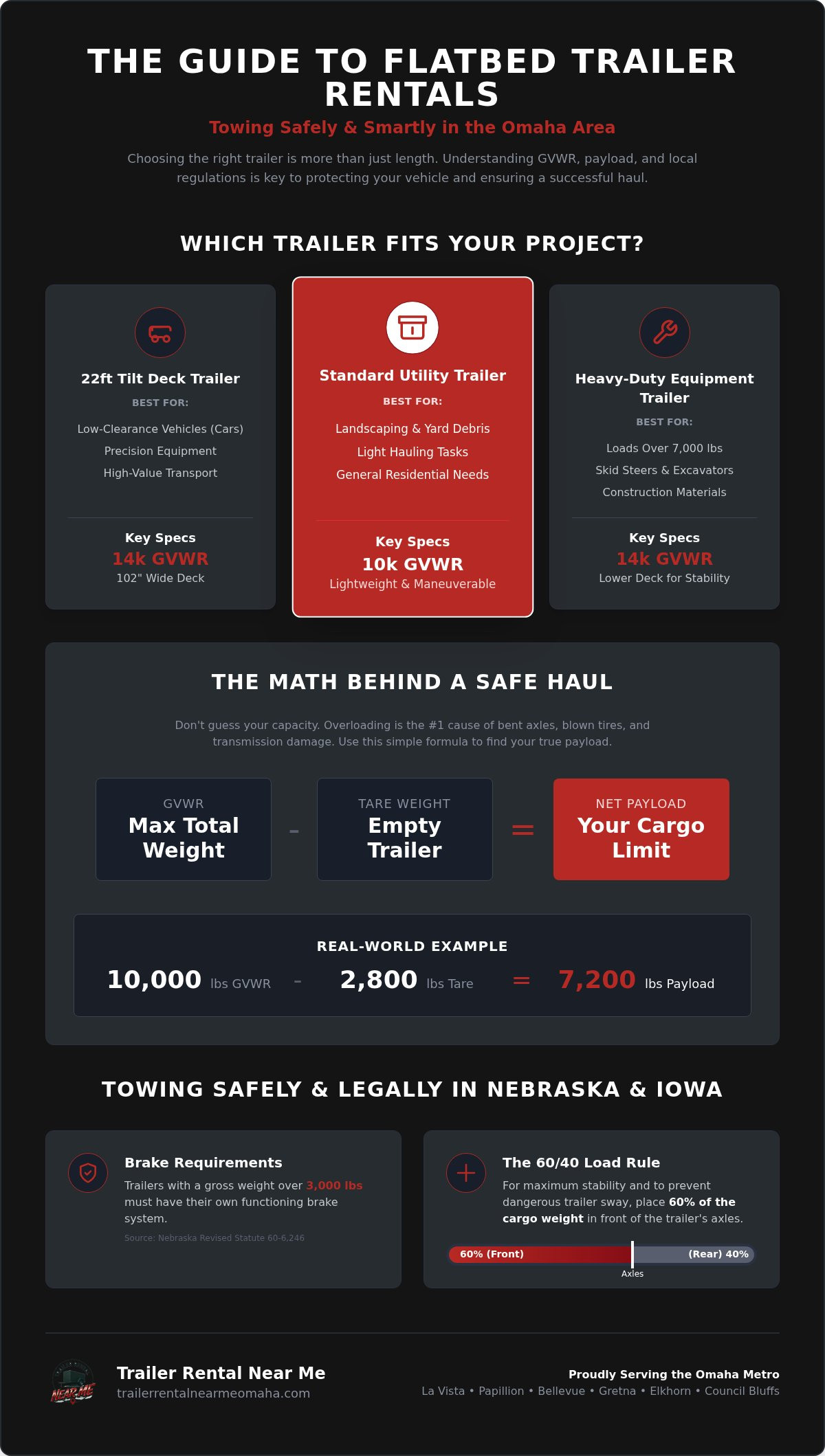
Loading low-clearance vehicles or precision equipment can be stressful when using traditional pull-out ramps. A 22ft tilt deck eliminates this friction. Instead of manual ramps, the entire rear portion of the trailer tilts to the ground. This creates a smooth, continuous approach angle that is much safer for sports cars or equipment with low ground clearance. In Douglas County, this setup is the preferred choice for high-value transport. The 14k GVWR (Gross Vehicle Weight Rating) on these trailers provides a heavy-duty capacity. It allows you to haul full-size pickups or medium excavators with confidence. You can find more details on our 22'x102 14k Tilt Deck Car Hauler Rental page.
Standard Utility vs. Heavy-Duty Equipment Trailers
Determining whether you need a 10k or 14k trailer depends on your total payload. A 10k utility trailer rental Omaha is sufficient for most residential needs, such as moving a zero-turn mower or hauling debris in Bellevue. These trailers are lighter and easier to maneuver. However, when the weight of the cargo approaches 7,000 lbs, you must transition to a heavy-duty equipment hauler. These trailers feature reinforced frames and heavier axles designed for structural integrity under stress. Lower deck heights on equipment trailers are also critical. By placing the load closer to the ground, you lower the center of gravity. This significantly increases stability when driving at highway speeds on I-80 or navigating the hills of Elkhorn.
Calculating Payload and GVWR: The Math Behind a Safe Haul
GVWR is the most misunderstood number in the towing industry. It stands for Gross Vehicle Weight Rating. This figure represents the absolute maximum weight the trailer can safely weigh when it's fully loaded. It isn't just a measure of your cargo. It includes the weight of the trailer frame, axles, and tires. Ignoring this limit leads to mechanical failure and safety risks on the road.
To find your actual hauling capacity, use this simple formula: GVWR minus Trailer Tare Weight equals your Net Payload. If you choose a utility trailer rental Omaha with a 10,000 lb GVWR that weighs 2,800 lbs empty, your max payload is 7,200 lbs. Exceeding this limit is the primary cause of bent axles and blown tires. It also puts extreme stress on your tow vehicle's transmission. Before you book, verify your truck's maximum towing capacity. Your truck's rating must be higher than the trailer's GVWR to ensure a safe trip through the hills of Gretna or Elkhorn.
Understanding 10k vs. 14k Capacity Ratings
A 10k rating is standard for equipment like a 7x12 dump trailer. This is perfect for roofing debris or heavy landscaping materials in Papillion. For professional machinery or full-size vehicles, you need a 14k rating. This rating typically indicates the trailer uses dual 7,000 lb axles. This extra structural integrity is vital for heavy-duty tasks. It's also a matter of legal compliance. According to Nebraska Revised Statute 60-6,246, trailers with a gross weight over 3,000 lbs must have their own functioning brake system to operate safely on public roads.
Tongue Weight and Load Distribution
How you position the weight is just as critical as the total poundage. Always follow the 60/40 rule. Place 60% of the cargo weight in front of the trailer axles. Tongue weight is the downward force exerted on the hitch ball. If this weight is too low, the trailer will sway dangerously at highway speeds. If it's too high, the rear of your truck will squat, which lifts the front tires and reduces your steering control. Proper distribution ensures your utility trailer rental Omaha stays stable while merging onto I-80. You can check our fleet of well-maintained trailers to find the exact capacity required for your next project.
Tilt Deck vs. Ramps: Choosing the Right Loading Mechanism
Selecting the right loading mechanism is the difference between a ten minute job and an afternoon of frustration. Most standard utility trailer rental Omaha options utilize 5ft or 6ft slide-in or fold-down ramps. While these are reliable for lawn mowers or ATVs, they create a steep approach angle. This angle often causes low-clearance vehicles to scrape their bumpers or undercarriages. A tilt deck trailer solves this by allowing the rear portion of the frame to pivot. This creates a long, gradual slope that significantly reduces the approach angle. According to the Trailer Safety Week safety guide, maintaining proper loading angles is essential for preventing equipment damage and ensuring operator safety during the transition from ground to deck.
The Advantages of a Hydraulic Tilt System
Hydraulic tilt systems offer a distinct advantage by removing the physical strain of manual ramp setup. Instead of lifting heavy steel ramps into place, the operator uses a hydraulic pump to lower the deck to the ground. This is particularly valuable for professional contractors in Omaha who load and unload equipment multiple times throughout the day. It also eliminates the "breakover" point, which is the peak where the ramp meets the trailer bed. On a traditional ramp setup, this peak can high-center a vehicle, leading to costly frame damage. You can view our 22ft Tilt Deck Car Hauler specs to see how this hydraulic system simplifies the loading process for wide-track machinery.
When Ramps Are the Right Choice
Traditional ramps still have a place for specific hauling needs. They are often the most cost-effective option for a standard utility trailer rental Omaha. Ramps allow for loading from the side of the trailer, which is necessary when transporting multiple smaller items like pallets or narrow landscaping equipment. However, managing ramp weight requires careful technique to prevent back injuries. Always lift with your legs and keep the ramps secured to prevent them from kicking out during use. For specialized vehicles, you may need ramp extensions to further soften the angle. If your project involves a low-profile car or heavy skid steer, the mechanical advantage of a tilt deck usually outweighs the lower cost of a ramp-only trailer.
Towing Regulations and Safety Standards in Nebraska and Iowa
Operating a utility trailer rental Omaha requires compliance with two sets of state laws. Nebraska and Iowa share similar standards, but enforcement priorities can vary. For any trailer with a Gross Vehicle Weight Rating (GVWR) over 3,000 lbs, both states mandate a functioning brake system. This is why a trailer brake controller is essential in your tow vehicle. Without it, you cannot legally or safely manage a heavy load on steep grades or in sudden traffic. Safety chains are also a legal requirement. They must be crossed under the tongue to catch the trailer if the hitch fails.
Before you leave La Vista or head across the bridge to Council Bluffs, perform a thorough pre-trip inspection. Iowa DOT officers are known for strict enforcement of lighting and securement rules near the border. This routine prevents breakdowns and legal citations. Follow this checklist every time you hook up:
- Tires: Check for proper PSI and visible tread wear or dry rot.
- Lights: Verify turn signals, brake lights, and side markers are functioning.
- Hitch: Ensure the coupler is fully seated and the locking pin is in place.
- Safety Chains: Confirm they are secure and not dragging on the pavement.
- Breakaway Switch: Check that the cable is attached to the vehicle frame, not the hitch.
Essential Safety Gear: Winches and Tie-Downs
A 12,000 lb winch is a critical tool for vehicle recovery. If you're hauling a non-running car, you cannot rely on gravity or manual pushing. Our car haulers include these heavy-duty winches to ensure you can load safely without damaging the equipment. Securing the load is just as important as loading it. Use the four-point tie-down method. This involves securing each corner of the vehicle to the trailer frame. While nylon ratcheting straps are excellent for most cars, heavy machinery may require transport chains to meet FMCSA standards for cargo securement. Always check your straps for frays or cuts before use.
Licensing and CDL Requirements for Heavy Hauls
Many renters worry about needing a Commercial Driver's License (CDL). In both Nebraska and Iowa, you only need a CDL if the Gross Combined Weight Rating (GCWR) exceeds 26,001 lbs. This is the total weight of your truck plus the trailer's GVWR. Most residential projects using a utility trailer rental Omaha stay well within the limits of a standard Class O license. For example, a half-ton pickup towing a 10k trailer typically results in a GCWR around 17,000 lbs. If you're unsure about your specific combination, check the door jamb sticker on your truck for the manufacturer's weight ratings.
Renting Your Flatbed in Omaha: Why Local Expertise Matters
Choosing a utility trailer rental Omaha shouldn't feel like a gamble with a national aggregator. When you rent from a local La Vista business, you're working with experts who understand the specific demands of Nebraska roads. National platforms often act as middle-men; this can lead to confusion regarding equipment availability or maintenance history. We prioritize the mechanical integrity of our fleet to ensure your project stays on schedule. Whether you're hauling debris in Papillion or equipment in Bellevue, local support means having a partner who knows the tools inside and out.
Reliability is paramount when you're navigating heavy traffic on I-80 or Dodge Street. A breakdown in these high-traffic areas is more than an inconvenience. It's a safety risk. Our maintenance schedule exceeds industry standards to prevent tire blowouts and electrical failures. We also provide personalized technical support that national chains can't match. We'll verify that your tow vehicle has the correct 2-5/16 inch ball and help you determine the ideal hitch height for a level tow. This attention to detail prevents trailer sway and ensures your brakes function exactly as intended.
The Trailer Rental Near Me Difference
We focus on providing heavy-duty solutions for demanding tasks. While other providers might offer light-duty alternatives, our fleet features high-capacity 10k and 14k trailers designed for professional-grade work. We don't believe in hidden costs or missing gear. Our car haulers come standard with 12,000 lb winches and the necessary tie-downs to secure your load properly. This "work-ready" approach saves you time and the extra expense of sourcing your own recovery gear. You can browse our full trailer inventory in Omaha to find the right match for your next haul.
How to Reserve Your Trailer Today
Our online booking system is built for efficiency. Select your trailer, choose your dates, and complete the reservation in minutes. This streamlined process is perfect for contractors managing tight deadlines or homeowners planning a weekend project. When you arrive for pickup at our La Vista location, please bring a valid driver's license, proof of insurance for the tow vehicle, and a truck capable of handling the trailer's GVWR. We'll perform a final walk-around with you to ensure all lights and safety chains are secure. If you have specific questions about payload or local DOT rules, contact Trailer Rental Near Me today to finalize your reservation.
Secure Your Load for the Omaha Road
Hauling across the Omaha metro requires more than just a truck and a hitch. It demands a clear understanding of payload math and the right mechanical tools for the job. By matching your equipment to a 22ft tilt deck specialist, you eliminate the risks associated with steep ramp angles and manual lifting. Local La Vista ownership means you receive equipment that is maintained to handle the heavy-duty requirements of Douglas and Sarpy Counties.
A successful utility trailer rental Omaha experience depends on preparation. You now have the knowledge to calculate net payload, distribute weight for proper tongue force, and navigate the specific DOT regulations in Nebraska and Iowa. Having a 12,000 lb winch included on your trailer provides the peace of mind needed for non-running vehicle recovery or precision equipment placement. We are here to ensure your equipment arrives at its destination without damage or delay. Our team understands the logistical challenges of the local landscape and is ready to help you execute a safe, professional haul.
Frequently Asked Questions
Do I need a special license to tow a 14k flatbed trailer in Nebraska?
You don't need a Commercial Driver’s License (CDL) as long as your Gross Combined Weight Rating (GCWR) remains under 26,001 pounds. This rating is the total of your truck's weight plus the trailer's GVWR. Most standard pickups used for a utility trailer rental Omaha stay well within these limits. A standard Nebraska Class O license is sufficient for the majority of residential and light commercial hauling tasks.
Does the car hauler rental include a winch and straps?
Every car hauler for rent includes a 12,000lb winch and professional-grade tie-downs as part of the package. We provide these tools because we prioritize the safety of your equipment. You won't need to source your own recovery gear or pay extra for basic securement. This ensures you can load non-running vehicles safely and meet FMCSA standards for cargo securement without additional friction.
What size hitch ball do I need for a 22ft tilt deck trailer?
You must use a 2-5/16 inch hitch ball for our 22ft tilt deck and all 14k trailers. A standard 2-inch ball is not compatible with the heavy-duty couplers on these units. It's also critical to verify that your ball mount and hitch receiver are rated for the 14,000 lb weight capacity. Using undersized hardware is a significant safety risk that can lead to equipment failure.
Can I tow a flatbed trailer with a half-ton pickup truck like an F-150?
You can tow our trailers with a half-ton pickup, provided the total weight stays within your truck's manufacturer-rated towing capacity. A 10k utility trailer rental Omaha is often compatible with modern half-ton trucks for lighter loads. However, a 14k trailer fully loaded will likely exceed the safe towing limits of most F-150 or 1500-series pickups. Always check your truck's door jamb sticker for exact ratings.
What is the difference between a car hauler and an equipment trailer?
Car haulers typically feature lower deck heights and specialized loading angles for low-clearance vehicles. Equipment trailers are built with heavier structural steel and dual 7,000 lb axles to handle the concentrated weight of machinery like skid steers or mini-excavators. Our 22ft tilt deck serves as a hybrid solution, offering the strength of an equipment hauler with the gentle approach angle required for cars.
Are your trailers allowed to be taken out of state to Iowa or Kansas?
Our rentals are permitted for travel into neighboring states like Iowa, Kansas, and Missouri. You are responsible for following the specific DOT regulations in those jurisdictions once you leave the Omaha metro area. This includes Iowa’s specific requirements for safety chains and lighting when crossing the bridge into Council Bluffs. Always ensure your load is secured according to the laws of every state you enter.
What happens if I get a flat tire on the rental trailer?
If you experience a flat tire, pull over to a safe location and contact our La Vista office immediately. We perform rigorous maintenance on our tires to prevent blowouts, but road hazards can still occur. We will provide instructions on how to proceed or coordinate assistance to get you back on the road. Do not continue towing a trailer with a flat tire, as this will damage the rim and axle.
Do I need a brake controller installed in my truck to rent a trailer?
You must have a functioning electric brake controller installed in your tow vehicle for any trailer over 3,000 lbs. Nebraska law requires trailers in this weight class to have their own braking system. The controller allows you to adjust the trailer’s braking force from your cab. This is essential for maintaining control during sudden stops on I-80 or when navigating the hills of Elkhorn and Gretna.

Article by
Chuck Crom
Chuck Crom is the owner of Trailer Rental Near Me, serving Omaha, La Vista, Papillion, Bellevue, Gretna, Elkhorn, and the surrounding Nebraska and western Iowa communities. With years of hands-on experience towing, hauling, and helping customers choose the right trailer for the job, Chuck specializes in making trailer rentals simple, safe, and stress-free.
He writes practical, no-nonsense articles covering trailer safety, towing tips, weight ratings, loading techniques, equipment transport, landscaping projects, home renovations, vehicle hauling, and everything in between. His goal is to help renters avoid common mistakes, stay safe on the road, and get their projects done with confidence.
When he's not helping customers or creating educational content, Chuck is focused on growing a locally owned business built on honest advice, quality equipment, and exceptional customer service.


