
For a tandem axle utility trailer in Council Bluffs, compare nearby listings by distance and match the trailer type to the load. That gives you a practical way to review utility trailer inventory alongside equipment trailer options without treating every listing as the same fit. The article organizes those options around proximity to Council Bluffs.
Choosing a trailer takes more than finding one close by. You need to consider what you’re hauling, how it will load, and whether a utility or equipment trailer suits the job. Here, you’ll find a clear comparison of tandem axle utility trailer inventory, equipment trailer options, and listings ordered by distance from Council Bluffs. Use the details to narrow your search and identify the trailer type that makes sense for your project.
Key Takeaways
- Compare nearby listings by distance, then separate utility trailers from equipment trailers based on the load and loading method.
- Review deck dimensions, axle setup, and tie-down or loading features to narrow down trailers suited to your project.
- Match the loaded trailer to your specific vehicle’s tow rating, payload, GCWR, and hitch rating before choosing a setup.
- Use the trailer’s capacity and intended purpose to compare local options, including utility and car-hauling rentals.
Tandem-axle utility trailer inventory
For a tandem axle utility trailer in Council Bluffs, compare listings by distance, trailer type, and the job each can handle. A utility trailer suits open-deck hauling, such as moving yard equipment or bulky project materials. An equipment trailer serves a different loading need. Similar names don’t mean the trailers have matching decks, capacities, or loading features.
Start with the trailer category, then review each option’s specifications. Note the deck dimensions, stated capacity, axle arrangement, loading method, and tie-down points. These details help distinguish a trailer for a riding mower from one intended for heavier equipment. Don’t infer capacity from a tandem-axle design alone. Check the listed rating and account for the trailer’s own weight and the cargo.
- Utility trailer: Compare deck size and side or rail design for items such as lumber, a mower, or landscaping tools.
- Equipment trailer: Look for loading features suited to wheeled machinery. One custom equipment trailer listing describes a three-axle setup, so classify it separately from tandem-axle inventory.
- Distance: Review listings from closest to farthest from Council Bluffs. A nearby option may simplify pickup, but it still needs to fit the load.
- Listing details: Note whether the page states dimensions, capacity, and loading features. Use those specifics to compare like with like.
Then match the trailer to the cargo. A mower or compact machine needs a deck that accommodates its footprint and a way to secure it. Yard debris or building materials may call for open access from the sides. For a car, a utility trailer is not automatically the right choice. A tilt-deck car trailer listing describes an option designed for vehicle loading.
Before towing a tandem-axle utility trailer, inspect the tires, wheels, lights, coupler, safety chains, brakes, deck, and tie-down points for visible damage or looseness. Secure the load and recheck it after loading. Stop if a tire, connection, or light appears damaged.
Use the same inspection sequence when comparing trailers. Check that the condition and features match the description, then confirm the cargo can sit securely on the deck. For example, compare a mower’s width with the usable deck area, not just the trailer’s overall length. Balance and secure the cargo so it won’t shift during transport.
A clear comparison prevents mismatches. Sort Council Bluffs-area listings by distance, separate utility trailers from equipment and car haulers, and compare each trailer’s stated dimensions and capacity against the actual load. The result is a more useful shortlist, based on the work rather than the trailer label.
Equipment trailer
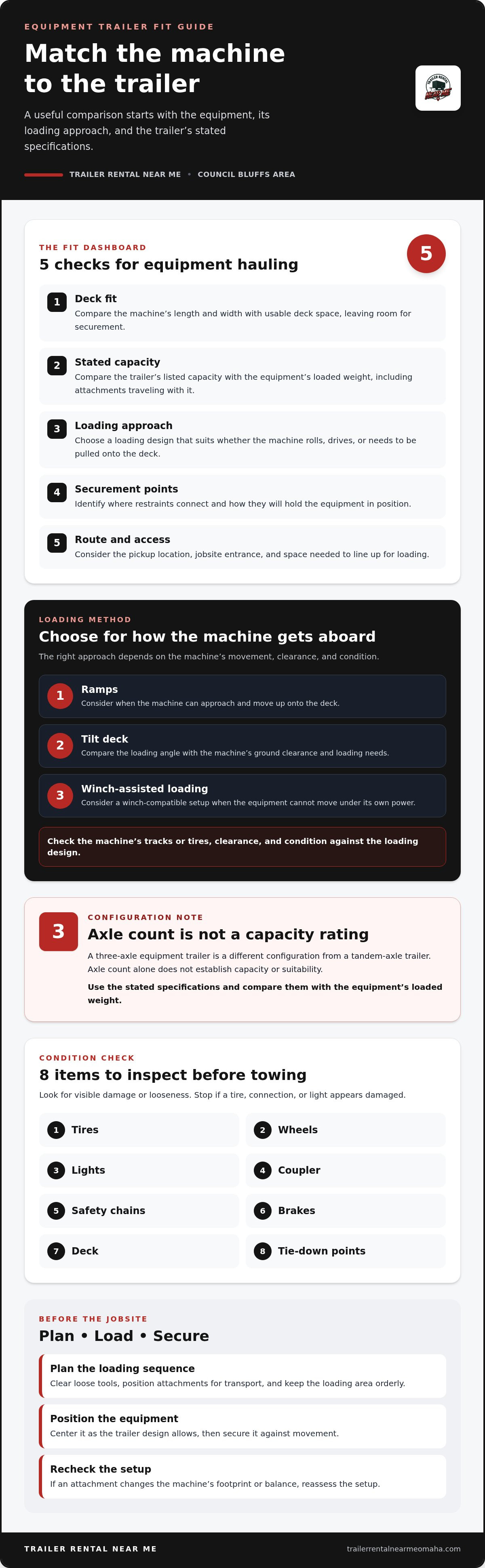
An equipment trailer is designed for loading and carrying machinery, rather than simply loose cargo. A compact tractor, skid steer, or small excavator has different loading needs from lumber or yard debris. Compare the machine’s footprint, ground clearance, and loading approach with the trailer’s deck and features. Start with the machine, not the trailer’s label.
Trailer options near Council Bluffs can have different axle configurations. A three-axle equipment trailer, for example, differs from a tandem-axle trailer, but axle count alone doesn’t establish capacity or suitability. Read the specifications and compare them with the equipment’s loaded weight. Don’t judge a trailer’s carrying ability by appearance.
Loading method matters, too. Ramps provide an approach onto the deck, while a tilt deck changes the loading angle. Equipment that can’t move under its own power may need a winch-compatible setup. Check that the loading design suits the machine’s tracks or tires, clearance, and condition. A low-clearance machine, for example, may need a different approach from a compact tractor.
- Deck fit: Compare the machine’s length and width with usable deck space, including room for securement.
- Capacity: Use the trailer’s stated capacity and the equipment’s loaded weight. Include attachments that travel with the machine.
- Loading approach: Match ramps, tilt deck, or winch-assisted loading to whether the machine rolls, drives, or needs pulling.
- Securement points: Identify where restraints can connect and how they will hold the machine in position.
- Route and access: Consider the pickup location, jobsite entrance, and room needed to line up for loading.
Plan the loading sequence before reaching the job site. Clear loose tools from the machine, position attachments for transport, and keep the loading area orderly. Once aboard, center the equipment as the trailer design allows, then secure it against movement. Reassess the setup if an attachment changes the machine’s footprint or balance.
For a car, choose a trailer designed for vehicle hauling rather than treating an equipment trailer as interchangeable. A comparison of trailer types and configurations can help narrow the category before you review fit and loading details. For machinery, the useful comparison is specific: deck dimensions, stated capacity, axle arrangement, loading method, and securement layout.
A three-axle description identifies a configuration, not whether the trailer is a complete fit. Match the machine and loading process to the trailer’s specifications. This helps distinguish a suitable equipment-hauling option from one that only looks close.
What features should I compare when choosing a tandem axle utility trailer?
Start with the cargo and compare each trailer’s usable deck dimensions. Measure the longest and widest item, such as a riding mower or fence panels. Leave room for tie-downs and access around the load. Overall trailer length may include the tongue, so compare the deck itself with the cargo footprint. The listed length may not represent the usable loading area.
Compare the stated capacity with the load you plan to carry. Account for the trailer’s empty weight and cargo weight rather than treating the rating as available payload. A mower, attachments, and tools all add weight. Distinguish the trailer’s rating from the weight it can carry, and use the listed capacity details to compare options accurately.
- Deck and sides: An open deck can suit a mower, while side rails can help contain loose yard waste.
- Axle and tire setup: Compare the listed configuration and inspect tire condition. Tandem axles alone don’t establish carrying capacity.
- Loading access: Check whether the trailer uses ramps, a tilt deck, or another loading method. A low-clearance machine may need a gradual approach.
- Securement points: Identify attachment locations and whether restraints can hold the cargo without interfering with moving parts.
- Coupler and connection: Compare the trailer connection with the towing vehicle’s hitch setup and ratings.
- Lights and condition: Check visible components and compare their condition with the trailer manufacturer’s operating instructions.
Match the features to the load’s shape and handling needs. Bagged mulch needs a stable placement area, while a mower needs a loading path suited to its tires and clearance. Long boards may fit by length but still require secure placement. Compare cargo dimensions and restraint options, not just weight.
For safety checks, follow the trailer manufacturer’s instructions and established trailer-safety guidance. Apply them when assessing the coupler, tires, lights, and load securement. If a component appears damaged or a restraint cannot hold the cargo properly, choose a different setup. A feature list alone doesn’t establish that a trailer is safe for your load.
Photos can help you compare the deck, tires, coupler, and tie-down locations. Look for visible damage or uneven tire wear, and compare the description with the trailer itself. Clear dimensions and capacity information provide a stronger basis for comparison than a trailer name alone.
For projects in Council Bluffs, note each option’s usable deck dimensions, stated capacity, loading method, securement points, and distance. Rule out trailers that don’t fit the cargo or connection. This leaves a practical shortlist for moving a mower, landscaping supplies, or bulky household materials.
What towing vehicle and hitch capacity are needed for a tandem axle utility trailer?
No single vehicle class suits every tandem-axle utility trailer. The right match depends on the vehicle configuration, manufacturer’s tow rating, vehicle payload, GCWR, hitch rating, trailer weight, and cargo weight. Evaluate these limits together. A strong tow rating alone doesn’t establish that the fully loaded combination is suitable.
Start with the vehicle owner’s manual and manufacturer labels. Identify the tow rating for the specific engine, drivetrain, and installed equipment. Then review GCWR and payload. Passengers, tools, and cargo inside the vehicle also use payload. A pickup carrying a crew and work gear, for example, has less remaining capacity than the same pickup traveling without them.
Next, compare the trailer and cargo with the vehicle’s limits. Use the trailer’s stated weight and the actual cargo weight. Don’t estimate from trailer size. Cargo placement also affects the load carried at the hitch. Landscaping materials, for instance, can have different weights depending on their type and quantity. The National Highway Traffic Safety Administration’s trailer-safety guidance emphasizes considering the towing vehicle and trailer as a combined setup.
- Tow rating: Use the manufacturer’s rating for your exact vehicle configuration.
- Payload: Include passengers, in-vehicle cargo, and the load carried by the vehicle through the hitch.
- GCWR: Consider the combined loaded vehicle and trailer, including cargo.
- Hitch rating: Compare the ratings of the receiver and connecting components with the loaded trailer connection.
- Trailer and cargo: Use their actual weights when assessing the full combination.
Inspect the connection before departure. The coupler must fit the hitch ball, and all connected components must be rated for the setup. Follow the vehicle and trailer manufacturers’ instructions for the coupler, safety chains, and electrical connection. Confirm the trailer lights work. A mismatch between the vehicle, hitch, or trailer can make the combination unsuitable, even if one component appears capable.
Before towing from Council Bluffs, load and secure cargo according to the trailer manufacturer’s instructions. Recheck the connection and lights after setup. If the manual gives different ratings for different configurations, use the rating that matches the vehicle. The decision rests on the complete combination, not a general label such as pickup or SUV. For a practical comparison of trailer types, review the available trailer configurations alongside your vehicle’s ratings.
Trailer Rental Near Me: 22'x102 14k Tilt Deck Car Hauler Rental
Trailer Rental Near Me offers a 22'x102 14k Tilt Deck Car Hauler Rental for vehicle moves that need a purpose-built loading setup. Its deck measures 22 ft by 102 in, with a 14,000-lb GVWR and 9,850-lb payload. A 12,000-lb winch, snatch block, and drive-over fenders support the loading configuration.
Choose a tilt-deck car trailer when you’re hauling a car and need that design rather than an open utility trailer. Compare the vehicle’s weight and dimensions with the trailer specifications, then assess your tow vehicle’s ratings, payload, GCWR, and hitch capacity for the loaded combination.
For vehicle-hauling details and the next step, visit the tilt-deck car hauler page.
Choose the Trailer That Fits Your Next Move
Before choosing, define the job: what you’re hauling, how it will load, and where it’s going. If you’re looking for a tandem-axle utility trailer in Council Bluffs, match the trailer type to the cargo rather than choosing by distance alone.
Trailer Rental Near Me offers utility, dump, and car-hauling trailer rentals. Compare the available trailer options against your project needs and towing setup. The right match keeps the next step straightforward. “The Trailers You Wish Your Buddy Owned.”
A clear plan helps you move forward with confidence and get the work underway.
Frequently Asked Questions
What sizes and load capacities are available for tandem axle utility trailers?
Trailer Rental Near Me lists a 10k Utility Trailer Rental for utility hauling. Choose a trailer by comparing its deck dimensions with your cargo’s footprint and the listed load capacity with the loaded cargo weight. For example, a mower with attached equipment needs space for the machine and securement. Don’t treat the “10k” name as a payload figure; use the capacity information for the specific trailer.
Are trailer rentals available in Council Bluffs, and what do they cost?
Yes. Trailer rentals serve Council Bluffs, including options for utility hauling, vehicles, and dump loads. Those rates apply to those named trailers, not automatically to the utility trailer. The selected trailer and rental period determine the applicable cost; choose the option that fits your cargo and project.

Article by
Chuck Crom
Chuck Crom is the owner of Trailer Rental Near Me, serving Omaha, La Vista, Papillion, Bellevue, Gretna, Elkhorn, and the surrounding Nebraska and western Iowa communities. With years of hands-on experience towing, hauling, and helping customers choose the right trailer for the job, Chuck specializes in making trailer rentals simple, safe, and stress-free.
He writes practical, no-nonsense articles covering trailer safety, towing tips, weight ratings, loading techniques, equipment transport, landscaping projects, home renovations, vehicle hauling, and everything in between. His goal is to help renters avoid common mistakes, stay safe on the road, and get their projects done with confidence.
When he's not helping customers or creating educational content, Chuck is focused on growing a locally owned business built on honest advice, quality equipment, and exceptional customer service.


