
The right heavy duty utility trailer in Ralston is the one whose capacity, axle setup, weight rating, and deck size fit both your equipment and your tow vehicle. Compare the loaded trailer weight with your vehicle’s towing capacity, and remember that GVWR includes the trailer and its cargo, not cargo alone. Your vehicle’s owner’s manual is the starting point for its towing limit.
Choosing by appearance or deck size alone can lead to a poor match. The trailer and its load must also stay within the limits of your vehicle, hitch, and trailer.
This guide explains how to compare capacity and ratings, choose a practical size and axle configuration, and prepare for towing around Ralston. Use it to weigh your equipment, understand the ratings, and decide whether a rental suits the job.
Key Takeaways
- Match the trailer’s usable capacity to the loaded equipment, not just its advertised size or empty weight.
- Compare axle configuration with your load’s weight and how it will sit on the deck; axle count alone doesn’t determine suitability.
- Read GVWR as the maximum combined weight of trailer and cargo, then account for the trailer’s own weight when planning a load.
- Choose deck dimensions around the equipment’s footprint, loading method, and securement needs.
- For vehicle hauling, compare your tow vehicle’s ratings and hitch limits with the trailer and loaded vehicle before selecting a rental.
Matching trailer capacity to equipment and tow vehicle
To choose a heavy duty utility trailer in Ralston, start with your equipment’s loaded weight, dimensions, and loading method. Compare these with the trailer’s payload, deck length and width, axle ratings, and GVWR. A wood-floor flatbed may suit palletized supplies or wheeled equipment, but check its floor condition and rated capacity. Specifications vary by model, so use the figures for the specific trailer.
For tandem axles, compare the combined rating with the load and how it will sit on the deck. Two axles don’t automatically double a trailer’s capacity. Check the trailer, tire, and wheel ratings, then position and secure cargo according to the manufacturer’s instructions. A long machine may need more deck length even if its weight is manageable, while a compact load can still exceed the rating.
A 14PI designation alone doesn’t establish dimensions or payload. Match the exact model’s documentation to the equipment’s loaded weight and footprint. Payload is the cargo allowance, not the trailer’s total rating. Include attachments and tools when estimating the load.
Check your tow vehicle’s owner’s manual and specific configuration. Compare its manufacturer’s tow rating, vehicle payload, GCWR, and hitch rating with the trailer’s weight and cargo. Each limit applies to a different part of the setup. A vehicle category or engine label alone can’t confirm a suitable match. Also make sure the hitch and wiring connector fit the trailer.
When comparing Ralston utility trailers with other heavy-duty brands, look at each model’s payload, deck dimensions, axle ratings, and loading features. A brand name alone won’t tell you whether a specific trailer suits your equipment and tow vehicle.
Registration, title, and trailer-lighting requirements depend on the trailer and its use. Follow the applicable Nebraska rules for your setup. Include working lights and compatible wiring in your pre-trip inspection.
Specifications and payload capacities vary among Ralston utility trailers. Match the individual trailer’s ratings and dimensions to your loaded equipment instead of assuming all trailers have the same capacity.
Are Ralston heavy-duty utility trailers available in stock or for custom order? This section covers rental choices, not sales or custom builds. Select a rental configuration based on the load and loading method.
What should renters inspect before using a utility trailer? Check the deck, tires, hitch, wiring, ramps, and tie-down points before loading. For example, look over a wood floor for damage that could affect equipment placement. Compare a heavy duty utility trailer in Ralston with the load’s approach angle and securement needs; for car hauling, a tilt deck offers a different loading approach. The tilt-deck car trailer details show that configuration.
Axle configurations
Axle layout affects how a trailer supports cargo, responds on the road, and suits your loading plan. A single-axle trailer has one axle assembly; a tandem setup has two. This matters when matching a trailer to equipment with a concentrated footprint, such as a compact tractor or mower. Axle count alone doesn’t establish payload. The trailer’s rating, tires, wheels, and other components still set its limits.
A tandem setup places two axles under the trailer, but doesn’t automatically double its capacity. The manufacturer’s rating governs the permitted load. Check it alongside tire capacity and the loaded trailer weight. A machine with dense attachments, for example, can concentrate more weight in a small area than its dimensions suggest. Distribute cargo as the manufacturer directs and secure it against shifting.
A single axle may suit a lighter, compact load when the trailer’s full rating is adequate. A tandem axle may suit a longer or heavier load if that specific trailer is rated for it. Neither layout is automatically the right choice. Compare the machine’s weight, footprint, loading position, and towing setup with the exact trailer specifications.
- Match the load: Record equipment weight, attachments, and any cargo carried alongside it.
- Check the rating: Compare the trailer’s stated capacity with the full loaded weight.
- Review the setup: Confirm axle, tire, wheel, and hitch ratings for the selected trailer.
- Plan placement: Keep equipment positioned and secured according to the trailer manufacturer’s guidance.
Axle layout can also affect how a loaded trailer moves through tight spaces. A longer tandem-axle trailer may need a wider turning path than a compact single-axle model. Before choosing, map the loading area, driveway, and route around the Ralston job site. Consider where equipment can approach the deck safely and whether it can be aligned without sharp turns.
Before departure, inspect the tires, wheels, visible suspension parts, coupler, and lights. Look for damage, loose components, or faulty wiring. Connect the trailer and confirm that the hitch setup matches your tow vehicle’s rating. These checks don’t replace the manufacturer’s instructions, but can help you spot obvious issues before loading.
For vehicle hauling, the available trailer configurations can help you compare loading approaches, including a car trailer equipped with a winch and tie-downs. Choose by the vehicle’s weight, dimensions, and securement needs, then match the complete loaded setup to your tow vehicle.
Confirm the suitable hitch class and wiring connector before towing a utility trailer. Include this check in your review of the trailer’s axles and load, rather than choosing by configuration alone. Verify the hitch and connector for your actual tow vehicle and trailer combination before loading.
Follow the manufacturer’s instructions for your equipment and resolve any mismatch before setting out. Include hitch and wiring checks in your preparation, so you consider axle choice as part of the complete towing setup, not in isolation. If essential details are unclear, verify them before proceeding.
Gross vehicle weight ratings
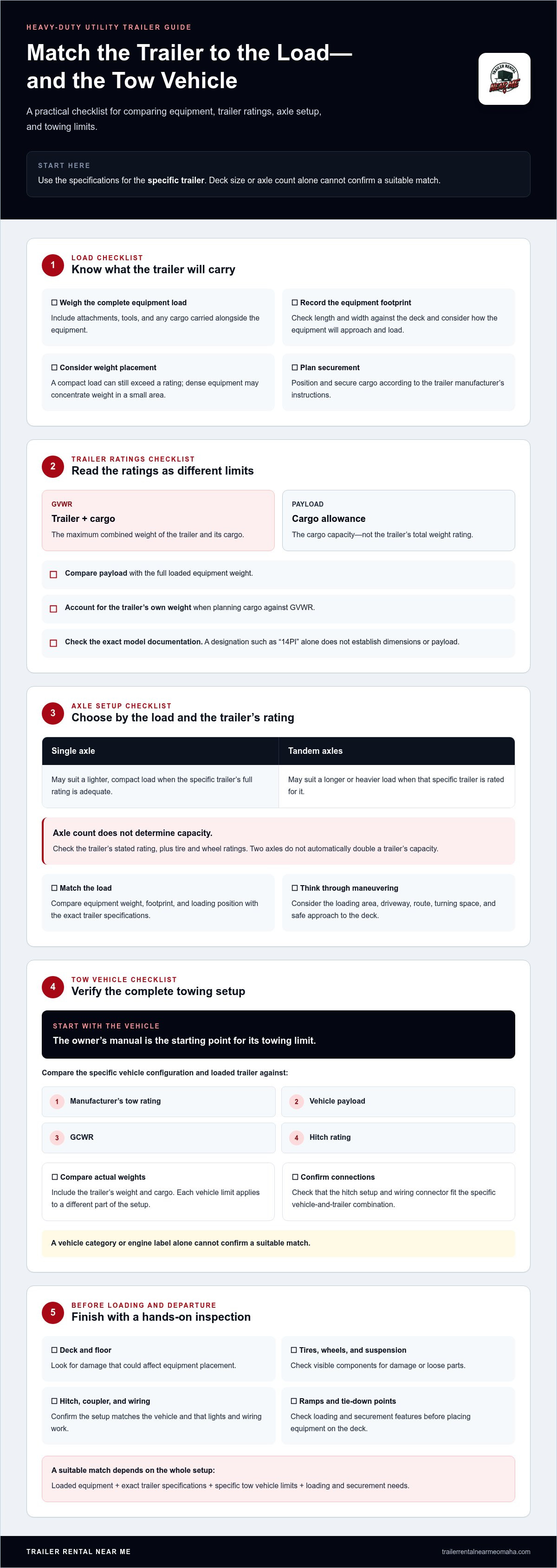
A trailer’s GVWR is the maximum permitted weight of the fully loaded trailer. It includes the trailer itself and everything carried on it, not just the cargo. A utility trailer’s deck may look spacious, but its GVWR limits the combined weight of the trailer, equipment, and cargo. Use the rating shown for that specific trailer, not an estimate based on appearance.
Payload is the cargo allowance; GVWR is the maximum weight of the fully loaded trailer. The trailer’s empty weight counts toward its total rating, leaving less capacity for equipment. Include attachments, tools, fuel, and other cargo in your estimate. A compact machine with a heavy attachment can use more payload than its footprint suggests. Deck area is no substitute for weight information.
Keep your tow vehicle’s ratings in view, too. Its tow rating addresses the trailer load, while vehicle payload accounts for occupants and items carried in the vehicle. GCWR applies to the combined loaded vehicle and trailer. The hitch has its own rating, which must suit the connection. A safe match keeps every component within its manufacturer’s limit.
- Read the trailer rating: Find the GVWR on the trailer identification plate or in its documentation.
- Establish the empty weight: Use the trailer’s stated weight for the exact model.
- List the cargo: Include equipment, attachments, materials, and anything else riding on the deck.
- Check vehicle limits: Compare tow rating, payload, GCWR, and hitch rating with the planned setup.
- Reassess additions: Recalculate the load plan when tools or other cargo are added.
A vehicle scale can help establish actual loaded weights. Weigh the tow vehicle and trailer as you plan to use them, including passengers, equipment, and cargo. Compare the readings with the ratings in the vehicle manual and trailer documentation. If you add a tool chest or machine attachment after weighing, the earlier reading no longer represents the setup.
For vehicle hauling, check the car, trailer, and tow vehicle as one setup. The car is cargo, while the trailer’s own weight counts toward the trailer total. Securement equipment also adds weight to the loaded combination. Use the specific vehicle and trailer documentation to plan the load, rather than relying on a generic rating or vehicle class.
Before committing to a utility trailer, confirm that the tow vehicle has enough towing capacity for the planned combination and can handle the combined weight of the trailer and its load. Check the vehicle’s owner’s manual for its towing capacity before towing; do not rely on a sales description or a familiar-looking vehicle model as a substitute.
Then compare the utility trailer’s GVWR with the vehicle’s maximum towing limit. The trailer’s GVWR should not exceed that limit. This is an initial screening step, not a reason to ignore other ratings for the loaded setup. If the planned load is too heavy, choose a lighter trailer or reduce the cargo. Recheck the figures whenever the trailer, vehicle, or load changes, and keep the relevant documentation available.
Trailer sizes and hauling uses
Measure the cargo before choosing a trailer. Record its length, width, height, and weight, including attachments. For a riding mower, measure the deck and note the wheel positions. For a vehicle, include its widest points, wheelbase, and approach angle. These measurements help you identify usable deck space and a suitable loading method.
A 22 ft by 102 in deck gives a car-hauling example with substantial length and width. Compare those dimensions with the vehicle’s footprint, then allow room for securement points and loading. Deck length alone doesn’t guarantee a fit. A low vehicle may need a gentler loading angle, while a wider vehicle needs adequate clearance between its sides and the trailer edges.
For equipment hauling, consider how the machine will reach the deck. A tractor with a front attachment may need more clearance than its body dimensions suggest. A tilt deck changes the loading approach; ramps offer another option when compatible with the trailer. Check ground clearance, tire position, and turning space before choosing. A tight jobsite entrance also affects which trailer you can maneuver and position safely.
Loose materials need a different trailer and loading plan than vehicles or machines. A dump trailer can carry yard debris, soil, or landscaping material within its rated capacity. Concrete and brick are not permitted in the dump trailer. For permitted materials, consider how moisture and compaction affect weight. Volume alone can’t confirm that the load is within capacity.
- Measure the cargo: Include attachments, mirrors, tires, and overhanging parts.
- Plan loading: Match ramps or tilt-deck access to the equipment’s clearance.
- Check usable space: Leave room for safe placement and securement.
- Map the route: Consider turns, driveway access, and unloading space in Ralston.
- Match the material: Confirm the cargo type and weight suit the trailer’s design and rating.
Plan the full trip before settling on a trailer size. A trailer that fits at pickup may be difficult to position beside a garage, landscape bed, or worksite. For a vehicle move, plan where the car will line up and how you’ll secure it. For a yard project, account for the route between the loading area and unloading point.
Trailer Rental Near Me: 22'x102 14k Tilt Deck Car Hauler Rental
Trailer Rental Near Me offers a 22 ft x 102 in tilt-deck car hauler for vehicle transport. It has a 14,000-lb GVWR, a 9,850-lb payload, and a 12,000-lb winch with a snatch block and drive-over fenders. Compare your vehicle’s dimensions and loaded weight with the trailer’s specifications before choosing it.
Tow suitability depends on your specific vehicle configuration, manufacturer’s tow rating, vehicle payload, GCWR, hitch rating, trailer weight, and cargo weight. Every limit matters to the complete setup.
For car hauling that suits this configuration, Trailer Rental Near Me offers a practical rental option. The Trailers You Wish Your Buddy Owned. Contact Trailer Rental Near Me to discuss your trailer needs.
Choose the Trailer That Fits Your Next Load
Before your next haul, turn your equipment measurements and project plan into a clear rental choice. For a heavy duty utility trailer in Ralston, consider how you’ll load, secure, and unload the cargo, along with access at both ends of the trip. Trailer Rental Near Me serves La Vista, Omaha, Bellevue, Papillion, Ralston, Council Bluffs, and Bennington with straightforward rental options.
Use the trailer options page to take the next step and focus your selection on the job ahead.
With a practical plan in place, you’re ready to get your project moving.

Article by
Chuck Crom
Chuck Crom is the owner of Trailer Rental Near Me, serving Omaha, La Vista, Papillion, Bellevue, Gretna, Elkhorn, and the surrounding Nebraska and western Iowa communities. With years of hands-on experience towing, hauling, and helping customers choose the right trailer for the job, Chuck specializes in making trailer rentals simple, safe, and stress-free.
He writes practical, no-nonsense articles covering trailer safety, towing tips, weight ratings, loading techniques, equipment transport, landscaping projects, home renovations, vehicle hauling, and everything in between. His goal is to help renters avoid common mistakes, stay safe on the road, and get their projects done with confidence.
When he's not helping customers or creating educational content, Chuck is focused on growing a locally owned business built on honest advice, quality equipment, and exceptional customer service.


