
Could a car hauler be a practical motorcycle trailer alternative in Papillion, even though it’s built for larger loads? A dedicated motorcycle trailer may be the straightforward choice, but if you only haul a bike occasionally, renting a general-purpose trailer could be worth considering. The key is making sure the motorcycle can be loaded and secured safely.
It’s reasonable to question whether a larger trailer is suitable for a motorcycle. Deck space alone doesn’t settle it: loading access, tie-down points, securement, and your motorcycle’s dimensions all matter. This guide compares dedicated motorcycle trailers with a tilt-deck car hauler and explains what to assess before choosing.
The RawMaxx tilt-deck car hauler available for rent has a 22 ft x 102 in deck, a 14,000-lb GVWR, a 9,850-lb payload, and a 12,000-lb winch with a snatch block, drive-over fenders, and tie-downs. Those specifications don’t by themselves establish motorcycle compatibility. You’ll also need to compare your bike and gear with the trailer’s capacity and evaluate your tow vehicle’s specific ratings, payload, GCWR, and hitch rating. We’ll walk through those tradeoffs and show how renting can serve an occasional haul in Papillion and the surrounding Omaha area.
Key Takeaways
- Choose a dedicated motorcycle trailer when its purpose and design best match your loading and transport needs.
- A tilt-deck car hauler can be a Papillion motorcycle trailer alternative, but only if the motorcycle fits and can be secured appropriately.
- Use the motorcycle’s actual dimensions to assess deck fit, loading access, and securement rather than assuming all bikes fit alike.
- Before towing, compare the loaded trailer with your specific vehicle’s tow rating, payload, GCWR, and hitch rating.
- For an occasional haul, rental may offer a practical option without owning specialized equipment.
Papillion Motorcycle Trailer Alternatives: Start With the Haul You Need
Moving a motorcycle starts with the bike, the loading plan, and the trip, not with a trailer category. A dedicated motorcycle trailer, a rental car hauler, or another transport approach may each suit a different situation. Compare the motorcycle’s actual length and width with the available deck, then consider how it will be loaded and secured. Your tow vehicle’s ratings matter too. A trailer alternative is suitable only when the complete setup matches the haul.
A useful starting point is understanding the range of designs grouped under Motorcycle trailer. Whatever type you consider, don’t assume that a trailer’s size or general purpose proves it’s appropriate for your motorcycle. Fit, loading access, securement planning, and towing compatibility must work together.
When does a dedicated motorcycle trailer make sense?
A dedicated motorcycle trailer is designed for the specific task of transporting motorcycles. Riders may prefer equipment with a focused purpose because it can make motorcycle loading and securement central to the design, rather than adapting a broader-use trailer. Still, the label alone doesn’t settle the decision. Match the motorcycle and its loading needs to the trailer, then account for the tow vehicle and the full trip.
When might a broader-use rental be worth comparing?
If you haul a motorcycle occasionally, renting a broader-use trailer may be worth comparing with owning specialized equipment. A car hauler is a conditional alternative, not an automatic motorcycle solution. Its deck dimensions and loading method must work for the bike, and the securement plan must suit the setup. Trailer Rental Near Me serves Papillion and the surrounding Omaha area, with a tilt-deck car hauler rental option for people assessing that approach.
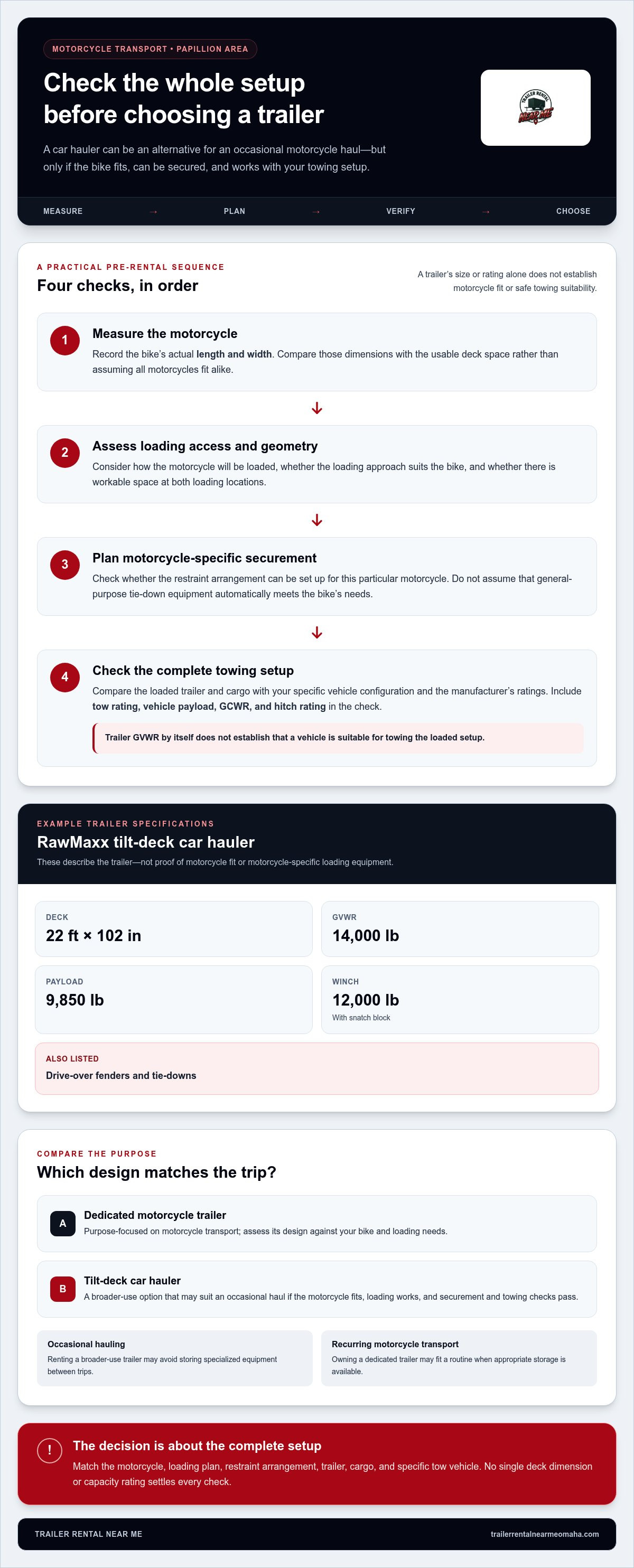
For a concrete comparison, the RawMaxx tilt-deck car hauler has a 22 ft x 102 in deck, a 14,000-lb GVWR, and a 9,850-lb payload. It also has a 12,000-lb winch with a snatch block, drive-over fenders, and tie-downs. Those specifications describe the trailer, but don’t confirm motorcycle fit or motorcycle-specific loading equipment. Before choosing a Papillion motorcycle trailer alternative, compare the bike and complete cargo weight with the trailer, then evaluate your specific vehicle configuration, manufacturer tow ratings, payload, GCWR, and hitch rating.
Motorcycle Trailer vs. Tilt-Deck Car Hauler: Compare the Real Tradeoffs
A dedicated motorcycle trailer is purpose-focused; a tilt-deck car hauler is a broader-use option. The comparison is less about which trailer is better and more about whether its layout and intended use match your trip. Keep the motorcycle’s loading plan at the center of the decision. A car hauler’s general capacity doesn’t make it a motorcycle-specific solution.
Purpose
A dedicated motorcycle trailer is intended for motorcycle transport. A car hauler is intended for broader vehicle hauling.
Loading needs
Compare the loading approach each option supports with the motorcycle and the available space at your loading locations.
Securement
Consider whether the restraint setup can be arranged for the specific motorcycle, rather than assuming a general-purpose setup will suit it.
Flexibility
A dedicated trailer focuses on motorcycle hauling. A car hauler may serve other hauling tasks, which can matter if you need equipment for more than one kind of trip.
Compatibility checks
Evaluate the complete setup, including motorcycle fit, loading plan, restraint arrangement, and tow vehicle.
What the Papillion-area tilt-deck car hauler offers
The rental listing provides dimensions, capacity ratings, and equipment details to use in your comparison. Treat those as information about the trailer, not proof that a motorcycle fits or that its loading and restraint needs are met. Reviewing the tilt-deck car hauler rental details can help you compare the listed setup with your planned haul.
Which option better matches an occasional motorcycle haul?
If motorcycle transport is a recurring need and you have appropriate storage, owning a dedicated trailer may fit your routine. If hauling is occasional, renting a broader-use trailer may let you avoid storing specialized equipment between trips. Neither route is automatically safer, cheaper, or suitable for every rider. Base the decision on the motorcycle, the trip, and the complete towing setup.
Check the vehicle manufacturer’s requirements for your specific vehicle configuration. The Federal Motor Carrier Safety Regulations address regulated commercial motor vehicle operations; they don’t replace checking the rules that apply to your own trip. If you’re comparing options for a haul, review the available trailer rental options alongside your transport plan.
Check Motorcycle Fit, Securement, and Towing Compatibility Before Renting
Use a step-by-step check before choosing a Papillion motorcycle trailer alternative. A broad deck or high rating can look reassuring, but neither replaces measuring the motorcycle, planning how it will be restrained, and matching the loaded setup to the tow vehicle. A trailer's GVWR alone does not establish a vehicle's safe towing suitability.
- Measure the motorcycle and assess loading geometry. Record the bike’s actual length and width, then compare those measurements with the usable deck dimensions. Consider how it will approach the deck and whether its clearance and stability during loading suit the loading path. A listed deck size doesn’t tell you whether the motorcycle can be positioned as needed. Don’t assume a motorcycle-specific loading system is part of a broader-use trailer.
- Plan the securement for this bike and trailer. Identify suitable restraint points on the motorcycle and trailer, then consider whether tie-down placement can hold the bike securely without interfering with vulnerable parts. Included tie-downs are useful equipment, but their presence alone doesn’t establish that the arrangement fits every motorcycle. Review a car-hauling guide’s vehicle-securement discussion for general context, then assess the motorcycle’s specific restraint plan separately.
- Match the loaded trailer to the tow vehicle. Check the vehicle manufacturer’s tow rating, payload, GCWR, and hitch rating. Compare them with the trailer weight and the motorcycle and other cargo weight, using verified figures rather than estimates. The specific vehicle configuration matters; a general vehicle class can’t establish towing suitability.
Check each part of the setup
These checks work together. A motorcycle that fits the deck may still be difficult to load or secure with the available layout. A trailer that can carry the cargo may still exceed a vehicle-specific limit once the complete loaded setup is considered. If any measurement, restraint point, or rating doesn’t align, treat that as a reason to reconsider the combination, not to rely on a broad category label.
For a rental comparison, use the tilt-deck car hauler details alongside your measurements and vehicle specifications. The trailer’s published capacity describes the trailer, not what a particular tow vehicle can safely handle.
Once you’ve assessed fit, securement, and towing compatibility, you can review trailer rental options that may suit your hauling plans.
Choose a Papillion Motorcycle Trailer Alternative That Fits the Job
The right choice comes down to the specific motorcycle, the way it needs to be loaded and secured, and the tow vehicle’s limits. If motorcycle-focused loading is essential, prioritize a purpose-built motorcycle trailer. A tilt-deck car hauler is another option to assess, not a guaranteed substitute. Consider it only when measurements, securement planning, and towing compatibility all align.
A simple decision path for Papillion-area riders
Start with the motorcycle’s actual dimensions and loading needs. If the bike’s approach, clearance, or restraint plan calls for equipment designed around motorcycle transport, choose a dedicated motorcycle trailer. If you’re comparing a car hauler, use its stated deck dimensions to check physical fit. Then evaluate the tow vehicle’s manufacturer ratings against the complete loaded setup before proceeding.
Review the rental option and plan the next step
Trailer Rental Near Me serves Papillion through its La Vista and surrounding Omaha-area coverage. Its tilt-deck car hauler is a rental option for occasional hauling, provided your motorcycle fits and the planned securement and towing setup are suitable. Review the Papillion-area tilt-deck car hauler rental details alongside your measurements and vehicle ratings. That information helps you assess the trailer, but it doesn’t establish compatibility with a particular motorcycle.
Before choosing, make sure the entire combination works: motorcycle dimensions, loading access, restraint points, trailer and cargo weights, and the tow vehicle’s specific tow rating, payload, GCWR, and hitch rating. If a key measurement or rating doesn’t align, a different trailer type may be the more suitable choice. The decision should follow the job, not a broad assumption about what a car hauler can carry.
For an occasional haul, reviewing the available trailer options can help you compare rental equipment with your trip needs without committing to ownership.
Make Your Next Haul a Planned One
Before setting a pickup date, turn your measurements and vehicle information into a clear go-or-no-go decision. If motorcycle-specific loading is central to the trip, choose equipment designed around that task. If a general-purpose trailer remains in consideration, base the choice on the actual bike, loading plan, securement, and complete tow setup, not on deck size alone.
For riders in Papillion, local rental options make it possible to compare a car hauler without committing to owning specialized equipment. The available tilt-deck specifications provide concrete details for that comparison, while the final fit depends on your motorcycle and tow vehicle. A little preparation now can help you rule out an unsuitable setup before loading day and choose an approach that matches the trip ahead.
Review the options with your haul in mind, then move forward with a setup that fits the job and your plans.
A well-planned haul starts with the right match. You’re ready to make an informed choice.
Frequently Asked Questions
Can you use a car hauler to transport a motorcycle?
Yes, a car hauler can transport a motorcycle if the bike fits, can be loaded appropriately, and has a suitable securement plan. Measure with the motorcycle in its transport configuration, including any attached accessories that affect its dimensions. Consider the loading area at both ends of the trip, too. A trailer that looks workable in a listing may be difficult to use if the loading approach or available space doesn’t suit the bike.
Is a tilt-deck car hauler a practical alternative to a motorcycle trailer?
It can be, provided the motorcycle and the whole transport setup are compatible. A tilt deck describes the trailer’s deck arrangement, not motorcycle-specific loading equipment or a guarantee that a particular bike can be loaded safely. For a Papillion motorcycle trailer alternative, compare the bike’s dimensions and loading needs with the trailer details, then assess the restraint plan and towing setup. If the bike’s loading method doesn’t suit the trailer, choose another approach.
How do I know whether my vehicle can tow a loaded rental trailer?
Use the vehicle manufacturer’s ratings for your specific configuration, not a general truck or SUV category. Compare the tow rating, payload, GCWR, and hitch rating with the trailer and its loaded cargo. Remember that people and gear inside the tow vehicle also use vehicle payload. If you can’t establish the relevant weights or ratings for the complete setup, don’t assume the combination is suitable based on the trailer’s rating alone.
What should I check before loading a motorcycle onto a trailer?
Check the motorcycle’s dimensions, the usable deck area, and the loading path, including clearance at the transition onto the deck. Plan where restraints can attach without bearing on fragile parts, and consider how the bike will remain stable during loading. A wheel support or other loading aid may be appropriate for some setups, but don’t assume one is supplied. Follow the motorcycle and trailer manufacturers’ guidance for loading and restraint.
Is renting a motorcycle trailer alternative better than owning one?
Renting may suit a one-time move or occasional trip, especially if you don’t want to store specialized equipment between uses. Ownership may make more sense if motorcycle hauling is a regular part of your routine and you have suitable storage. Compare how often you’ll haul, the space available, and whether the equipment fits your recurring needs. A rental car hauler is still conditional on the bike, loading plan, securement, and tow vehicle being compatible.
Can I rent a car hauler near Papillion, Nebraska?
Yes. Trailer Rental Near Me serves Papillion as part of its La Vista and surrounding Omaha-area coverage and rents a tilt-deck car hauler. Renting gives local riders an option to evaluate for an occasional haul without owning a trailer. The rental itself doesn’t establish motorcycle fit, loading suitability, or tow-vehicle compatibility, so use your bike’s dimensions and vehicle information to assess the setup before the trip.

Article by
Chuck Crom
Chuck Crom is the owner of Trailer Rental Near Me, serving Omaha, La Vista, Papillion, Bellevue, Gretna, Elkhorn, and the surrounding Nebraska and western Iowa communities. With years of hands-on experience towing, hauling, and helping customers choose the right trailer for the job, Chuck specializes in making trailer rentals simple, safe, and stress-free.
He writes practical, no-nonsense articles covering trailer safety, towing tips, weight ratings, loading techniques, equipment transport, landscaping projects, home renovations, vehicle hauling, and everything in between. His goal is to help renters avoid common mistakes, stay safe on the road, and get their projects done with confidence.
When he's not helping customers or creating educational content, Chuck is focused on growing a locally owned business built on honest advice, quality equipment, and exceptional customer service.


