
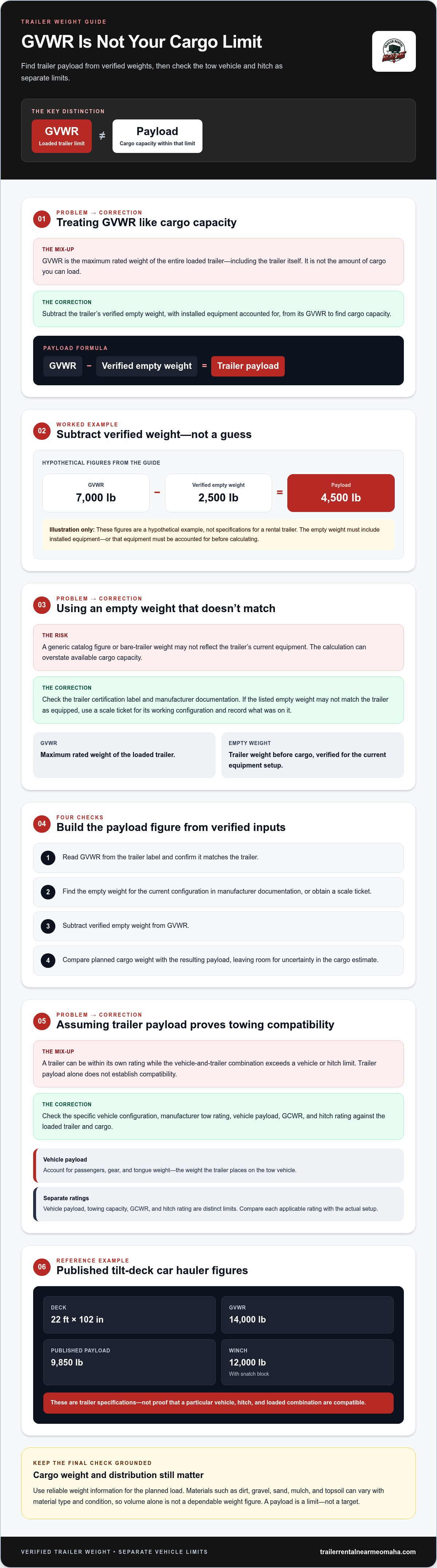
Knowing how to calculate trailer payload starts with a simple distinction: a trailer’s GVWR is not the amount of cargo it can carry. GVWR is the maximum rated weight of the loaded trailer, including the trailer itself. To find the cargo capacity, subtract the trailer’s verified empty weight, including installed equipment, from its GVWR.
It’s easy to confuse payload, GVWR, and towing capacity, especially when a listed empty weight doesn’t reflect added equipment. The subtraction is straightforward, but the numbers must match the trailer’s current configuration. Then check the tow vehicle and hitch separately. A trailer can be within its own rating while the combination exceeds the vehicle’s payload, tow rating, GCWR, or hitch limit.
This guide explains which weight figures to find, how to set a cargo limit without guessing, and how to compare trailer and vehicle ratings before hauling a car or project materials. You’ll also learn why load weight and distribution matter, so your plan accounts for the full towing setup rather than one number on a label.
Key Takeaways
- Calculate trailer payload by subtracting a verified empty weight, including installed equipment, from the trailer’s GVWR.
- Check trailer payload, tow-vehicle payload, tow rating, GCWR, and hitch rating as separate limits.
- Count passengers, gear, and tongue weight when assessing how much capacity remains in the tow vehicle.
- Estimate material loads by weight, not volume alone. Dirt, gravel, sand, mulch, and topsoil can vary with material type and condition.
- Before hauling a car or project materials, compare the actual load and trailer weight with every applicable vehicle and trailer limit.
What trailer payload means, and why GVWR is not your cargo limit
Trailer payload is the cargo weight a trailer can carry within its rating. GVWR is the manufacturer’s maximum rated weight for the entire loaded trailer, including the trailer itself. Confusing these figures can lead you to plan a load that exceeds the trailer’s capacity.
GVWR is the trailer’s total loaded-weight limit; payload is the cargo capacity available within that limit. Payload is also different from your tow vehicle’s payload and towing capacity. Those are separate vehicle limits. A trailer’s payload rating alone does not show whether a particular vehicle and hitch can tow it when loaded.
GVWR, empty weight, and payload: what each number describes
GVWR is the trailer manufacturer’s rated maximum loaded weight. Empty weight, sometimes called tare weight, is the trailer’s weight before cargo. For payload planning, use an empty-weight figure that reflects the trailer as equipped. Installed equipment takes up part of the capacity available for cargo, so a bare or outdated figure may not describe the trailer you’re using.
Payload is the capacity remaining for cargo after accounting for the trailer’s own weight. The calculation appears in the next section. Treat a published payload rating as a limit, not as the trailer’s GVWR. For a reference on the GVWR term, see Gross Vehicle Weight Rating (GVWR) on Wikipedia.
Why a trailer’s advertised rating is not the whole towing answer
A trailer may have enough payload for a car or project load and still be unsuitable for a particular tow setup. Check the tow vehicle’s manufacturer tow rating, vehicle payload, gross combined weight rating (GCWR), and hitch rating against the loaded trailer and cargo. Vehicle configuration matters to each rating.
Vehicle payload is the weight the vehicle carries, including passengers, gear, and tongue weight. Towing capacity is a separate rating for what the vehicle can tow. Don’t use a broad label such as half-ton or three-quarter-ton as a safe towing recommendation. Ratings vary by vehicle configuration.
For example, the published specifications for the 22 ft x 102 in tilt-deck car hauler include a 14,000-lb GVWR and a 9,850-lb payload. Those figures describe the trailer’s stated limits. They do not establish whether a particular vehicle, hitch, and loaded combination is compatible.
How to calculate trailer payload using verified weight figures
Trailer payload equals GVWR minus the trailer’s verified empty weight. Empty weight must reflect the trailer in the condition used for the calculation. The result is the cargo capacity available within the trailer’s rating. To calculate payload accurately, confirm that both figures describe the same trailer and equipment setup.
Where to find GVWR and the trailer’s actual empty weight
Start with the trailer certification label and manufacturer documentation. The label identifies GVWR, while the empty-weight figure may appear separately in the documentation. These figures serve different purposes: GVWR is the maximum, and empty weight is the starting point you subtract.
If documentation lists a generic catalog weight that may not match the trailer as equipped, use a scale ticket for the empty trailer in its working configuration. Record what was on the trailer when it was weighed. That makes it easier to account for equipment added or removed since the measurement.
Calculate usable cargo capacity without changing a product specification
Use the manufacturer’s published payload when it applies to the exact trailer configuration. For your own calculation, verify the inputs rather than inferring a new product rating from incomplete figures. If the empty-weight figure excludes added equipment, account for that equipment before calculating. Don’t subtract it again if the verified empty weight already includes it.
- Read GVWR from the trailer label and confirm it matches the trailer.
- Find the empty weight for the trailer’s current configuration in manufacturer documentation, or obtain a scale ticket.
- Subtract the verified empty weight from GVWR.
- Compare the planned cargo weight with the resulting payload, leaving room for uncertainty in the cargo estimate.
For a hypothetical example, imagine a trailer with a 7,000-lb GVWR and a verified empty weight of 2,500 lb. Subtracting the empty weight gives 4,500 lb of payload. These figures are for illustration only, not specifications for a rental trailer. If the empty-weight record excludes an installed accessory, first include that accessory’s verified weight in the empty-weight total. Otherwise, the result overstates cargo capacity.
Payload is a limit, not a target. Cargo weights can be uncertain, especially when equipment or materials vary. Use reliable weight information for the planned load, and don’t treat an approximate estimate as exact. If you’re comparing trailer types for a vehicle or project, the available trailer options can help you compare equipment and published ratings.
Check tow-vehicle payload and towing limits before hauling a car
A trailer’s payload rating describes what the trailer can carry. It doesn’t tell you whether your vehicle can handle the loaded combination. Check each vehicle and hitch rating against the actual trailer weight and planned cargo. Compatibility depends on the specific vehicle configuration and requires respecting every applicable limit.
| Rating | What it limits | What to compare |
|---|---|---|
| Trailer payload | Cargo carried by the trailer | Planned cargo weight |
| Vehicle payload | Weight carried by the tow vehicle | Passengers, in-vehicle cargo, and tongue weight |
| Tow rating | Maximum trailer weight specified for the vehicle configuration | Actual loaded trailer weight |
| GCWR | Maximum combined weight rating for the vehicle and trailer | Actual combined weight |
| Hitch rating | Limits for the hitch and its components | Trailer and hitch loads, including tongue weight |
How tongue weight affects the tow vehicle
Some of the trailer’s load transfers to the tow vehicle through the hitch. That tongue weight uses vehicle payload capacity, just like occupants and gear inside the vehicle. Include it in the vehicle payload check rather than treating it as weight carried only by the trailer. The amount depends on the loaded setup, so use relevant measured or manufacturer-provided information rather than a universal percentage.
Use the vehicle’s ratings as a complete compatibility check
Check the tow rating, vehicle payload, GCWR, and hitch rating together. Compare them with the trailer’s actual weight and the cargo you plan to carry. Meeting one rating doesn’t make up for exceeding another. The vehicle’s exact configuration matters, so don’t rely on broad labels such as half-ton or three-quarter-ton as a towing recommendation.
For car hauling, account for the vehicle being transported, equipment carried in the tow vehicle, and the trailer itself. The car trailer hauling guide covers related planning considerations. If your route crosses Nebraska or Iowa, check current official state guidance for applicable towing rules rather than assuming requirements are identical across state lines.
Use the full set of ratings to assess whether the specific vehicle, hitch, trailer, and load work together. Explore trailer options for your hauling plans.
Apply the payload calculation to car hauling and project materials
A payload figure is useful when you compare it with the real load, not a guess based on appearance or volume. Get a vehicle’s weight from a reliable source. For loose materials, account for the material type and condition. Dirt, gravel, rock, sand, mulch, and topsoil can vary in weight with moisture and composition. A cubic-yard estimate alone can’t confirm that a load is within the trailer’s payload.
Match a car-hauling load to the listed trailer payload
For a car-hauling plan, compare the transported vehicle’s verified weight with the trailer’s published payload. The RawMaxx tilt-deck car hauler has a published payload of 9,850 lb. Use that specification as stated. Don’t derive a different payload from other figures or assume the vehicle’s weight is the only relevant limit. The tow vehicle and hitch still need to be checked for the specific setup.
The tilt-deck car hauler details provide the listed trailer information, while this car trailer rental guide covers related hauling considerations. Use vehicle-specific weight information when planning a load, and include any equipment carried with the vehicle.
Plan material loads for an Omaha-area project
For a landscaping or cleanup project in Omaha, La Vista, Bellevue, Papillion, Ralston, Bennington, or Council Bluffs, first identify the material and estimate the amount needed. Then verify its weight using reliable information that matches the material type and condition. Wet soil or sand, for example, may weigh differently from a dry load. Keep the material estimate separate from the trailer’s listed payload, and don’t treat volume as a substitute for weight information.
The RawMaxx 7x12 dump trailer has a published payload of 6,540 lb. Use this stated specification without recalculating it. Concrete and brick are prohibited in the dump trailers. For project planning, dump trailer rental information provides a relevant equipment reference, and the La Vista dump trailer guide adds local hauling context. Keep the planned material load within the published payload, and check the specific tow vehicle’s ratings before hauling.
Make your next haul a measured plan
Before loading, write down what’s going on the trailer, find dependable weight information, and leave room for uncertainty. A careful approach to how to calculate trailer payload helps you make decisions based on the actual load rather than appearance or guesswork.
Then check the whole combination. Your trailer, cargo, tow vehicle, and hitch each have limits that need to work together. If the load changes, revisit the plan before you head out. That pause can help you choose equipment that fits the job and plan the haul with greater confidence.
Frequently Asked Questions
How much can I load into a trailer with a 10,000-lb GVWR?
There isn’t one cargo limit for every trailer with a 10,000-lb GVWR. The trailer’s verified empty weight determines how much capacity remains, and the figure can differ between trailers or configurations. If you’re planning a rental, use that trailer’s published payload rather than borrowing an empty-weight number from a similar model. That’s the practical starting point for calculating trailer payload without guessing.
Can a trailer’s payload rating tell me whether my truck can tow it?
No. A trailer’s payload rating can’t establish whether your specific truck can tow the loaded setup. A vehicle may have enough tow capacity on paper but limited remaining payload once passengers, tools, and hitch load are included. Check the manufacturer ratings for the exact vehicle configuration, then compare them with the actual loaded trailer and hitch. A different engine, cab, or drivetrain can affect which ratings apply.
Does adding a toolbox or spare tire affect trailer payload?
It can reduce the cargo capacity remaining if its weight isn’t already included in the trailer’s recorded empty weight. First identify which equipment was present when that figure was established. If a toolbox or spare was added afterward, use reliable weight information for the added item and account for it once. If you can’t establish the trailer’s current weight from documentation, a scale measurement can replace guesswork.
Can two loads that take up the same space have different weights?
Yes. Two loads that fill the same portion of a trailer can differ in weight because material and condition matter. A measured volume of damp soil, for instance, shouldn’t automatically be treated like the same volume of dry soil. For a landscaping job in Papillion or Bellevue, identify the material and its condition, then use weight information suited to that load. Volume helps plan quantity, but it doesn’t verify payload.
Should I rely on a trailer’s payload number if my load is close to the limit?
Don’t rely on visual judgment for a load that appears close to the limit. Check the trailer’s stated payload and get dependable weights for the cargo and any equipment traveling with it. If possible, weigh the loaded setup and compare the result with applicable trailer and vehicle ratings. If the estimate is uncertain or the numbers leave little room, reduce the load or make another trip rather than assume it fits.
Where should I check current towing requirements in Nebraska or Iowa?
Use current official information from the state relevant to your route, such as Nebraska state agency guidance or the Iowa Department of Transportation, and consult the vehicle and trailer manufacturers for equipment ratings. Don’t assume a rule in one state applies across the border. This matters for regional trips, including routes between La Vista and Council Bluffs. Look for guidance that matches your trailer and situation, and verify that the publication is current.

Article by
Chuck Crom
Chuck Crom is the owner of Trailer Rental Near Me, serving Omaha, La Vista, Papillion, Bellevue, Gretna, Elkhorn, and the surrounding Nebraska and western Iowa communities. With years of hands-on experience towing, hauling, and helping customers choose the right trailer for the job, Chuck specializes in making trailer rentals simple, safe, and stress-free.
He writes practical, no-nonsense articles covering trailer safety, towing tips, weight ratings, loading techniques, equipment transport, landscaping projects, home renovations, vehicle hauling, and everything in between. His goal is to help renters avoid common mistakes, stay safe on the road, and get their projects done with confidence.
When he's not helping customers or creating educational content, Chuck is focused on growing a locally owned business built on honest advice, quality equipment, and exceptional customer service.


