
A dump trailer may look like the obvious choice for heavy blocks, but concrete and brick are prohibited in dump trailers. For a retaining wall block hauling trailer Ralston project, start with the material, its verified weight and the trailer’s actual payload, not its appearance.
Block weights vary by size and type, so use the supplier’s documented pallet or unit weight rather than estimating by sight. Remember that GVWR is not cargo capacity: it includes the trailer and its cargo. You’ll need to compare the complete load with the trailer’s payload and check that the loaded setup fits your tow vehicle’s specific ratings.
This guide walks through calculating the planned load, comparing it with trailer and vehicle limits, and preparing blocks for transport. It also covers the 22-foot tilt-deck trailer, which has a 9,850-pound payload. Trailer Rental Near Me serves Ralston and the surrounding Omaha area. “The Trailers You Wish Your Buddy Owned.”
Key Takeaways
- Use the block manufacturer’s or supplier’s verified weight and dimensions, then total the complete load before selecting equipment.
- For a retaining wall block hauling trailer Ralston project, compare cargo weight with the trailer’s rated payload, not its GVWR alone.
- Check your specific tow vehicle’s tow rating, payload, GCWR and hitch rating against the loaded combination.
- Follow the trailer and securement-equipment manufacturers’ instructions, and keep concrete blocks out of dump trailers.
Planning a Retaining Wall Block Haul in Ralston Starts with the Load
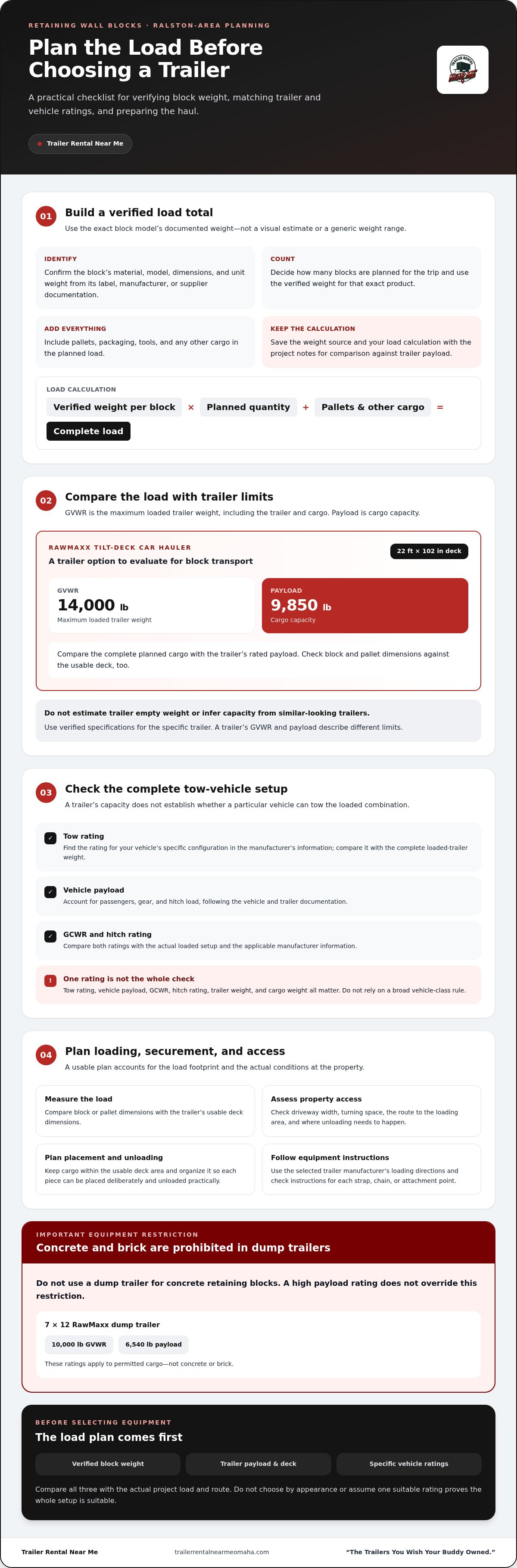
Determine the block load before choosing a trailer. Retaining blocks vary by material, dimensions and manufacturer, so a weight listed for one model may not apply to another. Identify the exact block, confirm its documented weight, count the pieces you plan to move and total the load. That gives you a useful figure to compare with trailer capacity instead of relying on a visual estimate.
Trailer selection depends on the actual cargo weight, not how large or heavy the blocks appear.
- Identify the block model and material.
- Find its unit weight in manufacturer or supplier documentation.
- Multiply the verified weight by the number of blocks planned for the trip.
- Add pallets, packaging, tools and any other cargo.
How do you estimate the weight of retaining wall blocks?
Start with the product label. If it doesn’t list a unit weight, use the manufacturer’s specifications or supplier documentation for that exact block. Multiply the documented weight per piece by your planned quantity, then include pallets and packaging in the total. Don’t substitute a generic online range for the product information. Keep the source and calculation with your project notes so you can compare the load with trailer payload ratings.
Why block dimensions and delivery access matter in Ralston
Weight is only one part of the plan. Measure the blocks or pallet footprint and compare it with the trailer’s usable deck dimensions. Retaining wall designs and block types vary. The Retaining Wall Overview provides background on common wall forms and their purpose, while your supplier’s product details should guide your measurements.
Next, assess the route at the property: driveway width, turning space, the path to the loading area and the place where the blocks need to be unloaded. Access varies from one Ralston property to another, so measure the actual route rather than assuming the trailer can reach every spot. The 22-foot-by-102-inch tilt-deck trailer’s dimensions are available with its tilt-deck car hauler details. Compare the listed deck dimensions with your load footprint and access plan before selecting equipment for a retaining wall block hauling trailer Ralston project.
Match Retaining Wall Blocks to Trailer and Tow-Vehicle Ratings
Once you have a documented load total, compare it with the ratings for the exact trailer and tow vehicle. GVWR is the maximum loaded weight of the trailer, including the trailer itself and its cargo. Payload is the cargo capacity. GVWR describes the trailer’s total loaded-weight limit; payload describes how much cargo it can carry.
Use verified specifications for the specific trailer. Don’t estimate its empty weight by subtracting one rating from another or assume that trailers with similar dimensions have the same capacity. The 22-foot-by-102-inch RawMaxx tilt-deck car hauler has a 14,000-pound GVWR and a 9,850-pound payload. Those figures help you compare a planned load with the trailer’s limits, but they don’t establish whether your tow vehicle can handle the combination.
What ratings must you compare before towing?
Find the tow rating for your vehicle’s specific configuration in the manufacturer’s information, then compare it with the complete loaded-trailer weight. Also account for the vehicle’s payload, GCWR and hitch rating, along with the trailer’s weight and cargo. These limits apply to different parts of the setup, so meeting one rating does not prove the entire combination is suitable. Include passengers, gear and the hitch load when checking vehicle payload, following the vehicle and trailer documentation.
Don’t assume a half-ton, three-quarter-ton or any other broad vehicle class is automatically suitable. Engine, drivetrain, equipment and other configuration details affect manufacturer ratings. For a retaining wall block hauling trailer Ralston project, make the decision using the ratings for your actual vehicle and the exact trailer, not a general rule of thumb.
Does a dump trailer work for concrete retaining blocks?
No. Concrete and brick are prohibited in dump trailers. A high payload rating does not override that restriction, so do not use the 7x12 RawMaxx dump trailer for concrete retaining blocks. Its 10,000-pound GVWR and 6,540-pound payload apply to permitted cargo, not concrete or brick.
The tilt-deck car hauler is an option to evaluate for this load, subject to its ratings, the block dimensions and your vehicle’s towing limits. Compare the available trailer options with your load plan and vehicle specifications before choosing.
Loading and Securing Retaining Blocks for a Ralston-Area Haul
A sound plan continues after you choose a trailer. Stage the blocks, plan where they will sit and follow the selected trailer manufacturer’s instructions for loading and cargo securement. Securement instructions must match both the cargo and the trailer equipment. Block shape, packaging and the trailer’s tie-down points all matter, so don’t assume a method used for another load or setup will work here.
How should you prepare blocks for loading?
Stage the verified quantity you intend to move and keep the complete cargo within the trailer’s applicable ratings, including pallets and other items. Before loading, consider the block weight, the equipment needed to handle it and the space available at the project site. Organize the load so each piece can be placed deliberately and the unloading sequence is practical.
Plan the placement before loading begins. Keep cargo within the usable deck area and follow the trailer manufacturer’s loading directions. Check the instructions for any strap, chain or attachment point you plan to use instead of assuming it is suitable. For a retaining wall block hauling trailer Ralston project, this preparation connects the load plan with the trailer setup and the actual worksite.
What should you check before leaving the project site?
Do a final walk-around. Confirm the cargo is positioned and secured as directed by the trailer manufacturer, then check the hitch and trailer connections according to their instructions. Look for shifted blocks or loose packaging, and account for tools and other cargo. If anything moved during loading, correct it before departure.
Plan the route and unloading position as well. Consider the approach, turning room, driveway access and space to position the trailer. Ralston-area properties differ, so use the actual pickup point, project entrance and unloading area to guide the plan. Compare the available trailer options with your load and site requirements.
Choose a Trailer Rental for Retaining Blocks Without Guesswork
Make the rental decision by following the load from identification through unloading. Confirm the block material, verify its weight, count the quantity and measure the footprint. Compare the complete load with the exact trailer’s ratings, then check the tow vehicle’s manufacturer ratings and plan how the cargo will be secured. This process helps prevent choosing a trailer based on deck size alone when its capacity or intended use may not fit the job.
Material restrictions matter as much as capacity. Concrete and brick are prohibited in dump trailers, regardless of their payload rating. Choose equipment whose use fits the cargo, and keep the complete load and tow-vehicle combination within applicable ratings.
When should you choose a rental instead of improvising?
A rental can make sense when a project requires hauling equipment you don’t already have. Base the choice on the blocks, trailer specifications and tow vehicle ratings. A trailer used for another heavy-duty task is not automatically appropriate for concrete blocks. Match the equipment to the material, then confirm the load, dimensions, towing fit and securement plan before booking.
A final Ralston block-hauling checklist
Work through these details before choosing equipment. A complete plan includes the blocks and the trip to and from the project site.
- Confirm the block type, manufacturer’s documented unit weight, quantity and overall dimensions.
- Include pallets, packaging, tools and other cargo in the planned load.
- Compare the load and footprint with verified specifications for the exact trailer.
- Check your vehicle’s specific tow rating, payload, GCWR and hitch rating against the loaded combination.
- Plan loading, securement, transport and unloading according to the trailer manufacturer’s instructions.
For a retaining wall block hauling trailer Ralston project, review the available equipment against the material and your planning criteria. Trailer Rental Near Me offers trailer rentals in the La Vista and Omaha area, with online booking and flexible rental periods. Review the options and book the trailer that fits your project plan.
Set Up the Haul to Keep Your Project Moving
Once you’ve settled on equipment, coordinate the haul with the work at the property. Align the block arrival with the installation schedule, choose a staging spot and keep the unloading path clear. Planning where the load will go can help avoid extra handling or interference with other work.
For a retaining wall block hauling trailer Ralston project, choose equipment that fits the job and your pickup, transport and return plans. Trailer Rental Near Me serves Ralston and nearby communities, including La Vista, Omaha, Bellevue, Papillion, Council Bluffs and Bennington. Browse trailer options and book online for your project.
With the load, site access and equipment plan aligned, you can focus on building the wall.
Frequently Asked Questions
Can you haul retaining wall blocks in a dump trailer?
No. Concrete and brick are prohibited in dump trailers, regardless of the trailer’s payload rating. For a retaining wall block hauling trailer Ralston project, confirm the blocks’ material and choose equipment intended for that cargo. Then assess the planned load and towing setup, following the trailer and securement-equipment manufacturers’ instructions during loading and transport.
How do I calculate the weight of a retaining wall block load?
Use the documented unit weight for the exact block model and multiply it by the number of blocks planned for the trip. Add the weight of pallets, packaging, tools and any other cargo. If the quantity changes after ordering, update the calculation rather than relying on the earlier total. Keep the product information and current load figure together while comparing equipment ratings.
Does trailer GVWR tell me how many retaining blocks I can carry?
No. GVWR is the maximum total loaded weight of the trailer, including the trailer itself, while payload is cargo capacity. Check both figures for the exact trailer rather than treating GVWR as the weight of blocks it can carry. Compare the planned cargo with the trailer’s payload, then assess whether the loaded combination fits your vehicle’s tow rating, payload, GCWR and hitch rating.
Can my truck safely tow a trailer loaded with retaining wall blocks?
That depends on the specific truck configuration and the weights and ratings involved. Use the vehicle manufacturer’s information to check tow rating, payload, GCWR and hitch rating. Compare those limits with the trailer and cargo weights, including other items traveling in the vehicle. A truck’s class or badge alone cannot establish towing suitability. Get any missing weight or rating before planning the trip.
How should I secure retaining wall blocks for transport?
Follow the trailer manufacturer’s instructions and the instructions for the securement equipment you use. Before loading, consider how the block arrangement affects access to securement points and unloading at the destination. After placement, check the setup against those instructions, including the condition and routing of the securement equipment. Don’t assume a tie-down count or method for another trailer applies to your load.
What should I check before renting a trailer for a Ralston retaining-wall project?
Confirm the block material, documented unit weight, quantity and dimensions, and plan how the blocks will be loaded and unloaded. Compare the complete load with the exact trailer’s ratings and your vehicle’s specific towing limits. Concrete blocks are prohibited in dump trailers. For projects in Ralston, Omaha, La Vista, Bellevue, Papillion, Council Bluffs or Bennington, include pickup and site access in your plan.

Article by
Chuck Crom
Chuck Crom is the owner of Trailer Rental Near Me, serving Omaha, La Vista, Papillion, Bellevue, Gretna, Elkhorn, and the surrounding Nebraska and western Iowa communities. With years of hands-on experience towing, hauling, and helping customers choose the right trailer for the job, Chuck specializes in making trailer rentals simple, safe, and stress-free.
He writes practical, no-nonsense articles covering trailer safety, towing tips, weight ratings, loading techniques, equipment transport, landscaping projects, home renovations, vehicle hauling, and everything in between. His goal is to help renters avoid common mistakes, stay safe on the road, and get their projects done with confidence.
When he's not helping customers or creating educational content, Chuck is focused on growing a locally owned business built on honest advice, quality equipment, and exceptional customer service.


