
You arrive at the job site with a wide skid steer or a pre-built shed, only to realize your standard trailer's fenders are exactly three inches too narrow. It's a common headache for contractors and DIYers across the Omaha metro. When your cargo is wider than 82 inches, a standard utility trailer becomes a liability rather than an asset. Finding a deck over trailer rental is the most practical way to reclaim your efficiency and handle those oversized hauls without the stress of tight clearances.
We understand that hauling heavy equipment requires more than just a truck and a hitch. You need equipment that works as hard as you do. This 2026 guide will help you master the technical advantages of the deck over design, from side-loading pallets with a forklift to safely managing a 102-inch wide load on I-80. We'll cover essential payload calculations for 14k trailers and explain Nebraska's specific towing requirements, including the 55 mph speed limit and brake regulations. By the end of this article, you'll have the confidence to choose the right rental in La Vista or Omaha for your specific project needs.
Key Takeaways
- Identify why the 102-inch deck width is essential for hauling wide equipment like skid steers and sheds without fender interference.
- Learn how a deck over trailer rental provides a completely flat loading surface, allowing for efficient side-loading with forklifts on Omaha job sites.
- Compare deck heights and centers of gravity to determine if a high-profile deck over or a low-profile tilt trailer is better for your cargo.
- Master payload calculations and the 60/40 weight distribution rule to ensure your 14,000lb trailer remains stable and safe on the road.
- Verify your tow vehicle's hitch class and braking system requirements to stay compliant with Nebraska and Iowa hauling regulations.
What is a Deck Over Trailer? (Definition and Key Features)
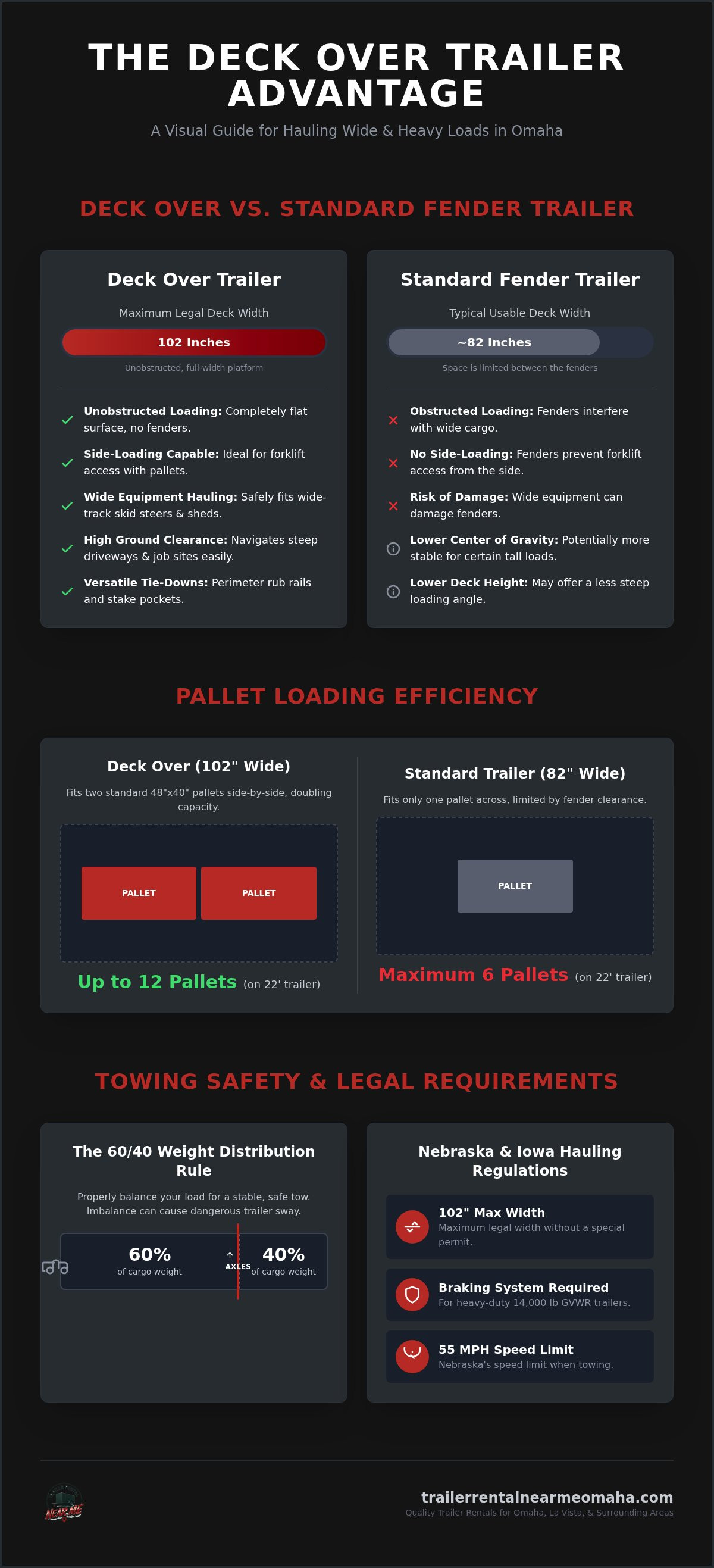
A deck over trailer is defined by its platform placement. While standard trailers tuck the bed between the wheels, a deck over builds the entire loading surface above the tires. It's a design that eliminates interior fenders. This engineering choice results in a completely flat, unobstructed deck that measures 102 inches in width. For contractors and homeowners in the Omaha metro, a deck over trailer rental is often the only way to move cargo that exceeds the narrow 82-inch limit of traditional car haulers.
These trailers are built for heavy-duty work. Most configurations feature a 14,000 lb Gross Vehicle Weight Rating (GVWR), making them suitable for hauling wide-track machinery, industrial pallets, or large sheds. Because the deck is flat, you can load from the rear or the sides. This versatility makes them a staple for transporting bulk materials like hay or construction supplies that require forklift access. You don't have to worry about damaging fenders or maneuvering around wheel wells when placing a load.
The 102-Inch Advantage
The primary reason to choose this design is width. According to Nebraska DMV regulations, 102 inches is the maximum legal width for trailers on public roads without requiring a special wide-load permit. A standard trailer limits your cargo to the space between the fenders, which is typically only 82 inches. By opting for a deck over, you gain 20 inches of critical real estate. This extra room allows you to fit two standard 48-inch pallets side-by-side. It effectively doubles your loading efficiency for palletized freight compared to narrower models.
Anatomy of a Deck Over
Durability starts with the frame. Most high-quality deck overs utilize heavy-duty I-beam construction to support the elevated platform. Unlike other types of semi-trailers or smaller utility models, these units feature rub rails and stake pockets along the entire perimeter. This provides infinite tie-down points for securing irregular loads. You should be aware that the deck height is higher than standard models, usually sitting between 33 and 36 inches off the ground. This elevation requires longer ramps or a tilt deck design to maintain a manageable loading angle for equipment. A deck over is the definitive solution for any oversized cargo that won't fit between traditional trailer fenders.
Top Benefits of the Deck Over Design: Why Width Matters
The deck over design isn't just about size; it's about accessibility. By moving the deck above the wheels, you eliminate the physical barriers that limit most trailers. This configuration offers a completely unobstructed surface from side to side. It's the primary reason professionals choose a deck over trailer rental when logistics get complicated. You don't have to worry about tires rubbing against your cargo or fenders getting crushed by a shifting load.
One often overlooked benefit is ground clearance. Because the deck sits higher, the trailer's frame and axles are less likely to bottom out on steep driveways or unpaved construction sites in Sarpy County. This added height provides peace of mind when navigating the rolling terrain found in Bellevue or Papillion. It's a straightforward solution for getting heavy equipment onto a site without getting hung up on the curb.
Solving the 'Wide Track' Problem
Standard utility trailers usually offer 82 inches between the fenders. This is fine for a small car, but it's a disaster for wide-track skid steers, dual-wheel tractors, or large zero-turn mowers. If your equipment's wheel or track width exceeds 80 inches, you risk damaging both the machinery and the trailer fenders during loading. You shouldn't have to thread a needle just to get your gear to the job site.
The 22ft Tilt Deck Car Trailer eliminates this risk. It provides a massive 102-inch platform, allowing you to drive straight on without millimeter-perfect precision. It's a rugged solution for professional contractors who can't afford downtime due to fender damage or loading delays. It turns a stressful loading process into a quick, one-man job.
Pallet and Material Logistics
Efficiency on the job site often comes down to how quickly you can load and unload. For landscaping and roofing contractors in Omaha, time is money. A 102-inch wide deck allows you to place standard 48x40 pallets side-by-side with room to spare. Since two 48-inch pallets only take up 96 inches of width, you have clearance for the forklift forks to operate safely. On a 22-foot deck over, you can comfortably load up to 12 standard pallets in a single trip, nearly doubling the capacity of a standard hauler.
Side-loading is another game-changer. You don't have to back a forklift into the trailer or slide pallets from the rear. You can pull up alongside the trailer and place materials exactly where they need to go. Every deck over includes stake pockets and rub rails. These features are essential for securing irregular loads like bundles of shingles or nursery stock while following established trailer safety guidelines. If you're planning a complex haul, reviewing our full selection of trailers will help you match the right deck to your cargo requirements.
Deck Over vs. Standard Flatbeds: A Performance Comparison
Choosing between these two designs involves a trade-off between vertical stability and horizontal utility. Standard flatbeds position the deck between the wheels, resulting in a lower center of gravity. This provides excellent stability but limits your cargo width to the narrow space between the fenders. A deck over trailer rental trades that low profile for a massive, unobstructed 102-inch workspace. You gain the ability to load "fender-blind," meaning you don't need the extreme precision required to thread a vehicle between steel wheel wells.
The table below summarizes the key technical differences that affect how these trailers perform on the road and at the job site.
| Feature | Standard Flatbed | Deck Over Trailer |
|---|---|---|
| Usable Deck Width | Typically 82 inches | Full 102 inches |
| Deck Height | 18 to 24 inches | 33 to 36 inches |
| Center of Gravity | Low (More stable) | High (Requires careful loading) |
| Side Loading | Blocked by fenders | Full accessibility |
| Best Use Case | Standard cars and narrow gear | Wide-track machinery and pallets |
Stability and Center of Gravity
Raising the deck naturally raises the center of gravity. This change affects towing dynamics, especially in windy Nebraska conditions. A high-profile load on a deck over can act like a sail during a crosswind. You must compensate by centering the weight over the axles and slowing down. Remember that the general speed limit when towing any trailer in Nebraska is 55 mph. This is particularly critical for deck overs to prevent trailer sway during cornering. If your cargo is heavy but fits within an 82-inch width, a low-profile Flatbed Trailer Rental: Omaha Guide might offer a more stable towing experience for long distances.
Loading Angles and Ramp Requirements
The 33-to-36-inch deck height creates a steeper loading angle than a standard trailer. If you use short ramps, low-clearance equipment like skid steers with attachments can high-center at the top of the incline. To solve this, deck over models often utilize extra-long heavy-duty ramps or a tilt-deck feature. The tilt-deck design allows the entire rear of the trailer to meet the ground, creating a continuous slope. If you're primarily moving standard vehicles, the lower approach of a Car Trailer Rental in Omaha is usually more convenient. However, for wide-track machinery and side-loaded pallets, the deck over remains the superior tool for the job.
Towing Safety: Weight Distribution and Legal Requirements
Safe hauling starts with math. A 14,000 lb GVWR deck over trailer rental isn't just a number; it's a legal limit. You must subtract the trailer's curb weight from that 14,000 lb rating to find your actual payload capacity. For a standard 22-foot model, this usually leaves you with roughly 9,600 lbs of usable capacity. Overloading leads to tire failure and structural stress. Use the 60/40 rule for every load. Place 60% of the cargo weight toward the front half of the deck. This positioning prevents trailer sway, which is the leading cause of towing accidents.
Nebraska and Iowa DOT laws allow for a maximum width of 102 inches. Since a deck over trailer rental maximizes this legal limit, you must be precise when staying within your lane on narrow metro streets. Nebraska law requires any trailer with a gross weight over 3,000 lbs to have its own braking system. Your tow vehicle must have a functional brake controller to manage a 14k load safely. Remember that the general speed limit when towing in Nebraska is 55 mph. This lower speed is critical for maintaining control of high-profile loads.
Check your equipment before you hook up. A 14k trailer requires a Class V receiver and a matching 2-5/16 inch ball. Both must be rated for at least 14,000 lbs. Using a Class IV hitch on a fully loaded heavy-duty trailer is dangerous and violates safety standards. Ensure your safety chains are rated for the load and are properly crossed under the coupler.
Mastering Tongue Weight
Target 10-15% of the total loaded weight on the hitch. If your total weight is 10,000 lbs, you need 1,000 to 1,500 lbs of tongue weight. Look for visual cues to identify problems. Rear-end sag in your truck suggests too much weight is forward. Front-end lift makes your steering feel light and unresponsive. This indicates the load is too far back. Proper balance follows NHTSA safety guidelines and ensures the truck's tires maintain a firm grip on the road during turns and braking.
Local Compliance in the Omaha Metro
Hauling across the metro requires attention to detail. If you're crossing the Mormon Bridge or the South Omaha Bridge into Council Bluffs, double-check your safety chains. Iowa DOT officers often look for proper chain cross-patterns. Within city limits like Papillion, Bellevue, or Ralston, check local ordinances before parking on residential streets. Many Sarpy County municipalities prohibit overnight parking for trailers of this size. Always verify your equipment is street-legal before leaving our La Vista location.
How to Reserve Your Deck Over Rental in Omaha
Securing a deck over trailer rental in the Omaha metro is a straightforward process when you have the right data. Start by confirming your cargo's footprint. If your equipment tracks wider than 82 inches, the 102-inch deck is the correct choice. You also need to verify the total weight of your load. Our 14k trailers are designed for heavy-duty use, but your tow vehicle must be rated to handle the combined weight of the trailer and the cargo. Check your truck's door jamb sticker for the Gross Combined Weight Rating (GCWR). You'll need a Class IV or V hitch. Most half-ton trucks reach their limit quickly in this category; a 3/4-ton or 1-ton pickup is typically required for a fully loaded 14,000 lb trailer. You can browse our current Trailer Rental Near Me listings to see real-time availability for our heavy-duty fleet. Our online booking system allows you to select daily, weekly, or monthly rates with just a few clicks.
What to Bring for Pickup
Preparation ensures a smooth handoff at our La Vista facility. You must provide a valid driver's license and proof of insurance for the tow vehicle at the time of pickup. Your vehicle must be equipped with specific hardware to handle our 22'x102 14k Tilt Deck Car Hauler Rental. We require the following setup:
- A 2-5/16 inch ball rated for at least 14,000 lbs.
- A functional 7-way round electrical plug for lights and brakes.
- An on-board brake controller to manage the trailer's stopping power.
Plan for a 15-minute safety orientation when you arrive. Our team provides hook-up assistance and will walk you through the tilt mechanism and tie-down points. We want you to feel confident before you head out toward Papillion or Bellevue with a wide load.
Flexible Rental Options for Professionals
Owning a specialized 102-inch trailer involves high upfront costs and ongoing maintenance. For many Omaha-based contractors, renting is more cost-effective for specific one-off wide hauls. You get access to well-maintained, late-model equipment without the storage headache or the need for annual inspections. This flexibility allows you to scale your capabilities based on the job at hand. Whether you're moving a shed in Gretna or a wide-track skid steer in Council Bluffs, we provide the rugged gear you need to finish the task. Our goal is to be your practical partner in local logistics.
Master Your Next Wide Load in Omaha
Navigating the technical requirements and legal standards of 2026 hauling ensures your project stays on schedule and within budget. You're now equipped to handle wide-track machinery and palletized logistics without the common pitfalls of fender interference. Choosing the right deck over trailer rental is the final step in turning a complex transport into a routine task. By prioritizing proper weight distribution and respecting local regulations, you protect your cargo and your tow vehicle.
Our La Vista facility serves the entire metro area, providing rugged equipment that's ready for immediate use. We're committed to offering reliable tools that meet the demands of professional contractors and DIY enthusiasts alike. Whether you're hauling across the Mormon Bridge or through the streets of Papillion, our fleet is built to deliver peace of mind and functional value on every mile of the road.
We're here to help you finish your project with confidence. Please contact Trailer Rental Near Me for questions or reservations to secure your equipment today.
Frequently Asked Questions
Do I need a CDL to rent a 14k deck over trailer in Nebraska?
You generally don't need a CDL if your Gross Combined Weight Rating (GCWR) stays under 26,001 lbs. Most 3/4-ton trucks paired with a 14k deck over trailer rental fall below this threshold. However, if your combined GVWR exceeds 26,000 lbs for commercial purposes, federal and Nebraska state laws may require a Class A CDL. Always verify your truck's specific weight ratings on the door jamb sticker before hooking up.
What is the maximum width I can haul without a permit in Omaha?
The maximum legal width for hauling without a permit in Omaha and across Nebraska is 102 inches. This matches the exact width of a deck over trailer. If your cargo extends even one inch beyond the trailer's rub rails, you're required to obtain a wide-load permit from the Nebraska DOT. This width limit ensures you can safely navigate standard 12-foot highway lanes on I-80 or local metro streets.
Can I load a car on a deck over trailer?
You can load a car on a deck over trailer, but you must account for the steeper loading angle. Because the deck sits 33 to 36 inches high, low-profile cars may scrape their bumpers or undercarriages on standard ramps. Using a tilt-deck model or extra-long ramps is essential for safe clearance. This design is better suited for trucks, SUVs, and wide-track machinery than for sports cars or low-clearance sedans.
How much does it cost to rent a deck over trailer for a day?
Rental rates depend on the specific trailer model and the length of your rental period. We offer flexible daily, weekly, and monthly options to fit both short-term DIY projects and long-term commercial contracts. You can view our current real-time availability and booking options through our online portal. Renting a specialized trailer is often more economical than paying for maintenance, storage, and annual inspections on a trailer you only use occasionally.
What size hitch ball is required for a 14k deck over rental?
A 2-5/16 inch hitch ball is required for all 14k deck over rentals. You must ensure the ball and the ball mount are both stamped with a weight rating of at least 14,000 lbs. Using a smaller 2-inch ball or a lower-rated mount is a major safety violation and will prevent you from securing the coupler. We recommend a Class V receiver for the best performance and safety when hauling heavy loads.
Is a brake controller required for towing a deck over trailer?
Yes, a functional electric brake controller is required in your tow vehicle. Nebraska law mandates that any trailer with a gross weight over 3,000 lbs must have its own braking system. Since our deck over trailers are rated for 14,000 lbs, you cannot safely or legally tow them without a controller. This device allows you to adjust the trailer's braking force, which is critical for stopping safely in heavy Omaha traffic.
What is the difference between a deck over and a deck between trailer?
The main difference is the location of the loading surface relative to the wheels. A deck over trailer rental positions the platform above the tires to provide a flat 102-inch width. A "deck between" or standard flatbed places the deck between the wheels, limiting width to about 82 inches. While a deck between trailer offers a lower center of gravity, it forces you to work around protruding fenders that can obstruct wide cargo.
Can I rent a deck over trailer for one-way hauling from Council Bluffs?
We specialize in local rentals that start and end at our La Vista facility. This allows us to maintain high equipment standards and offer competitive rates for the Omaha metro area. While we don't offer one-way rentals to distant cities, our trailers are perfect for regional hauls across Council Bluffs, Bellevue, and Papillion. You'll need to plan for a round-trip return when scheduling your rental with us.

Article by
Chuck Crom
Chuck Crom is the owner of Trailer Rental Near Me, serving Omaha, La Vista, Papillion, Bellevue, Gretna, Elkhorn, and the surrounding Nebraska and western Iowa communities. With years of hands-on experience towing, hauling, and helping customers choose the right trailer for the job, Chuck specializes in making trailer rentals simple, safe, and stress-free.
He writes practical, no-nonsense articles covering trailer safety, towing tips, weight ratings, loading techniques, equipment transport, landscaping projects, home renovations, vehicle hauling, and everything in between. His goal is to help renters avoid common mistakes, stay safe on the road, and get their projects done with confidence.
When he's not helping customers or creating educational content, Chuck is focused on growing a locally owned business built on honest advice, quality equipment, and exceptional customer service.


