
The trim badge on your truck's tailgate won't tell you if your rig can safely handle a heavy tilt-deck hauler. Drivers frequently ask, "What size truck do I need to pull a 14k car trailer?" hoping for a simple answer like a half-ton or three-quarter-ton pickup. In reality, relying on generic vehicle classes is an easy way to burn out a transmission, sag your rear suspension, or run into legal trouble. You already know the headline tow ratings in glossy manufacturer brochures rarely match the actual payload limits stamped on your driver-side door jamb.
Safe towing requires verified mechanical data, not guesswork. In this guide, you'll learn how to calculate your truck's exact towing capacity, door-jamb payload limits, and hitch receiver requirements to safely haul a 14,000-lb car trailer. We will break down the essential math behind GVWR, GCWR, and tongue weight, while reviewing Nebraska and Iowa brake and licensing rules so you can hit the road with complete confidence in your setup.
Key Takeaways
- Determining what size truck do I need to pull a 14k car trailer requires inspecting specific door-jamb stickers rather than trusting generic truck class labels.
- Safe hauling demands cross-referencing four distinct mechanical metrics: manufacturer tow ratings, Gross Combined Weight Rating (GCWR), available vehicle payload, and hitch receiver class.
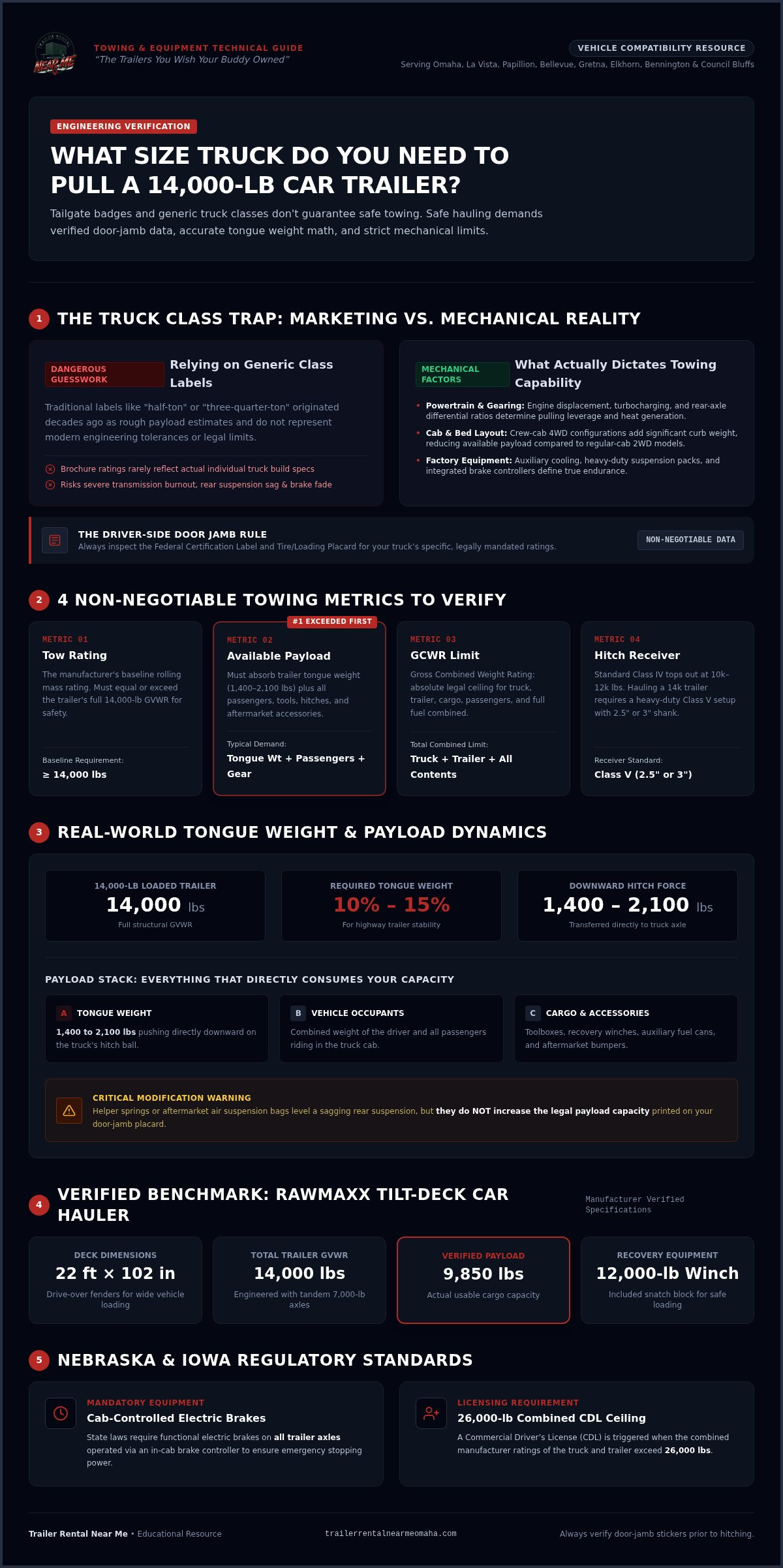
- Trailer tongue weight eats up 10% to 15% of your total loaded weight, directly reducing the payload capacity remaining for passengers and gear inside your truck.
- Nebraska and Iowa state regulations require functional cab-controlled electric brakes on all trailer axles and mandate a CDL if your truck and trailer combination ratings cross 26,000 lbs.
- Matching your truck configuration to a 22ft x 102in tilt-deck trailer with a 9,850-lb payload capacity simplifies loading low-clearance vehicles safely using an integrated 12,000-lb winch.
The 14K GVWR Calculation: Why Truck Classes Don't Tell the Whole Story
Drivers asking, "What size truck do I need to pull a 14k car trailer?" often expect a simple class badge like "three-quarter-ton" or "one-ton" as the answer. That assumption creates serious mechanical risk on the road. Traditional truck classes originated decades ago as payload estimates and no longer represent modern engineering limits. Towing capability depends entirely on your specific vehicle configuration, manufacturer tow ratings, rear-axle ratios, and curb weights, not a generalized marketing label.
Understanding 14,000-lb Gross Vehicle Weight Rating
A trailer's Gross Vehicle Weight Rating (GVWR) defines the maximum operating mass mandated by the manufacturer. This number includes the weight of the trailer frame plus the cargo resting on the deck. Tandem 7,000-lb axles establish that 14,000-lb structural ceiling. Pulling an empty trailer down the highway creates relatively light rolling resistance, but loading full-sized work trucks or project vehicles pushes the rig toward its structural limit. Safe towing demands verifying that your truck can handle this total rolling mass under sudden braking and incline stresses.
Why General Truck Classes Cannot Guarantee Safe Towing
Broad vehicle categories never guarantee safe or legal towing. Two trucks bearing identical model badges can have vastly different capabilities based on their build specifications. Tow ratings swing drastically based on specific factors:
- Powertrain and gearing: Engine displacement, turbocharging, and rear-axle differential ratios directly dictate pulling leverage and transmission heat buildup.
- Cab and bed layout: A crew-cab four-wheel-drive model weighs significantly more than a regular-cab two-wheel-drive version, reducing available towing margin.
- Factory equipment packages: Heavy-duty auxiliary cooling, upgraded suspension packs, and integrated brake controllers determine real-world endurance.
Before booking a heavy-duty tilt-deck car trailer rental, skip the sales brochure. Check the federal certification label and the tire loading placard on your driver-side door jamb. Those stickers list the non-negotiable payload and axle ratings engineered for your specific vehicle configuration.
Critical Truck Ratings: Evaluating GVWR, GCWR, Payload, and Hitch Capacity
Four primary engineering ratings determine whether your truck can haul a tandem-axle trailer safely: manufacturer tow rating, payload capacity, Gross Combined Weight Rating (GCWR), and hitch receiver classification. When planning your haul and asking yourself, "What size truck do I need to pull a 14k car trailer?" payload is almost always the metric that gets exceeded first. Horsepower rarely limits modern pickups. Downward tongue weight and legal weight ceilings cause real problems.
Calculating Tongue Weight Against Truck Payload
Stable bumper-pull trailers require 10% to 15% of their total loaded mass resting directly on the hitch ball. If you pull a fully loaded 14,000-lb trailer, the tongue transfers between 1,400 and 2,100 lbs of downward force onto your vehicle's rear axle. This direct downward mass counts entirely against your truck's available payload capacity.
Payload includes everything added to the bare truck after leaving the factory floor:
- Vehicle occupants: The combined weight of the driver and every passenger in the cab.
- Bed cargo and accessories: Toolboxes, winching recovery gear, aftermarket bumpers, and fuel cans.
- Trailer tongue weight: The 1,400 to 2,100 lbs pushing down on the hitch ball.
Installing aftermarket helper springs or air suspension bags will level a sagging rear end, but these modifications do not increase the legal payload capacity printed on your vehicle placard.
GCWR Limits and Hitch Receiver Classifications
Your vehicle's GCWR specifies the absolute ceiling for the truck, the trailer, all passengers, and full fuel tanks combined. Exceeding this figure strains drivelines, overheats transmissions, and creates massive brake fade on long descents.
Hardware ratings must also match the load. A standard Class IV hitch tops out at 10,000 to 12,000 lbs with conventional ball setups. Towing up to a 14,000-lb rating demands a heavy-duty Class V receiver using a 2.5-inch or 3-inch shank. A weight-distribution hitch is frequently required to distribute vertical tongue weight forward onto the truck's front steering axle.
Review our well-maintained rental equipment to inspect factory tag ratings and confirm the right trailer match for your vehicle build.
Real-World Tongue Weight and Loading Dynamics for 14K Car Trailers
Eyeballing your truck's rear bumper to see if it sags is not a loading strategy. An unmeasured setup turns highway towing into a dangerous liability. Proper weight placement keeps the trailer tracking straight, whereas shifting too much cargo behind the trailer axles induces violent fishtailing at speed. Solving the question of what size truck do I need to pull a 14k car trailer means balancing actual scale weight, not just theoretical maximums.
Step-by-Step Tow Vehicle Compatibility Verification
Run through this four-step checklist before backing up to the coupler:
- Step 1: Check door-jamb capacities. Locate the Tire and Loading Information placard to pull the exact available payload and Gross Axle Weight Ratings (GAWR).
- Step 2: Check powertrain limits. Confirm your vehicle's specific engine, cab layout, and axle ratio ratings in the factory towing guide.
- Step 3: Calculate gross trailer weight. Add the trailer curb weight to the verified weight of the vehicle or machinery you plan to haul. Do not assume you are hauling 14,000 lbs if your actual combined rolling load is only 8,500 lbs.
- Step 4: Inspect the hitch hardware. Match your receiver class, ball mount drop, and 2-5/16-inch hitch ball stamping to the total gross weight.
Trailer Brakes, Tires, and Nebraska Road Safety
Nebraska and Iowa state statutes require trailers with a gross weight exceeding 3,000 lbs to have functional braking systems on all wheels. Tandem-axle 14k trailers must be paired with an operational in-cab proportional brake controller. This unit synchronizes your truck's brake pedal with the trailer's electric drum brakes, preventing the trailer from pushing the truck during abrupt stops. Both states also mandate dual safety chains crossed under the tongue and an operational emergency breakaway switch with an onboard battery.
Cold tire inflation dictates load carrying strength. Check the sidewall PSI ratings on both your truck and trailer tires before leaving the staging area. Underinflated tires generate destructive internal heat under heavy loads, increasing blowout risks on interstate pavement.
Matching Your Truck Setup to a 14,000-lb Tilt Deck Car Hauler
Renting a tilt-deck trailer eliminates the hazards of steep loading ramps, especially when moving low-profile sports cars or heavy work trucks. Answering what size truck do I need to pull a 14k car trailer ensures your truck chassis and hitch can safely control both the trailer tare weight and your intended cargo. Matching an adequately rated tow rig with dedicated hauling equipment prevents road sway and equipment strain.
RawMaxx 22ft Tilt Deck Performance Specifications
The 22'x102 14k tilt deck car hauler rental delivers heavy-duty commercial utility for demanding transport jobs. Engineered with a 14,000-lb GVWR across tandem axles with electric brakes, this platform provides a verified 9,850-lb payload capacity. That structural threshold accommodates heavy-duty pickups, farm implements, and project chassis without exceeding axle limits.
A full 102-inch deck width features heavy-duty drive-over fenders, allowing wide-track off-road rigs and dual-rear-wheel trucks to load flat. The hydraulic dampening tilt deck creates a gradual approach angle, removing the need for traditional steel ramps that bend, slip, or scrape low-clearance front splitters.
Securing Vehicles and Renting Locally in Omaha
Safe transport requires balanced weight and industrial-grade tie-down equipment. Always anchor loaded cargo using a four-point tie-down setup, securing each vehicle corner with heavy-duty axle straps attached to integrated deck D-rings. Crossing your rear straps adds lateral stability against road vibration and sudden swerves.
Loading disabled vehicles requires controlled power. The trailer includes an integrated 12,000-lb winch with a snatch block and heavy-duty battery system, letting you manage non-running vehicle recoveries smoothly without sudden shock loads.
Trailer Rental Near Me operates as a dependable local partner serving Omaha, Bellevue, Papillion, La Vista, Gretna, and Council Bluffs. Matching your specific vehicle configuration to our equipment gives you the capability to handle challenging hauls with complete confidence. Check your door-jamb numbers, secure your tie-downs, and pull out with "The Trailers You Wish Your Buddy Owned."
Verify Your Truck Specs and Haul with Confidence
Determining what size truck do I need to pull a 14k car trailer comes down to cold numbers on your door jamb, not marketing badges. Check your vehicle's payload capacity to support 1,400 to 2,100 lbs of tongue weight, confirm your Class V hitch hardware, and verify your GCWR limits before loading up. When your truck configuration checks out, pairing it with the right equipment makes every haul straightforward.
Trailer Rental Near Me provides locally maintained RawMaxx 22ft x 102in tilt-deck car haulers built for tough tasks across Omaha, La Vista, Papillion, Bellevue, and Council Bluffs. With a 14,000-lb GVWR, a verified 9,850-lb payload capacity, drive-over fenders, and an onboard 12,000-lb winch with a snatch block, you get the dependable platform required for secure transport.
Get your payload math dialed in, hitch up safely, and hit the highway with the trailers you wish your buddy owned.
Frequently Asked Questions
Can a half-ton truck legally tow a 14,000-lb car trailer?
No broad vehicle category is automatically cleared to tow a 14,000-lb trailer. Towing suitability never depends on half-ton or three-quarter-ton badges. Instead, it relies on your specific vehicle configuration, manufacturer tow rating, rear-axle ratio, and door-jamb payload limits. While an empty trailer might weigh within a lighter truck's pulling limits, a fully loaded 14k trailer exceeds the payload and towing capacities of virtually every standard light-duty pickup on the road.
How do I find my truck's exact towing capacity instead of brochure estimates?
Check the federal certification label and the Tire and Loading Information placard located on your driver-side door jamb. These tags display your exact Gross Vehicle Weight Rating (GVWR) and maximum payload capacity for that specific chassis. Cross-reference your truck's VIN, engine, axle ratio, and cab configuration in the manufacturer towing guide to identify your exact Gross Combined Weight Rating (GCWR) and rated bumper-pull capacity.
What happens if a trailer's GVWR exceeds my truck's tow rating when empty?
Law enforcement and transportation officers generally evaluate actual scale weight during non-commercial roadside checks, provided your vehicle's registered capacity isn't exceeded. However, if your truck isn't rated to pull 14,000 lbs, you can only tow that trailer while the actual combined mass of the trailer and cargo stays below your vehicle tow rating. Exceeding your truck's mechanical limits creates serious liability if an accident occurs.
Do I need a commercial driver's license (CDL) to tow a 14k trailer in Nebraska?
In Nebraska and Iowa, private drivers don't need a CDL for personal hauling unless the Gross Combination Weight Rating exceeds 26,000 lbs. Because our tilt-deck trailer carries a 14,000-lb GVWR, pairing it with a truck rated at 12,001 lbs GVWR or higher pushes the combination into Class A CDL territory. Always calculate the combined GVWR of both vehicles to ensure you remain fully compliant on roads around Omaha and Council Bluffs.
What size hitch ball and receiver do I need for a 14,000-lb trailer?
A 14k trailer requires a heavy-duty Class V hitch receiver paired with a 2-5/16-inch hitch ball stamped for at least 14,000 lbs. Standard Class IV receivers and 2-inch balls aren't rated to safely handle that mass. Ensure your ball mount shank, hitch pin, and receiver tube match the total loaded weight of the trailer to prevent hardware failure when pulling heavy machinery across the Omaha metro area.
Why is vehicle payload capacity more restrictive than maximum towing capacity?
Asking what size truck do I need to pull a 14k car trailer usually leads drivers straight to tow ratings, but payload runs out first. A 14,000-lb trailer exerts 1,400 to 2,100 lbs of tongue weight directly onto the truck hitch. That downward vertical force eats directly into your door-jamb payload limit, leaving minimal room for the driver, passengers, aftermarket accessories, or tools stored inside the pickup bed.

Article by
Chuck Crom
Chuck Crom is the owner of Trailer Rental Near Me, serving Omaha, La Vista, Papillion, Bellevue, Gretna, Elkhorn, and the surrounding Nebraska and western Iowa communities. With years of hands-on experience towing, hauling, and helping customers choose the right trailer for the job, Chuck specializes in making trailer rentals simple, safe, and stress-free.
He writes practical, no-nonsense articles covering trailer safety, towing tips, weight ratings, loading techniques, equipment transport, landscaping projects, home renovations, vehicle hauling, and everything in between. His goal is to help renters avoid common mistakes, stay safe on the road, and get their projects done with confidence.
When he's not helping customers or creating educational content, Chuck is focused on growing a locally owned business built on honest advice, quality equipment, and exceptional customer service.


