
Would you bet your transmission and your safety on a gut feeling about towing capacity? Many people do, only to find themselves sidelined on I-80 with a broken hitch or a fine from a Nebraska state trooper. It's easy to feel overwhelmed by technical specs when you're looking for tra rentals in the Omaha area. Fear of damaging a rental or violating local laws is a real hurdle for many DIYers and local contractors.
We understand that hesitation. Whether you're hauling equipment in La Vista or clearing a lot in Papillion, you need gear that works and information you can trust. This guide separates fact from fiction to ensure your next project in the Omaha metro is safe and cost-effective. We'll debunk common misconceptions about towing to give you peace of mind before you hit the road.
We'll examine the reality of towing laws in Nebraska and Iowa, clarify payload limits, and help you identify the specific trailer type your project requires. From dump trailers to car haulers, you'll learn to navigate the 2026 regulatory landscape with confidence. You'll finish this guide knowing how to avoid legal issues and where to find a reliable local equipment source.
Key Takeaways
- Identify the right equipment for your specific job by understanding the diverse options available for tra rentals in the Omaha metro area.
- Protect your vehicle and transmission by learning why a truck's tow rating is not the only number that matters when hauling heavy loads.
- Save money on large projects by evaluating the flexibility and on-site benefits of a dump trailer rental over traditional junk removal services.
- Stay compliant with Nebraska and Iowa laws by treating 10k and 14k weight ratings as hard mechanical and legal limits.
- Streamline your loading process by selecting trailers equipped with specialized tools like high-capacity winches and tilt-deck technology.
Understanding "Tra Rentals" and the Omaha Hauling Landscape
Search habits often dictate your results. Many people type tra rentals into their phones when they need to move a car or clear a yard. This shorthand is convenient; however, it often pulls up irrelevant data. You might see listings for commercial semi-trailer leases or real estate agencies. In the context of local equipment hauling, a trailer is simply an unpowered vehicle towed by another. For residents in the Omaha metro, finding the right equipment means looking past the shorthand to find specific utility, dump, or car-hauler tools.
The landscape of tra rentals in Omaha is diverse. It ranges from small utility units for weekend projects to heavy-duty tilt decks for professional contractors. Matching the trailer type to your specific project goals in La Vista or Papillion is critical for safety. Using the wrong equipment increases the risk of vehicle damage or accidents on the road. You need a tool that fits the weight and dimensions of your cargo perfectly.
Common Trailer Categories for Local Projects
Choosing the right tool is the first step toward a safe tow. The Omaha landscape offers several distinct options for homeowners and contractors. Each category serves a specific purpose:
- Dump Trailers: These are designed for residential debris and landscaping materials. A 7x12 RawMax 10k dump trailer is a standard choice for roofers in Bellevue or homeowners in Papillion clearing out a garage.
- Tilt-Deck Car Haulers: These are essential for low-clearance vehicles and heavy machinery. A 22'x102 14k tilt deck removes the need for heavy ramps. This makes loading safer and faster for a single operator.
- Utility Trailers: Best for general hauling and quick home improvement runs. These are the workhorses for moving lawn equipment, ATVs, or bulk lumber from the hardware store.
Why Local Omaha Expertise Matters
Towing in Eastern Nebraska isn't like towing on a flat desert highway. You have to account for the rolling hills and unpredictable weather. A local business understands the terrain in Gretna and Elkhorn. They know that a trailer designed for a flat parking lot might struggle on a steep residential driveway in Omaha. Local expertise ensures you get equipment that can handle the specific geography of the Missouri River valley.
Local experts also distinguish between residential and commercial needs. A weekend DIY project has different requirements than a professional construction site. Renting from a locally owned business ensures the equipment is maintained for these specific regional conditions. It provides peace of mind that the gear is ready for the task at hand. You aren't just getting a trailer; you're getting equipment that's been vetted for Nebraska roads.
Myth #1: Any Pickup Truck Can Tow Any Rental Trailer
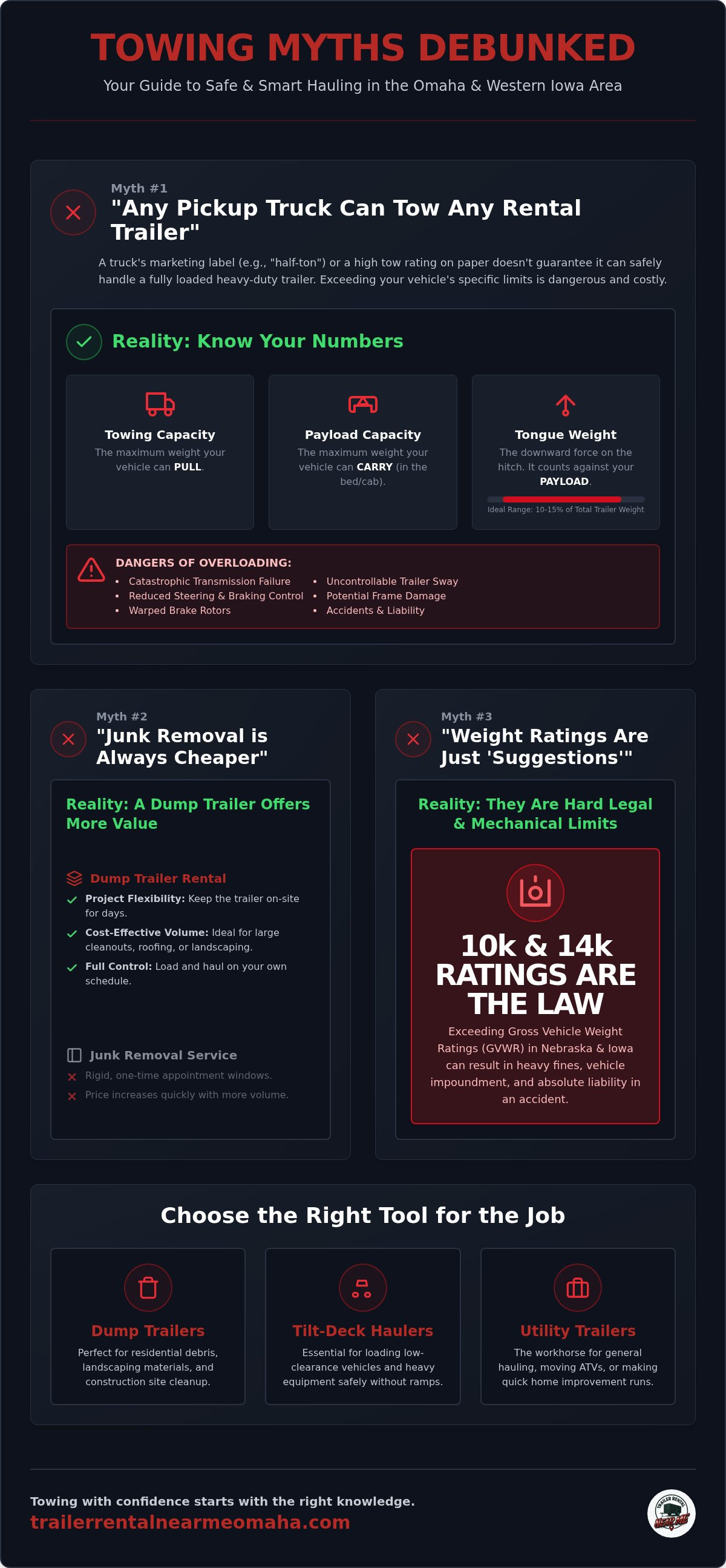
Many drivers assume that having a hitch and a "half-ton" label on their truck means they can pull any trailer on the lot. This is a dangerous misconception. A standard F-150 or Silverado 1500 might have a high towing capacity on paper, but that doesn't mean it can safely manage a fully loaded 22'x102 14k tilt deck. When browsing tra rentals in the Omaha area, you must look at your vehicle's specific limits rather than general marketing claims. Overloading your truck leads to catastrophic transmission failure, warped brake rotors, and potential frame damage.
The critical factor most people miss is the difference between towing capacity and payload capacity. Towing is what your truck can pull; payload is what it can carry. Your truck's rear axle and hitch have strict weight limits. Exceeding these causes the front end of your truck to lift. This reduces your steering control and makes braking unpredictable. Many homeowners start by comparing junk removal and dumpster rental services before deciding to handle the haul themselves. If you choose the DIY path, your first task is verifying your truck's mechanical limits.
Tongue weight is another vital metric. This is the downward pressure the trailer coupler exerts on your hitch ball. It should typically be 10% to 15% of the total loaded trailer weight. Too little tongue weight causes the trailer to sway dangerously at highway speeds. Too much tongue weight squats the rear of the truck, which compromises your suspension. Before you reserve any tra rentals, ensure your truck's payload can handle the tongue weight plus the weight of your passengers and gear.
Calculating Your Real Towing Capacity
Don't rely on the owner's manual for your specific truck's limits. Open the driver-side door and find the tire and loading information sticker. Look for the Gross Combined Weight Rating (GCWR). This is the maximum allowable weight of your truck, the trailer, and everything inside both. To find your actual capacity, subtract the weight of your truck, a full tank of fuel, all passengers, and any tools in the bed from the GCWR. GVWR is the maximum legal weight of the trailer itself plus the maximum load it can safely carry.
Hitch and Receiver Essentials
Your hitch receiver has its own rating that might be lower than your truck's tow rating. A Class III hitch is usually limited to 5,000 lbs. For heavier Omaha hauls involving 10k or 14k trailers, you need a Class IV or Class V receiver. You should also use a weight-distribution hitch for loads exceeding 5,000 lbs to keep the truck level. Finally, verify your ball size. Most heavy-duty trailers require a 2-5/16" ball. Using a 2" ball on a larger coupler is a major safety violation and will likely result in the trailer detaching. Before you book, review our available trailer inventory to see which unit fits your vehicle's specs.
Myth #2: Junk Removal is Always Cheaper Than a Dump Trailer Rental
Many homeowners and contractors see a flat-fee advertisement for junk removal and assume it's the most economical choice. For a few old chairs, it might be. However, for a full-scale renovation or landscaping overhaul, the math shifts quickly. A dump trailer rental offers a level of flexibility that per-load services cannot match. You have the equipment on-site for the duration of your project. This eliminates the stress of coordinating pickups and allows you to clear debris as it's generated.
There's also a persistent myth that renting heavy-duty equipment for tra rentals requires a Commercial Driver's License (CDL). In Nebraska and Iowa, you don't need a CDL for standard 10k or 14k trailers as long as your total Gross Combination Weight Rating stays under 26,001 pounds. This means a standard pickup truck and a 7x12 dump trailer are perfectly legal for the average driver. You get professional-grade hauling capacity without the regulatory hurdles of commercial logistics.
Cost-Benefit Analysis for Omaha Homeowners
The primary advantage of a rental is labor control. Junk removal crews charge for their time and the space your items occupy in their truck. By loading the trailer yourself, you save on those hourly labor costs. A 7x12 dump trailer provides a massive volume for bulky items, often outperforming the "per-load" capacity of residential haulers. This is especially true for heavy materials like shingles or concrete. For more details on these benefits, read our guide on Dump Trailer Rental in La Vista NE: Heavy-Duty 7x12 Solutions.
Managing Construction Debris Legally
Operating a trailer in the Omaha metro involves following specific local and state regulations. Nebraska law requires all loads to be secured against shifting or falling. This means tarps are mandatory when you're driving on highways like I-80 or the Kennedy Freeway. Spilling debris isn't just a safety hazard; it's a legal liability that leads to heavy fines. You must also be aware of tipping fees at facilities like the River City Transfer Station. These fees vary based on the type of waste, such as municipal solid waste versus construction debris. Never over-fill the trailer. Keep the load level with the sides to ensure the hydraulic lift functions correctly and the load remains stable during transit.
Myth #3: Trailer Weight Ratings are Just "Suggestions"
Some drivers believe that if their truck can physically pull the load, they're within the safety margin. This is a dangerous lie. In the world of tra rentals, weight ratings like 10,000 lbs (10k) or 14,000 lbs (14k) are hard mechanical and legal limits. These numbers represent the Gross Vehicle Weight Rating (GVWR), which is the maximum weight of the trailer plus its cargo. Exceeding these limits creates a liability that outweighs any potential time savings. Physics doesn't care about your schedule; it only cares about the structural integrity of the axles, tires, and frame.
Mechanical failure is the immediate risk of overloading. Trailer tires are engineered for specific load ranges. When you exceed those ranges, the sidewalls generate excessive heat, leading to a high-speed blowout. Similarly, trailer brakes are sized to stop a specific maximum weight. An overweight trailer will push your truck through intersections, even with the pedal floored. If you're crossing the Nebraska and Iowa border region, you're also inviting legal trouble. State troopers in Omaha and Council Bluffs look for sagging suspensions and bulging tires as probable cause for a roadside inspection. You'll face steep fines and may be forced to leave your trailer on the shoulder until a second vehicle arrives to split the load.
Understanding the 10k vs. 14k Threshold
Hauling a heavy load requires more than just a big engine. A 22ft 14k tilt deck car hauler requires specific tow vehicle specs to remain safe on a descent. When you're coming down the hills near Gretna or Elkhorn, the weight of a 14,000 lb load exerts massive force on your truck's braking system. You need a 3/4-ton or 1-ton truck with an integrated brake controller to manage that energy. It's also vital to understand that exceeding the GVWR can void your insurance policy in the event of an accident. If an investigator determines you were overweight, you could be held personally liable for all damages and injuries.
Nebraska DOT and FMCSA Safety Standards
Nebraska and Iowa laws are clear about trailer safety. Any trailer with a loaded weight exceeding 3,000 lbs must have a functional, independent braking system. This isn't a suggestion; it's a requirement for the safety of everyone on the road. High-quality tra rentals should always include electric brakes and a breakaway chain system. The breakaway system is designed to lock the trailer brakes if the hitch fails and the trailer detaches from the truck. Always reference the Nebraska DMV for local laws regarding safety chains and lighting. You must have functional taillights, brake lights, and turn signals to remain compliant with FMCSA standards during any haul.
Securing Your Selection: How to Rent the Right Equipment
Choosing the right gear for tra rentals doesn't have to be a guessing game. It starts with a clear project timeline and a firm understanding of your cargo's dimensions. Using a trailer rental schedule allows you to reserve the specific unit you need before your project starts. This is especially important for contractors in Bellevue or homeowners in Omaha who need to coordinate equipment pickups with material deliveries or site access. Planning ahead ensures you aren't stuck with a trailer that's too small or lacks the necessary features for a safe haul.
Specialized equipment provides a level of safety that standard utility trailers can't match. For example, our units include 12,000lb winches and heavy-duty tie-downs. These tools aren't just conveniences; they're essential for securing heavy machinery or non-running vehicles. Having the right securement gear on hand means you don't have to make extra trips to the hardware store. It allows you to focus on the task at hand with the confidence that your load is locked down according to FMCSA standards.
On the day of your rental, follow a strict utilitarian checklist to avoid delays. Verify your hitch ball size matches the trailer coupler, which is typically 2-5/16" for our 10k and 14k units. Inspect your 7-way plug to ensure the electric brakes and lights function perfectly. Finally, verify that your insurance policy extends liability coverage to a towed unit. This simple preparation prevents most common roadside issues and keeps you compliant with Nebraska DOT regulations.
The Tilt-Deck Advantage for Car Hauling
Traditional ramps can be dangerous, especially for low-clearance vehicles or in wet weather. A tilt-deck trailer solves this by allowing the entire bed to pivot to the ground. This creates a continuous, low-angle surface that eliminates the risk of a vehicle slipping off a narrow ramp. If you're moving a vehicle that doesn't run, the integrated 12,000lb winch is your primary tool. It allows for a controlled, steady pull that keeps the vehicle centered and stable. For a deeper look at these technical requirements, see our Car Trailer Rental Omaha: Your 2026 Buying & Hauling Guide.
Booking Your Rental in La Vista
We've designed our booking process to be frictionless for local contractors and DIY enthusiasts. Unlike corporate fleet services that require complex account applications, we focus on straightforward transactions that value your time. When you arrive at our La Vista location, have your valid driver's license and proof of insurance ready. Ensure your tow vehicle is equipped with a functional brake controller, as this is required for all trailers over 3,000 lbs in Nebraska and Iowa. If you have questions about specific equipment capabilities or local hauling requirements, contact the local experts at Trailer Rental Near Me to finalize your reservation.
Take Command of Your Next Omaha Haul
Successful hauling in the Omaha metro depends on facts rather than assumptions. You now understand that vehicle towing capacity and trailer weight ratings are mechanical realities that dictate your safety on the road. Whether you're clearing a site in Papillion or transporting a vehicle through Bellevue, choosing the right equipment is the first step toward a stress-free project. Moving past the shorthand of tra rentals allows you to focus on the specific technical needs of your cargo.
Trailer Rental Near Me provides the heavy-duty 10k and 14k rated equipment you need to get the job done right. We're locally owned and operated in La Vista, offering well-maintained trailers that meet the demands of Nebraska and Iowa roads. With our online booking system and flexible rental periods, you can secure professional-grade tools on your own schedule. Don't let myths compromise your safety or your budget.
We're here to support your next project with reliable gear and local expertise. Take the guesswork out of your logistics and get back to work with confidence.
Frequently Asked Questions
Do I need a special license for a 14k trailer rental in Nebraska?
You don't need a Commercial Driver's License (CDL) in Nebraska for a 14k trailer rental in most cases. A CDL is only required if your Gross Combination Weight Rating (GCWR) is 26,001 pounds or more. For most pickup trucks and 14k trailer combinations, you'll remain well under this federal and state threshold. Always verify your truck's GCWR on the door jamb to ensure you stay within legal non-commercial limits while using tra rentals.
Can I tow a dump trailer with a standard SUV?
Most standard SUVs cannot safely tow a 10k dump trailer. Standard SUVs are typically rated for 5,000 pounds or less. A 7x12 10k dump trailer has a significant curb weight even when empty. Attempting this tow will likely damage your transmission and suspension. You need a 3/4-ton or 1-ton truck to manage the weight and the tongue pressure of a fully loaded dump unit in the Omaha metro.
What is the difference between a tilt-deck and a ramp trailer?
A tilt-deck trailer allows the entire bed to pivot to the ground for loading. This creates a low-angle incline that is safer for low-clearance vehicles. A ramp trailer uses separate metal or wood ramps that you must manually position and secure. Tilt-decks are generally preferred for single-operator use because they eliminate the heavy lifting and potential instability of traditional ramps. They are ideal for moving machinery in La Vista or Papillion.
Are winches included with car hauler rentals in Omaha?
Yes, our car hauler rentals in the Omaha area include 12,000lb winches and tie-downs. These tools are essential for securing non-running vehicles or heavy equipment safely. Having a high-capacity winch included ensures you can load your cargo without needing extra help or additional equipment. We provide these features to ensure your haul is professional and secure from the moment you leave our La Vista location.
How do I calculate the payload for a 10k dump trailer?
To calculate payload, subtract the trailer's curb weight from its Gross Vehicle Weight Rating (GVWR). For a 10k dump trailer, the GVWR is 10,000 pounds. If the empty trailer weighs 3,500 pounds, your available payload is 6,500 pounds. This total must include all debris, tools, and materials you place inside. Never guess your load weight; use local Omaha transfer station scales to verify you are within legal mechanical limits for your tra rentals.
What happens if I exceed the trailers weight capacity?
Exceeding the weight capacity leads to immediate mechanical risks and legal penalties. Overloading causes excessive heat in tires, which often results in high-speed blowouts. It also compromises the trailer's braking distance. In the Nebraska and Iowa border region, state troopers look for signs of overweight loads. You may face significant fines and be forced to unload cargo on the shoulder of I-80 before you are allowed to continue your trip.
Does Nebraska law require trailer brakes for all rentals?
Nebraska law requires an independent braking system for any trailer with a loaded weight exceeding 3,000 pounds. Since most trailers for construction or car hauling exceed this weight, functional electric brakes are mandatory. You must also have a breakaway system that locks the brakes if the trailer detaches. We ensure all our rental units meet these Nebraska DMV and Iowa DOT safety standards to protect you and other drivers on the road.
Can I take a rental trailer across the river into Council Bluffs, Iowa?
Yes, you can take our rental trailers across the river into Council Bluffs and the surrounding Iowa areas. We serve the entire Omaha metro, including Bellevue, Papillion, and Gretna. Iowa law also requires functional brakes for trailers over 3,000 pounds, matching Nebraska's threshold. Ensure you follow Iowa DOT lighting and securement rules while traveling. Our equipment is maintained to meet the safety requirements of both states for your peace of mind.

Article by
Chuck Crom
Chuck Crom is the owner of Trailer Rental Near Me, serving Omaha, La Vista, Papillion, Bellevue, Gretna, Elkhorn, and the surrounding Nebraska and western Iowa communities. With years of hands-on experience towing, hauling, and helping customers choose the right trailer for the job, Chuck specializes in making trailer rentals simple, safe, and stress-free.
He writes practical, no-nonsense articles covering trailer safety, towing tips, weight ratings, loading techniques, equipment transport, landscaping projects, home renovations, vehicle hauling, and everything in between. His goal is to help renters avoid common mistakes, stay safe on the road, and get their projects done with confidence.
When he's not helping customers or creating educational content, Chuck is focused on growing a locally owned business built on honest advice, quality equipment, and exceptional customer service.


