
The biggest trailer isn’t always the best fit. A trailer that’s too small may not have enough payload, while a mismatch with your tow vehicle can make the haul unsafe or impractical. If you’re comparing equipment trailer rental Omaha options, start with the cargo and how it needs to be loaded, then check trailer and vehicle ratings.
Choosing a suitable trailer means checking the equipment or materials, the trailer’s verified specifications, and your exact vehicle configuration. This guide explains how to match a trailer to your load, compare cargo weight with payload, and check manufacturer tow ratings, vehicle payload, GCWR, and hitch rating before renting.
You’ll also find practical loading, securement, and trip-planning checks for projects in Omaha and nearby communities. Confirm disposal rules with your chosen facility before transporting debris. With the right details in hand, you can compare options such as a tilt-deck car hauler or a dump trailer.
Key Takeaways
- For an equipment trailer rental Omaha project, choose based on the cargo’s dimensions, weight, and loading method.
- Measure the load and establish its weight before comparing it with the trailer’s verified GVWR and payload.
- Check your specific vehicle’s manufacturer tow ratings, payload, GCWR, and hitch rating against the trailer and cargo.
- Use a clear sequence: define the job, confirm load details, check vehicle ratings, then compare suitable rental options.
- Plan around your pickup point, destination, and route in the Omaha area, including La Vista.
Equipment trailer rental in Omaha: start with the job, not the trailer
Hauling a car, moving equipment, picking up landscaping materials, or clearing project debris? The right trailer depends on what you’re carrying and how it will be loaded. Measure the cargo, note whether it rolls, drives, or gets loaded loose, and check your tow vehicle’s ratings before choosing. A trailer is a broad category; the deck style and loading setup determine whether a specific model suits the job.
Choose by checking the load, loading method, and tow compatibility. Vehicle and equipment hauling calls for a deck that fits the cargo and a workable way to load it. Loose materials and cleanup debris call for a different setup. In either case, check the actual cargo and tow vehicle rather than relying on the trailer’s rating alone.
When a tilt-deck car hauler fits the hauling task
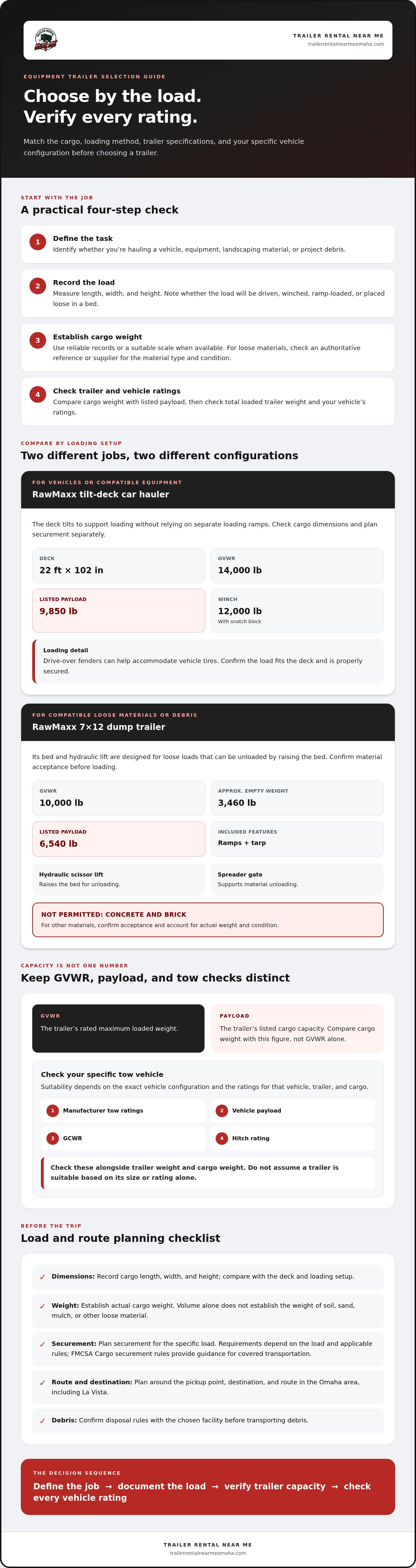
A tilt deck can make loading vehicles or compatible equipment more direct by angling the deck instead of relying on separate loading ramps. The confirmed deck measures 22 ft x 102 in, which gives you a reference when comparing cargo length and width. Drive-over fenders can help accommodate vehicle tires, while the included 12,000-lb winch and snatch block support controlled winching. Plan securement separately: loading equipment doesn’t prove that a load fits or is properly secured.
The hauler is rated at 14,000-lb GVWR with a 9,850-lb payload. Compare those listed specifications with your cargo and tow vehicle rather than assuming the trailer suits the job because of its size. Review the tilt-deck car hauler details to check its configuration against your needs.
When a dump trailer fits loose materials and cleanup
A 7x12 dump trailer may suit compatible loose project materials or debris that can be loaded into its bed and unloaded with its hydraulic scissor lift. It has a 10,000-lb GVWR, approximately 3,460-lb empty weight, and 6,540-lb payload. Ramps and a tarp are included, and a spreader gate supports material unloading. Use these specifications to plan the load, not as a reason to exceed the listed payload.
Concrete and brick are prohibited. For other materials, confirm acceptance before loading, then account for the material’s actual weight and condition. If a project includes both a vehicle and loose debris, don’t assume one trailer setup is suitable for both. Match each load to its dimensions, loading needs, and verified ratings.
How to match equipment trailer capacity to your load
Work through capacity checks in order. For an equipment trailer rental Omaha project, document the load before choosing a trailer, then compare it with the trailer’s stated ratings. Don’t treat GVWR and payload as interchangeable: GVWR is the trailer’s rated maximum loaded weight, while payload is its listed cargo capacity.
Measure the load and confirm its weight
- Identify the cargo. Note whether you’re hauling a vehicle, equipment, landscaping material, or debris.
- Record its dimensions and loading method. Measure length, width, and height. Note whether the cargo will be driven, winched, ramp-loaded, or placed loose in a bed.
- Establish the cargo weight. Use reliable records or a suitable scale when available. For dirt, gravel, rock, sand, mulch, or topsoil, consult an authoritative weight reference or supplier. Check that the information reflects the material type and condition.
- Compare the verified ratings. Check cargo weight against the trailer’s listed payload, then consider the total loaded trailer weight against its GVWR.
Volume alone doesn’t tell you the weight. The weight of a given volume of soil, sand, or mulch can vary with its type and moisture. Don’t estimate based on how full a trailer looks. Use a source that reflects the actual material and its condition.
Read GVWR and payload without mixing them up
Use the listed figures as specifications rather than numbers to recalculate. The RawMaxx tilt-deck car hauler is rated at 14,000-lb GVWR and has a 9,850-lb payload. The RawMaxx 7x12 dump trailer is rated at 10,000-lb GVWR and has a 6,540-lb payload. Compare your cargo with the relevant payload figure, not GVWR alone. GVWR describes the maximum loaded trailer weight.
Capacity is only one part of the plan. Securement matters too, and requirements depend on the load and applicable rules. The Federal Motor Carrier Safety Administration’s Cargo securement rules provide guidance for covered transportation. For a practical next step, compare your recorded load details with the available trailer options and specifications.
Can your vehicle tow the rental trailer? Check every rating
A vehicle class, model family, or engine size alone can’t confirm towing compatibility. For an equipment trailer rental Omaha job, check the exact tow vehicle, hitch, trailer, and cargo. The loaded trailer must fit within the applicable limits for that specific combination.
Compare the vehicle, hitch, trailer, and cargo ratings
Use the manufacturer’s information for your exact vehicle configuration, and check the hitch manufacturer’s rating as well. A tow rating alone doesn’t confirm compatibility. Review vehicle payload and gross combined weight rating (GCWR), then account for the trailer’s weight and the cargo you plan to carry. Confirm how each rating applies to your setup. If a limit or term is unclear, ask a qualified towing professional before departure.
Check the manufacturer tow rating, vehicle payload, GCWR, hitch rating, trailer weight, and cargo weight for your exact setup. All six matter. A trailer’s listed payload or GVWR doesn’t automatically make it suitable for your vehicle. For example, the 22 ft x 102 in tilt-deck car hauler has a 14,000-lb GVWR and 9,850-lb payload, but those specifications don’t establish that a particular vehicle can tow it. Review the tilt-deck car hauler specifications alongside your vehicle and hitch documentation.
Plan securement and trip checks before departure
Use applicable government guidance and the trailer or equipment manufacturer’s instructions to plan cargo securement. Before leaving, inspect the tires, lights, coupler, and safety chains. Check that the load is balanced and secured according to relevant guidance. These checks can help you spot problems early, but they don’t replace checking the ratings or following requirements that apply to your trip.
Keep the load details and vehicle specifications together while comparing rental options. If a rating is missing or doesn’t clearly apply to your configuration, pause and get qualified guidance instead of guessing.
Plan an equipment trailer rental around Omaha and your project
A clear plan helps you compare equipment trailer rental Omaha options without guessing. Start with the job, confirm what you’ll haul and how it will be loaded, check your specific tow-vehicle and hitch ratings, then review trailer information. For projects in Omaha or La Vista, include the pickup point, destination, and intended route in your planning.
Prepare the details before choosing a rental
Write down the cargo’s dimensions and documented or estimated weight. Note whether it needs to be driven or winched onto a deck, or loaded loose into a dump trailer. For equipment, compare its dimensions and loading needs with the tilt deck’s confirmed 22 ft x 102 in deck. The tilt-deck car hauler rental details provide one reference.
For debris or landscaping materials, identify the material and confirm it’s accepted before loading. Concrete and brick are prohibited in the dump trailer; ask about acceptance of other materials. Review the 7x12 dump trailer rental details when considering eligible loose materials. Confirm that your intended destination can receive the load, and check current route requirements with the appropriate local or state sources. Disposal rules and route conditions can differ by destination.
Choose the relevant trailer information and next step
Keep your load notes, vehicle ratings, pickup needs, and route together when comparing options. This makes potential mismatches easier to identify, such as equipment that exceeds the deck dimensions or a load whose weight hasn’t been verified. For loose materials, make sure the setup suits both the material and the unloading task.
Trailer Rental Near Me serves La Vista and the surrounding Omaha area, including Bellevue, Papillion, Ralston, Council Bluffs, and Bennington. Review the available trailer information after confirming your job details and tow compatibility.
Make your next haul a better-planned one
A successful equipment trailer rental Omaha starts with the job. Match the trailer type to the cargo and loading method, check dimensions and weight against verified trailer ratings, and confirm that your vehicle, hitch, and load are compatible. The manufacturer tow rating matters, along with vehicle payload, GCWR, hitch rating, trailer weight, and cargo weight.
Use confirmed specifications as a reference, not as a substitute for checking your own load. The RawMaxx tilt-deck car hauler has a 22 ft x 102 in deck, 14,000-lb GVWR, and 9,850-lb payload. The 7x12 dump trailer has a 10,000-lb GVWR, approximately 3,460-lb empty weight, and 6,540-lb payload. Trailer Rental Near Me is based in La Vista and serves the surrounding Omaha area.
With your cargo details, route, and vehicle ratings in hand, you can compare options with fewer unknowns.
Compare the available trailer specifications and book online once you’ve confirmed the right setup for your load.
Frequently Asked Questions
What is an equipment trailer used for?
An equipment trailer moves vehicles or compatible equipment, while a dump trailer carries suitable loose materials or debris. The right choice depends on cargo dimensions, weight, loading method, and verified trailer ratings. A tilt deck may suit a vehicle or equipment load that fits its deck and loading setup. A dump trailer is intended for eligible loose loads. Neither type automatically suits every vehicle, machine, or material.
How do I choose the right equipment trailer for my load?
Identify and measure the cargo, establish its weight from reliable information, choose a suitable loading method, and compare the trailer’s listed capacity. Check dimensions as well as weight. For loose materials, account for material type and condition using a reliable weight reference rather than estimating from volume. Confirm that the load fits the specific trailer and its ratings. Don’t rely on a broad trailer category or visual estimates to decide.
Can my truck tow a 14,000-lb GVWR trailer?
That number alone can’t determine whether your truck can tow the trailer. GVWR is the trailer’s maximum rated loaded weight, not a statement of a particular truck’s towing ability. Check the exact vehicle configuration and manufacturer tow rating, vehicle payload, GCWR, hitch rating, trailer weight, and cargo weight. Don’t assume compatibility based on vehicle class, model family, or engine size. If a rating is unclear, consult a qualified towing professional.
What materials can I put in a dump trailer?
Material acceptance depends on the rental provider’s restrictions, and safe loading depends on verified capacity. Concrete and brick are prohibited in Trailer Rental Near Me’s dump trailer. Before arranging a rental, confirm that other materials are accepted. For dirt, gravel, rock, sand, mulch, and topsoil, use a reliable weight reference that accounts for material type and condition. Don’t estimate weight from volume or assume a partial load is within payload.
What is the difference between GVWR and payload on a trailer?
GVWR is the trailer’s maximum rated loaded weight; payload is its stated cargo capacity. The RawMaxx tilt-deck car hauler has a 14,000-lb GVWR and 9,850-lb payload. The RawMaxx 7x12 dump trailer has a 10,000-lb GVWR and 6,540-lb payload. Treat each figure according to its label. Don’t recalculate specifications to infer an alternate payload, and compare cargo weight with the listed payload.
Where can I rent an equipment trailer near Omaha?
Trailer Rental Near Me provides trailer rentals in La Vista and the surrounding Omaha area, including Bellevue, Papillion, Ralston, Council Bluffs, and Bennington. For an equipment trailer rental Omaha project, compare your cargo dimensions, weight, and loading needs with the relevant trailer information, then check tow compatibility. Review the listed specifications before arranging a rental. Confirm details directly with the business, since prices and current availability aren’t stated here.

Article by
Chuck Crom
Chuck Crom is the owner of Trailer Rental Near Me, serving Omaha, La Vista, Papillion, Bellevue, Gretna, Elkhorn, and the surrounding Nebraska and western Iowa communities. With years of hands-on experience towing, hauling, and helping customers choose the right trailer for the job, Chuck specializes in making trailer rentals simple, safe, and stress-free.
He writes practical, no-nonsense articles covering trailer safety, towing tips, weight ratings, loading techniques, equipment transport, landscaping projects, home renovations, vehicle hauling, and everything in between. His goal is to help renters avoid common mistakes, stay safe on the road, and get their projects done with confidence.
When he's not helping customers or creating educational content, Chuck is focused on growing a locally owned business built on honest advice, quality equipment, and exceptional customer service.


