
Professional auto transport quotes shouldn't cost as much as the car you're moving. If you're looking into DIY car transport Omaha, you've likely realized that high carrier fees and the fear of loading damage are major roadblocks. It's frustrating to wait on a transporter's timeline when you'd rather handle the job yourself. You want the peace of mind that comes with using professional-grade tools instead of struggling with flimsy ramps or questionable trailers.
This 2026 guide helps you master the logistics of hauling using the exact equipment specs required for a safe move. You'll learn how to leverage a 14,000-lb GVWR and a 10,500-lb payload capacity to ensure your vehicle is secure. We'll walk through the technical details of using a 22 ft x 102 in deck and a 12,000-lb winch for effortless loading. We won't make guesses about your truck's capacity; instead, we'll show you how to verify manufacturer tow ratings for a safe trip. This is the practical roadmap to completing your move on your own schedule with the trailers you wish your buddy owned.
Key Takeaways
- Save on high carrier fees by mastering the logistics of self-hauling with professional-grade tilt-deck equipment.
- Learn to verify your specific truck's GCWR and hitch ratings to safely manage a trailer with a 14,000-lb GVWR.
- Discover how a 10,500-lb payload capacity and a 12,000-lb winch simplify DIY car transport Omaha for even the heaviest vehicles.
- Follow a step-by-step safety protocol for loading low-clearance cars onto a 22-foot tilt deck without the hassle of traditional ramps.
- Navigate the Omaha metro area with confidence by planning routes suitable for 102-inch wide-load trailers.
DIY Car Transport vs. Professional Shipping in Omaha
Professional auto transporters often prioritize their own multi-car schedules over your specific needs. Choosing DIY car transport Omaha allows you to bypass the logistical headaches of carrier delivery windows. Instead of waiting weeks for a driver to arrive in Nebraska, you can move your vehicle on your own timeline. It's a practical choice for those who value both their time and their budget.
Cost Savings and Scheduling in the Omaha Metro
Professional shipping rates fluctuate based on fuel prices and carrier availability. These quotes often lead to expenses that exceed the value of the move itself. Local trailer rentals provide a predictable, flat-rate alternative. By handling the hauling yourself, you eliminate the frustration of "delivery windows" common with long-haul carriers. You don't have to take a day off work to wait for a truck that might be delayed by three states. For weekend projects or local moves between Papillion and Council Bluffs, a rental offers a level of responsiveness that large logistics companies simply can't match.
Why Equipment Quality Matters for DIY Hauling
Many people hesitate to tackle DIY car transport Omaha because they've seen lightweight, consumer-grade trailers that feel unstable at highway speeds. Professional-grade equipment bridges this gap. A 22ft tilt deck car trailer rental provides the structural integrity needed for peace of mind. These units are built for durability and safety, featuring specifications that handle demanding tasks without hesitation:
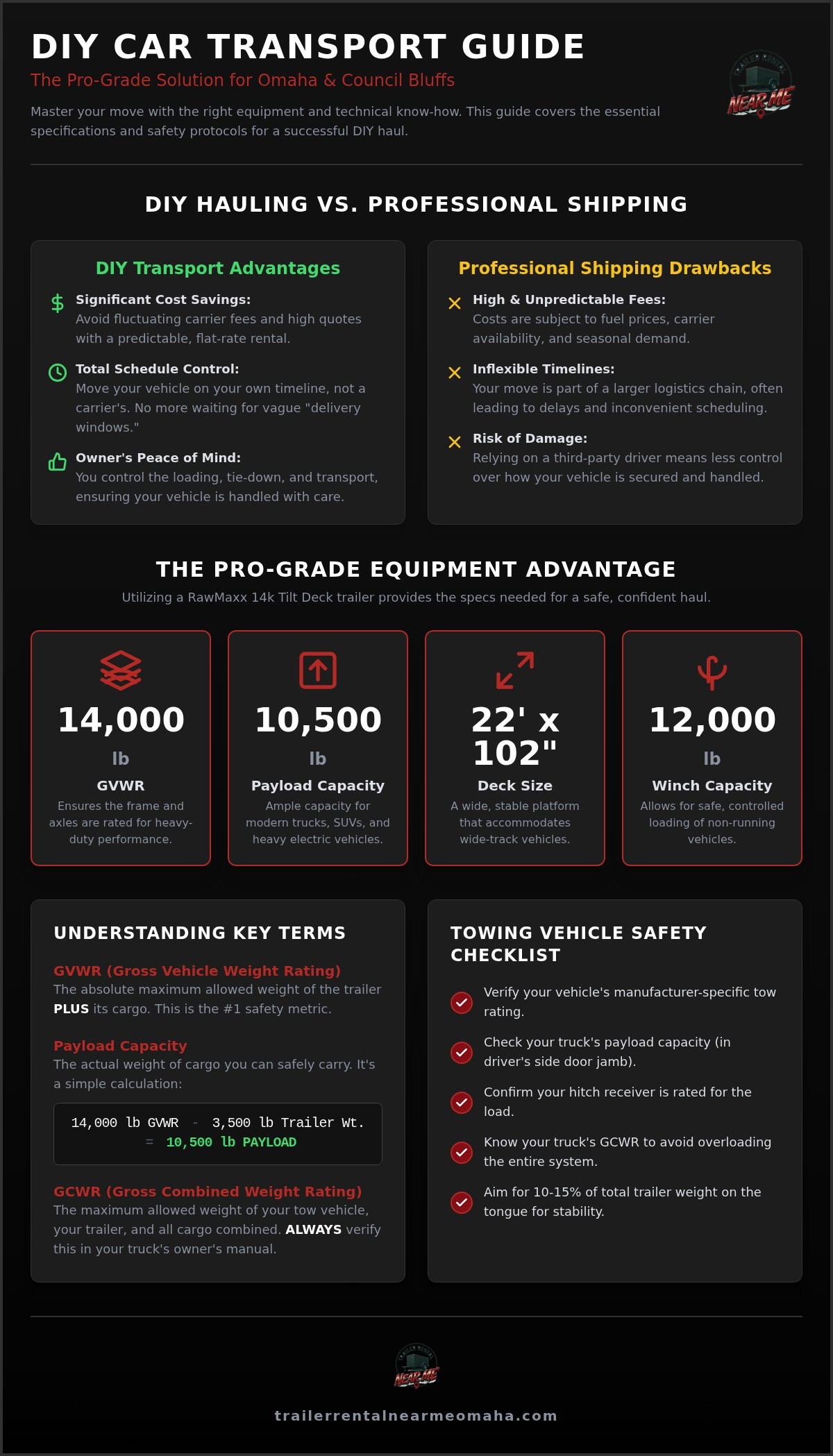
- 22 ft x 102 in deck: Provides a wide, stable platform that tracks straight behind your tow vehicle.
- 14,000-lb GVWR: Ensures the trailer frame and axles are rated for heavy-duty performance.
- 10,500-lb payload capacity: Offers plenty of overhead for modern trucks and SUVs.
- 12,000-lb winch: Allows for controlled loading of non-running vehicles.
When you use professional-grade tools, you decide exactly how the vehicle is secured. You aren't relying on a third-party driver to protect your investment. You control the tie-down tension and the placement. This ensures the car arrives in the same condition it left, handled with the care only an owner provides.
Technical Specs: Understanding GVWR and Payload for Safe Hauling
Gross Vehicle Weight Rating (GVWR) is the most critical number for any novice hauler. It represents the maximum total weight of the trailer plus its cargo. For DIY car transport Omaha, staying within these limits isn't just about legality; it's about mechanical survival. Roadside failures often happen because the operator guessed the weight instead of checking the data plates. You need to know exactly what your equipment can handle before you hit the highway.
The 10,500-lb payload rule serves as a hard limit. This figure is the GVWR minus the empty weight of the trailer. If you're hauling a heavy modern pickup or a large SUV, you need this specific capacity. A 14,000-lb GVWR provides a necessary safety margin for most cars. It ensures the brakes, axles, and tires aren't operating at maximum capacity during every mile of the trip. Operating with a buffer reduces heat buildup and improves handling on unpredictable Nebraska roads.
The RawMaxx 14k Tilt Deck Advantage
The RawMaxx tilt deck offers a 22 ft x 102 in deck. This size accommodates wide-track vehicles that often hang off the sides of standard trailers. Reviewing these heavy-duty trailer specifications ensures your equipment matches the task. Key features include:
- 12,000-lb winch: Essential for loading non-running project cars safely without manual labor.
- 10,500-lb payload: Sufficient capacity for modern trucks and heavy electric vehicles.
- Hydraulic tilt: Eliminates the need for heavy, dangerous ramps while loading low-clearance cars.
Towing Vehicle Requirements and Safety
Suitability for towing depends on your specific vehicle configuration. You must check your specific manufacturer tow rating, payload, and hitch rating before hooking up. Find your Gross Combined Weight Rating (GCWR) in the owner's manual. This number dictates the maximum allowable weight of your truck and trailer combined. Proper tongue weight distribution is also vital. Aim for 10% to 15% of the total trailer weight on the hitch. This placement prevents dangerous trailer sway and keeps your steering responsive while navigating the Omaha metro.
Step-by-Step: Safely Loading a Vehicle on a Tilt Deck
Loading a vehicle for DIY car transport Omaha requires a systematic approach to ensure both the car and the operator remain safe. Start by clearing a 22ft area behind the trailer to provide a straight, unobstructed approach. Inspect the hydraulic system to confirm the deck tilts smoothly to the ground. A centered load is critical for trailer sway prevention. If the vehicle is even slightly off-center, it creates uneven weight distribution that can become dangerous at highway speeds. Use the 102-inch deck width as a guide to keep the tires perfectly aligned with the trailer frame.
The 12,000-lb winch is your most valuable tool for a controlled loading process. Even if the vehicle runs, using the winch allows for a slow-speed ascent that eliminates the risk of overshooting the deck. Keep the cable under steady tension and avoid sudden jerks. This mechanical control is far safer than driving up, especially when working alone. Once the vehicle is in position, use the "four-point" tie-down method. This involves securing each corner of the vehicle to the trailer's integrated D-rings using heavy-duty ratchet straps.
Why Tilt Decks are Safer for Low-Clearance Cars
Traditional ramps are often too steep for modern sports cars or lowered vehicles. They create a sharp "break-over" angle that can easily rip off front spoilers or damage the undercarriage. The hydraulic tilt mechanism on a professional trailer provides a continuous, gentle slope from the pavement to the deck. This design eliminates the gap where damage usually occurs. You can view the specific deck dimensions and capabilities on the tilt deck car trailer schedule page to see how this equipment protects your investment during the loading phase.
Tie-Down Best Practices
Choosing the right securement method depends on the vehicle's frame. Axle straps are excellent for most cars because they don't compress the suspension, whereas wheel nets are ideal for larger tires on trucks or SUVs. Safety checks are mandatory after you begin your trip. Stop and check the strap tension after the first five miles of Omaha city driving. Vibrations from local roads can cause straps to settle. Most importantly, never rely on the winch as a primary tie-down. The winch is a loading tool; the ratchet straps are what keep the vehicle in place during transit.
Planning Your Omaha DIY Haul: Routes and Logistics
Successful DIY car transport Omaha depends on local accessibility and smart route planning. Pick-up and drop-off points in the La Vista and Papillion area simplify the logistics. You spend less time fetching equipment and more time on the move. Navigating the metro requires constant awareness of your trailer's 102-inch width. This is the maximum legal width for a standard trailer. It tracks wider than your truck. Precise lane positioning is vital for a safe trip.
Omaha and Council Bluffs Towing Considerations
Avoid narrow construction zones on I-80 when hauling a 102-inch wide deck. These sections often have concrete barriers that leave zero margin for error. Plan routes that use wider bypasses or main thoroughfares with generous shoulders. Local landmarks like the Sapp Bros in Omaha or the rest areas near Council Bluffs serve as safe pull-offs for load checks. You should stop every 50 miles to verify your straps haven't loosened. You can find more specific local advice in our Omaha car trailer guide.
Booking Your DIY Car Hauler
Online scheduling for the RawMaxx 14k car trailer ensures the equipment is ready when your project starts. When arriving for pick-up, bring a valid ID and proof of insurance for your tow vehicle. We require a tow vehicle with a manufacturer rating capable of handling the 14,000-lb GVWR of the trailer. This isn't about vehicle class. It's about the specific configuration of your truck's hitch and payload capacity. Verify these numbers in your owner's manual before booking.
Before leaving the lot, complete a final pre-trip inspection. Use this checklist to ensure everything is ready for the road:
- Tire Pressure: Check both the truck and trailer tires for proper inflation.
- Lighting: Verify all brake lights, turn signals, and marker lights are functioning.
- Securement: Ensure the 12,000-lb winch is retracted and the controller is stored.
- Hitch: Double-check the hitch pin, safety chains, and the breakaway cable connection.
Taking the stress out of car transport is possible with the right equipment and a methodical plan. By choosing professional-grade tools and following proven safety protocols, you maintain total control over your move. It's the most efficient way to handle a vehicle transport on your own terms. Ready to move? View our available car hauler rentals.
Take Control of Your Omaha Vehicle Move
Handling DIY car transport Omaha with professional equipment changes the entire experience. You no longer have to wait on carrier schedules or worry about how a stranger secures your vehicle. By understanding your truck's specific manufacturer tow rating and using a trailer with a 10,500-lb payload capacity, you ensure a safe and efficient trip across the metro. It's about finding a practical solution that fits your specific project timeline and budget.
Success comes down to the tools you use. A 12,000-lb winch included with your rental provides the mechanical advantage needed to load vehicles smoothly without the risk of ramp damage. With local La Vista support, you have access to the heavy-duty equipment required for a stress-free haul. You can move on your own timeline and save money while doing it. This approach provides the peace of mind that only comes from using well-maintained, professional-grade gear designed for the task.
Get started on your next project today with the confidence that your equipment is up to the task. We're here to help you get the job done right and move your vehicle with absolute certainty.
Common Questions About DIY Car Hauling
Can I tow a 14k car trailer with a standard half-ton truck?
Suitability for towing a 14k trailer depends entirely on your specific vehicle configuration. You cannot assume a standard half-ton truck is sufficient for the task. Check your manufacturer tow rating, payload capacity, and hitch rating before booking. Look for the Gross Combined Weight Rating (GCWR) in your owner's manual. Safety requires that your truck's mechanical limits exceed the 14,000-lb GVWR of the trailer. Never guess when it comes to towing capacity.
What is the maximum car weight I can haul on a 22ft tilt deck?
The maximum vehicle weight you can haul is 10,500 lbs. This is the verified payload capacity for the 22 ft x 102 in tilt-deck trailer. Staying within this limit is vital for maintaining the integrity of the axles and tires. It also ensures your braking system can handle the load effectively. Always confirm your vehicle's curb weight before loading to ensure you don't exceed this 10,500-lb threshold during your haul.
Do I need my own straps and tie-downs when renting a car trailer?
No, you do not need to bring your own securement gear. Every car trailer rental includes heavy-duty tie-downs and a 12,000-lb winch as standard equipment. We provide these professional-grade tools to ensure your vehicle remains stable during transit. This is a key part of successful DIY car transport Omaha. You can focus on the move itself rather than worrying about purchasing or maintaining your own expensive straps and winches.
How do I use a 12,000-lb winch if my car doesn't start?
To load a non-running vehicle, first engage the hydraulic tilt on the 22ft deck. Connect the 12,000-lb winch hook to a reinforced frame point or tow eye on your car. Use the winch controller to slowly guide the vehicle up the incline. Keep the cable centered to prevent the car from drifting toward the trailer edges. Once the vehicle is in position, secure it with the provided tie-downs before releasing winch tension for travel.
Is a tilt deck trailer better than a trailer with ramps for a lowered car?
A tilt deck is much safer for lowered cars than a ramp-style trailer. Ramps create a sharp angle at the top of the incline that often catches low-clearance bumpers or exhaust systems. The hydraulic tilt mechanism provides a smooth, continuous slope that protects your car's undercarriage. This design is the professional standard for moving sports cars or modified vehicles without the risk of expensive body or frame damage during the loading process.
What should I check on my truck before renting a heavy-duty trailer in Omaha?
Before renting, you must verify your truck's hitch rating and brake controller functionality. Check the door jamb sticker for your specific payload and Gross Combined Weight Rating (GCWR). Ensure your hitch is rated for a 14,000-lb GVWR trailer. You should also inspect your tires for proper inflation and tread depth. These technical checks are mandatory for safe DIY car transport Omaha and ensure your truck is mechanically prepared for the task.

Article by
Chuck Crom
Chuck Crom is the owner of Trailer Rental Near Me, serving Omaha, La Vista, Papillion, Bellevue, Gretna, Elkhorn, and the surrounding Nebraska and western Iowa communities. With years of hands-on experience towing, hauling, and helping customers choose the right trailer for the job, Chuck specializes in making trailer rentals simple, safe, and stress-free.
He writes practical, no-nonsense articles covering trailer safety, towing tips, weight ratings, loading techniques, equipment transport, landscaping projects, home renovations, vehicle hauling, and everything in between. His goal is to help renters avoid common mistakes, stay safe on the road, and get their projects done with confidence.
When he's not helping customers or creating educational content, Chuck is focused on growing a locally owned business built on honest advice, quality equipment, and exceptional customer service.


