
Loading a low-clearance sports car or a heavy skid steer shouldn't feel like a high-stakes gamble every time you approach the ramps. You've likely felt that spike of anxiety as you try to align narrow steel ramps, wondering if they'll kick out or if your tires will slip off the edge during the climb. This is why the tilt deck trailer has become the professional standard for safe, efficient hauling in the Omaha area. It replaces the physical strain of manhandling heavy steel with a simple, mechanical solution that keeps your equipment level and secure from start to finish.
We understand that protecting your vehicle and your physical health is a top priority for any job. This guide explains how tilt deck technology eliminates common loading hazards and ensures a damage-free transport every time you hit the road. We'll preview the technical benefits of using a 22ft deck, including the superior load angle for low-clearance cars and the time-saving efficiency that helps you finish your work faster. Whether you're moving equipment across La Vista or heading into Council Bluffs, you'll discover why the right trailer makes all the difference for a stress-free haul.
Key Takeaways
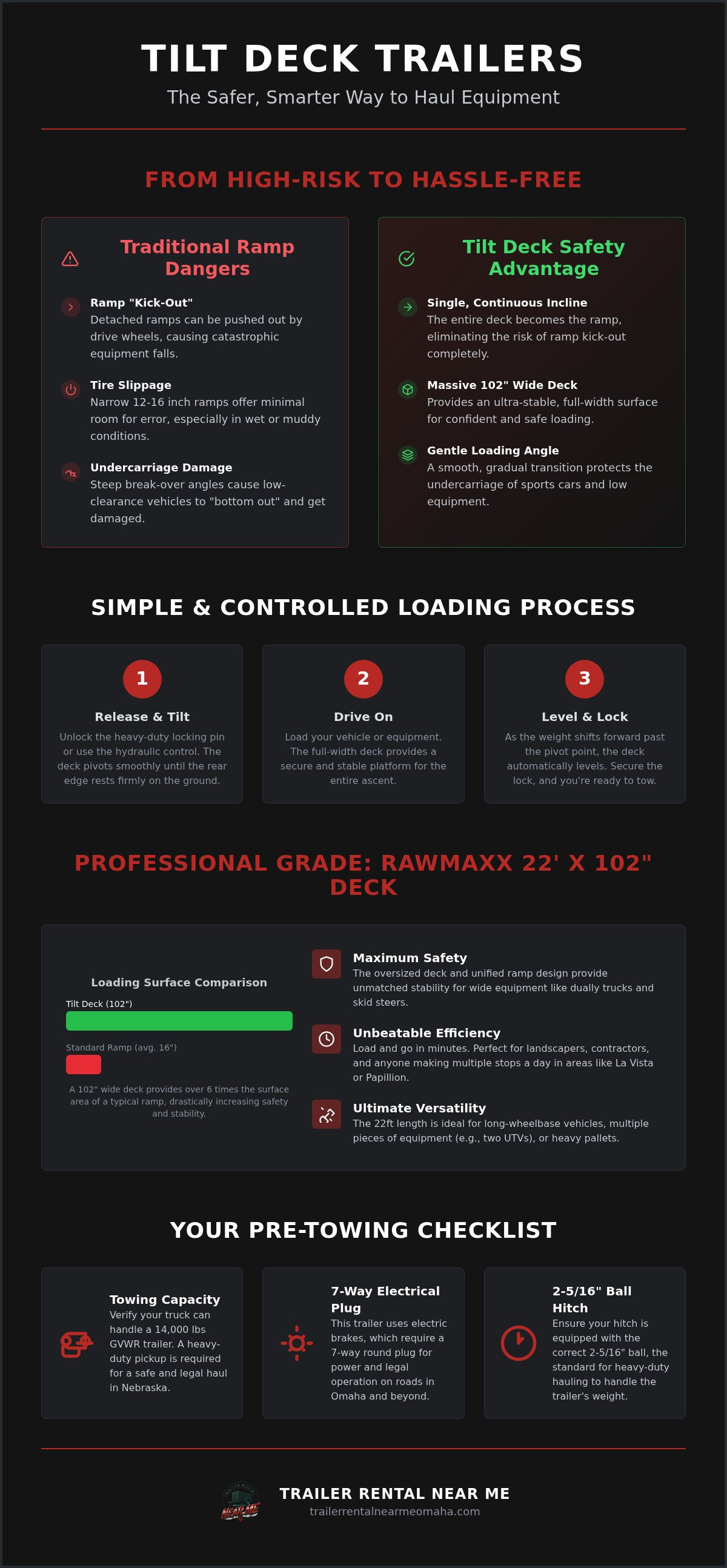
- Eliminate the danger of ramp "kick-out" and tire slippage by using a tilt deck trailer that creates a single, continuous incline to the ground.
- Identify the key differences between gravity and power tilt mechanisms to ensure you select the most efficient loading method for your specific cargo.
- Prepare for a legal and safe haul in Nebraska by verifying your truck's towing capacity and ensuring you have the required 7-way plug and 2-5/16" ball.
- Learn why an oversized 22ft x 102" deck is the preferred choice for moving long-wheelbase vehicles or multiple pieces of equipment in one trip.
- Discover the practical advantages of renting well-maintained, professional-grade equipment from a local partner in the Omaha and La Vista area.
What is a Tilt Deck Trailer and How Does It Work?
A tilt deck trailer isn't just a flatbed with a hinge. It's an engineered piece of equipment designed to simplify the most dangerous part of hauling: loading and unloading. While a standard utility trailer often requires you to lift and secure heavy ramps, a tilt deck uses a pivoting frame. This design allows the rear of the trailer to touch the ground directly. It creates a continuous, solid plane for your vehicle or equipment to climb. You don't have to worry about ramps slipping or kicking out because the ramp is the trailer itself.
The engineering behind a tilt deck trailer focuses on the pivot point, or fulcrum. On heavy-duty models like the RawMaxx GTX 22'x102" 14k, this pivot is strategically placed to balance the weight of the deck. When you release the locking mechanism, the bed tilts toward the ground. As you drive your vehicle up, the weight shifts forward, naturally bringing the deck back to a level position. It's a smooth, controlled process that reduces the shock of transitions often felt on steep, traditional ramps.
The Mechanics of the Tilt Bed
The efficiency of this system relies on a heavy-duty locking pin or hydraulic system that secures the deck for transport. Once the bed returns to its horizontal position, it locks into the main frame, ensuring it won't shift while you're driving through Omaha or Bellevue. The 102-inch width of the deck is a critical safety feature. This oversized width provides a massive platform for your tires, which is essential for wider equipment like skid steers or dually trucks. It offers a stability that narrow, 12-inch ramps simply can't match.
Who Benefits Most from a Tilt Deck?
This equipment is a game-changer for several types of haulers in the Nebraska and western Iowa region. If you're a classic car owner in Bennington or Elkhorn, you know that low-clearance vehicles often bottom out on standard ramps. The shallow approach angle of a tilt deck prevents bumper and undercarriage damage. Landscapers in La Vista and Papillion also find these trailers indispensable for moving skid steers and mini-excavators. Instead of struggling with heavy steel ramps multiple times a day, they can load and go in minutes. Contractors in Council Bluffs and Gretna who move heavy pallets or small tractors also prefer this setup for its reliability and speed.
If you're ready to see the difference for yourself, you can check availability for a 22'x102 14k Tilt Deck Car Hauler Rental to handle your next local haul.
The Safety Advantage: Why Tilt Decks Beat Traditional Ramps
Traditional ramps are the most common failure point during the loading process. When you use a standard flatbed, you rely on two narrow pieces of steel to stay perfectly aligned and securely attached while thousands of pounds of machinery climb them. The loading angle is the degree of incline the trailer deck forms in relation to the ground during the loading process. On a tilt deck trailer, this angle is consistently shallow and stable because the entire rear edge of the trailer maintains contact with the earth. This design eliminates the risk of ramp "kick-out," a dangerous event where the torque from a vehicle's drive wheels pushes a detached ramp backward, often causing the vehicle to fall off the trailer side.
Stability is also a matter of surface area. A standard ramp is typically only 12 to 16 inches wide, leaving very little room for error. If your alignment is off by just a few inches, you risk a tire slipping off the edge. In contrast, our 102-inch wide deck provides a massive, continuous target for your tires. This extra width is especially valuable when loading in the unpredictable weather conditions common in the Omaha and Council Bluffs area, where rain or mud can make narrow steel ramps slick and treacherous. You can view our full trailer inventory to see how these wider platforms provide a more secure foundation for your equipment.
Protecting Low-Clearance Vehicles
For car enthusiasts in Omaha and Papillion, protecting a vehicle's undercarriage is a major concern. Traditional trailers often have a sharp "break-over" point where the ramps meet the deck. This peak is where low-clearance sports cars, lowered trucks, and vehicles with front spoilers frequently bottom out or "high-center," leading to expensive body damage. A tilt deck provides a single, smooth plane that significantly reduces this break-over angle. By creating a gradual transition from the ground to the deck, it ensures that long-wheelbase vehicles can clear the frame without the frame rails or exhaust components scraping the metal.
Operator Safety and Physical Strain
Beyond protecting the cargo, a tilt deck protects the person doing the work. Standard equipment trailers often require the operator to lift and slide heavy steel ramps that can weigh between 50 and 80 pounds each. This repetitive lifting is a leading cause of back strain and shoulder injuries for contractors. There is also the constant risk of pinched fingers or smashed toes when locking traditional ramps into place. A tilt deck trailer eliminates this physical labor entirely. The mechanical or hydraulic system does the heavy lifting for you, allowing for a true one-man operation that is faster and significantly safer for your body. Industry data suggests that switching to a tilt system can reduce loading and unloading times by 15 to 20 minutes per cycle, allowing you to focus on the job rather than the equipment setup.
Gravity Tilt vs. Power Tilt: Which Rental Do You Need?
When selecting a tilt deck trailer for your project in Omaha, you'll encounter two primary systems: gravity tilt and power tilt. Both designs eliminate the need for separate ramps, but they operate through different mechanical principles. Choosing the right one depends on the type of equipment you're hauling and your comfort level with the loading process. A gravity model is often the choice for speed and simplicity, while power tilt offers a level of precision and control that is necessary for specialized hauls.
How Gravity Systems Work
Gravity tilt trailers rely on the physics of weight distribution. The deck is balanced on a central pivot point. When you release the deck locks, the rear of the bed naturally tilts down to the ground. As you drive your vehicle forward, its weight crosses the fulcrum, causing the deck to level out automatically. It's a simple, reliable design that requires no battery or electrical components to function, making it a dependable choice for standard equipment hauls.
To prevent the bed from crashing down, these trailers use a hydraulic damper. This is essentially a shock absorber that controls the speed of the descent. It ensures a smooth transition rather than a violent drop. This system is ideal for running vehicles and equipment like tractors or skid steers where you can drive forward at a controlled pace. For experienced haulers in La Vista or Papillion, gravity models are often the fastest option for quick loading and unloading. They allow you to get the job done with minimal mechanical intervention.
When to Choose Power Tilt
Power tilt systems use active hydraulic cylinders and an electric pump to move the deck. This allows you to lift or lower the bed at the push of a button, regardless of where the load is positioned. This system offers several advantages for specific hauling scenarios, especially when using a winch for non-runners. It provides total control over the deck movement, ensuring safety when the balance point is hard to find.
- Non-Running Vehicles: If you're using a winch to pull a vehicle onto the trailer, a power tilt is essential. Since you can't drive past the pivot point to trigger a gravity tilt, the hydraulic system allows you to level the deck once the vehicle is in place.
- Precision Control: Power tilt allows you to stop and hold the deck at any specific angle. This is helpful when loading equipment with extremely tight tolerances or when working on uneven ground in areas like Gretna or Elkhorn.
- Heavy Equipment: For machinery where the center of gravity is difficult to determine, power tilt removes the guesswork. You don't have to worry about the deck staying tilted or slamming shut unexpectedly.
If you're moving a project car that doesn't start, or if you simply prefer total control over the loading angle, a power tilt setup is the professional choice. You can find high-quality options like our 22'x102 14k Tilt Deck Car Hauler Rental which provides the heavy-duty capacity needed for these demanding tasks. This equipment is well-maintained and ready to handle the rigors of any job site in the Omaha or Council Bluffs region.
Essential Preparation: What to Know Before You Tow in Omaha
Safe towing begins long before you pull onto the road. When renting a heavy-duty tilt deck trailer, your first step is verifying that your truck's towing capacity meets or exceeds the trailer's Gross Vehicle Weight Rating (GVWR). Our RawMaxx GTX model has a 14,000 lb GVWR. This means your vehicle must be equipped to handle both the weight of the trailer and your cargo. You'll need a 2-5/16" ball and a functioning 7-way plug to operate the electric brakes. In Nebraska, any trailer with a gross weight exceeding 3,000 lbs is required by law to have its own braking system. Safety chains are also mandatory for every haul, whether you're crossing into Council Bluffs or staying in La Vista.
Local weather conditions play a significant role in towing safety. High winds are common along the I-80 corridor between Omaha and Lincoln. When hauling an empty deck, these gusts can cause significant sway. Always check the forecast before your trip. If you're moving equipment across the Missouri River, remember that Nebraska towing speed limits are generally 55 mph unless otherwise posted. Adhering to these regulations ensures you maintain control and stay compliant with Nebraska DMV and Iowa DOT standards.
Weight Distribution and Payload
Properly loading a tilt deck trailer requires following the 60/40 rule. You should place approximately 60% of the cargo weight in front of the axles, closer to the hitch. This maintains proper tongue weight and prevents dangerous trailer sway. To calculate your available payload, subtract the trailer's empty weight from its 14,000 lb GVWR. For our 22ft model, this leaves you with a payload capacity of approximately 10,800 lbs. The 22ft length is a major advantage here. It provides more room to shift your cargo forward or backward to find the perfect balance point, which is much harder to achieve on shorter, 16ft or 18ft trailers.
Securing the Load
Once your equipment is positioned, security is paramount. Use a four-point tie-down method for all vehicles, securing each corner with heavy-duty ratchet straps or chains rated for the load weight. Don't rely on the vehicle's "Park" gear or a winch to hold it in place. Before you leave the site in Papillion or Gretna, double-check that the tilt mechanism is fully locked and all safety pins are engaged. A loose deck can shift during transit, causing a sudden change in weight distribution that can lead to an accident.
Renting a 22ft Tilt Deck Trailer in La Vista and Omaha
Buying a high-quality tilt deck trailer is a significant investment that often doesn't make sense for occasional projects or seasonal work. Between the initial purchase price, annual registration, and the physical space required for storage, the total cost of ownership is substantial. Renting allows you to access professional-grade equipment for a fraction of that cost. Our 22'x102 14k Tilt Deck Car Hauler Rental is designed for those who need rugged performance without the long-term overhead. Whether you are moving a classic car across Papillion or transporting a skid steer in Ralston, renting ensures you have a specialized tool that is sized perfectly for the task.
We maintain our fleet to the highest industrial standards to ensure reliability and safety on the road. You won't have to worry about aging tires, frayed wiring, or faulty hydraulic systems that often plague older, neglected trailers. Every unit in our inventory is inspected regularly to handle the demanding tasks common in the Omaha metro area. This commitment to mechanical integrity means you can focus on your haul with the confidence that your equipment is well-maintained and capable. Our 22ft deck is specifically chosen for its versatility, offering the extra length needed for better weight distribution and the 102-inch width required for wider modern vehicles.
The Rental Process at Trailer Rental Near Me
Getting your equipment shouldn't be a hassle. We offer a streamlined online booking system that allows you to reserve your trailer in minutes. When you arrive for pickup in the Omaha area, please bring a valid driver's license, proof of insurance for your tow vehicle, and a truck equipped with a 2-5/16" ball. For those who are used to traditional ramps and are trying a tilt deck trailer for the first time, we provide a personalized walkthrough. We'll show you exactly how to operate the tilt mechanism, how the hydraulic damper functions, and how to verify that all locking pins are engaged. We want you to leave our lot feeling confident and ready to work.
Serving the Greater Omaha Community
Our location provides convenient access for residents and businesses throughout La Vista and Council Bluffs. We take pride in supporting the local community, from car clubs heading to regional shows to landscapers moving equipment between job sites in Bellevue and Gretna. Our flexible daily and short-term rates are designed to fit your project timeline, whether it's a quick afternoon move or a multi-day construction job. We offer straightforward transactions with no hidden fees, making us the practical partner for DIY movers and professional contractors alike. If you have questions about your specific truck's capabilities or how to calculate your payload, our team is here to provide honest, expert guidance.
Book Your 22ft Tilt Deck Trailer Rental Today
Streamline Your Next Haul with Professional Equipment
Choosing a tilt deck trailer isn't just about convenience; it's a commitment to safety and equipment longevity. You've seen how these trailers eliminate the hazards of narrow ramps and provide a superior loading angle for low-clearance vehicles. By removing the physical strain of manual setup, you can focus on the transport itself. Proper preparation, including weight distribution and legal compliance in Nebraska, ensures a successful journey across the metro area. Whether you're moving a classic car or heavy machinery, the right platform makes the difference between a stressful day and a smooth operation.
Trailer Rental Near Me provides the rugged, well-maintained equipment you need for professional or personal hauls. Our locally owned business in La Vista, NE, offers the heavy-duty 22ft x 102" oversized deck capacity required for today's most demanding jobs. We take pride in serving our neighbors in Omaha, Papillion, and Bellevue with reliable tools that work as hard as you do. Our team is ready to help you select the best trailer for your specific truck and load requirements.
Contact us today to secure your reservation and experience a safer way to move your valuable cargo.
Frequently Asked Questions
Do I need a special license to tow a tilt deck trailer in Nebraska?
You don't need a special commercial license for most personal hauls in Nebraska. A standard Class O driver's license is sufficient as long as your Gross Combined Weight Rating stays under 26,001 pounds. If you're towing for business purposes or exceeding that weight limit, you should consult the Nebraska DMV or FMCSA guidelines regarding CDL requirements. Always verify your specific truck and trailer combination before hitting the road in the Omaha area.
Can I load a non-running car onto a tilt deck trailer?
You can absolutely load a non-running vehicle onto a tilted deck. We provide a car trailer for rent with a 12,000lb winch and tie downs included specifically for this purpose. The winch does the heavy work while the tilted deck provides a smooth path for the vehicle. This setup is much safer than trying to push a car up narrow, traditional ramps in a driveway or parking lot.
What is the maximum weight capacity for a 22ft tilt deck rental?
The maximum payload capacity for our 22ft tilt deck rental is approximately 10,800 pounds. This is based on the trailer's 14,000 lb Gross Vehicle Weight Rating minus the weight of the trailer itself. It's built to handle heavy equipment like skid steers or large dually trucks. You should always calculate your cargo weight accurately to ensure you don't exceed these structural limits during your haul through La Vista or Council Bluffs.
How do I know if my truck has a high enough towing capacity?
You can find your truck's towing capacity by checking the manufacturer's label on the inside of the driver's side door jamb. This sticker lists the Gross Combined Weight Rating and the max towing capacity. Don't rely on general estimates for your truck model. Options like engine size, axle ratio, and factory towing packages significantly change how much weight your specific vehicle can safely pull through the Omaha hills.
Is a tilt deck trailer better than a trailer with slide-in ramps?
A tilt deck trailer is generally superior to slide-in ramps because it eliminates the risk of ramps slipping or kicking out. You don't have to lift heavy steel ramps, which prevents back strain and pinched fingers. The continuous deck also provides a much wider target for your tires. This makes the loading process more stable and significantly faster for operators who need to move equipment multiple times a day.
What happens if the vehicle is too low for even a tilt deck trailer?
If a vehicle is too low for a tilt deck trailer, you can use specialized approach accessories like race ramps or wood blocks. These tools extend the incline and further reduce the approach angle. While the tilt deck offers the shallowest standard angle available, extremely low-profile sports cars may still need this extra assistance to prevent the front splitter or air dam from scraping during the initial climb.
Do you provide the tie-down straps with the trailer rental?
We include heavy-duty tie-down straps with our car trailer rentals. You won't need to purchase your own set for a one-time move. These straps are rated for the trailer's capacity and are designed to work with the integrated D-rings on the deck. We recommend using a four-point tie-down method to secure each wheel or the frame, ensuring your load stays stationary while driving on I-80 or local Omaha streets.
How long does the loading process typically take with a tilt deck?
The loading process with a tilt deck typically takes between five and ten minutes. This is much faster than traditional trailers that require you to unstow, align, and secure heavy ramps. Once the deck is tilted, you simply drive on and secure the load. This efficiency is a major benefit for contractors in Papillion and Gretna who need to move equipment between multiple job sites in a single day.

Article by
Chuck Crom
Chuck Crom is the owner of Trailer Rental Near Me, serving Omaha, La Vista, Papillion, Bellevue, Gretna, Elkhorn, and the surrounding Nebraska and western Iowa communities. With years of hands-on experience towing, hauling, and helping customers choose the right trailer for the job, Chuck specializes in making trailer rentals simple, safe, and stress-free.
He writes practical, no-nonsense articles covering trailer safety, towing tips, weight ratings, loading techniques, equipment transport, landscaping projects, home renovations, vehicle hauling, and everything in between. His goal is to help renters avoid common mistakes, stay safe on the road, and get their projects done with confidence.
When he's not helping customers or creating educational content, Chuck is focused on growing a locally owned business built on honest advice, quality equipment, and exceptional customer service.


