
What if the only thing keeping your vehicle from a highway disaster is a single misplaced strap or an underrated trailer deck? That is a valid concern for anyone searching for car hauling trailers for rent in the Omaha metro. You need your vehicle to arrive without a scratch, but uncertainty about ramp angles or your truck's towing capacity can stall your plans. We agree that hauling a car shouldn't feel like a gamble. Reliability starts with the right gear and a solid understanding of the physics involved.
This guide provides a step-by-step approach to selecting, loading, and safely towing vehicles throughout Nebraska and western Iowa. You will learn how to calculate payload math, navigate Nebraska's 3,000-pound trailer brake requirements, and use 14k tilt decks to protect low-clearance cars. We will also cover why a 12,000-pound winch is essential for non-running project cars. Whether you are moving a classic across La Vista or a daily driver to Council Bluffs, these practical insights ensure you hit the road with total confidence in your equipment.
Key Takeaways
- Verify your truck's towing capacity and the vehicle's curb weight to ensure a safe, legal match before you start.
- Use tilt deck technology for low-clearance cars and a 12,000lb winch for non-running vehicles to prevent damage during the loading process.
- Apply the 60/40 weight distribution rule and proper tie-down techniques to maintain stability and prevent dangerous trailer sway on the highway.
- Navigate Nebraska DMV requirements for trailer brakes and lighting when selecting car hauling trailers for rent in the Omaha area.
- Understand why renting from a local expert in La Vista or Papillion ensures better equipment maintenance and more reliable support than national chains.
Understanding Your Options for Car Hauling Trailers
Not all trailers are built equal. A standard utility trailer might haul lawnmowers or mulch, but it lacks the structural integrity and specialized tie-down points of a dedicated car carrier trailer. When searching for car hauling trailers for rent in the Omaha metro, you must distinguish between light-duty equipment and professional-grade haulers. Open trailers are the standard for local transport because they offer easy access and lower rental costs than enclosed alternatives. They allow for quick inspections of your straps and load during transit through Bellevue or Papillion.
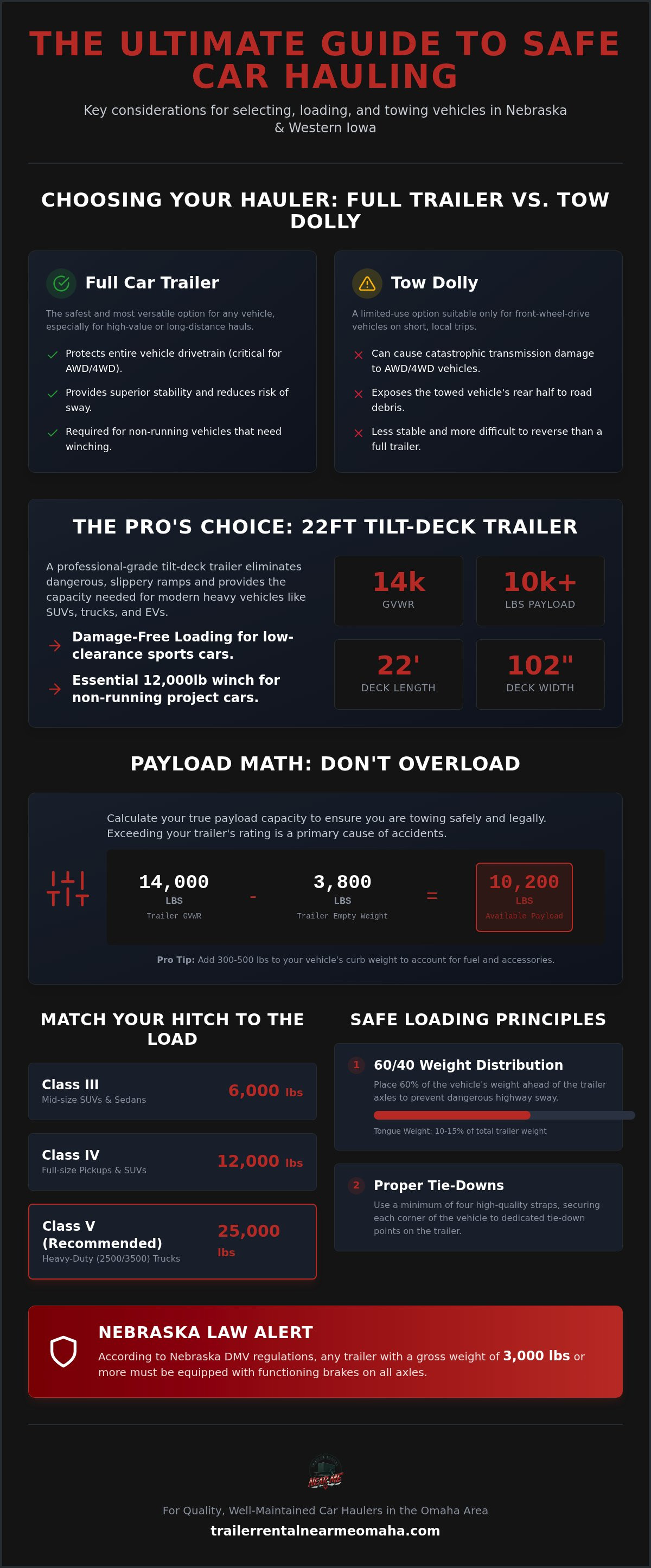
Choosing the right GVWR (Gross Vehicle Weight Rating) is critical for safety. Many national rental chains offer trailers with a load limit of 5,290 pounds. While this works for a small sedan, it is dangerous for a modern Jeep Grand Wagoneer or a heavy-duty pickup. A 14k GVWR rating ensures the trailer can support 10,000 pounds or more of actual vehicle weight. This provides a necessary safety margin for the heavy curb weights common in modern SUVs and trucks, ensuring the axles and tires aren't pushed to their breaking point.
Tow Dollies vs. Full Car Trailers
A tow dolly is a compact option that keeps the rear wheels of the towed vehicle on the pavement. These are acceptable for front-wheel-drive vehicles on short trips. However, full trailers are the superior choice for high-value hauls and long distances. Towing an All-Wheel Drive (AWD) or 4WD vehicle with two wheels down can cause catastrophic transmission failure. Using a full trailer eliminates this risk by keeping the entire drivetrain stationary and protected from road debris.
The 22ft Tilt-Deck Advantage
The 22-foot length of a professional hauler provides ample space for proper weight distribution. This is vital for preventing trailer sway at highway speeds. Traditional ramps can be dangerous; they are often slippery and create steep angles that scrape the bumpers of low-clearance sports cars. A tilt-deck solves this problem by removing the need for separate, heavy ramps entirely.
A tilt-deck trailer utilizes a hydraulic piston or gravity-fed pivot system to incline the entire trailer bed, creating a seamless transition from the ground to the deck. This 102-inch wide platform is essential for wide-track modern vehicles like the Ford Raptor or heavy electric vehicles. If you're moving a vehicle in Gretna or Elkhorn, a 22'x102 14k Tilt Deck Car Hauler Rental offers the safest and most efficient loading experience available today.
How to Match a Trailer to Your Vehicle and Tow Rig
Matching your tow vehicle to the load is a matter of mechanical safety. The National Highway Traffic Safety Administration (NHTSA) emphasizes that exceeding a vehicle's Gross Combined Weight Rating (GCWR) is a primary factor in mechanical failure and loss of control. Before searching for car hauling trailers for rent, locate the GCWR on your truck's door jamb sticker. This figure represents the maximum weight of the truck, the trailer, and all cargo combined. Selecting a 22ft car trailer with a 14,000lb capacity provides a vital safety buffer. This extra headroom ensures that your axles and tires aren't operating at their absolute limit while crossing the Platte River or navigating the grades around Council Bluffs.
| Hitch Class | Max Trailer Weight (GTW) | Standard Ball Size | Common Use Case |
|---|---|---|---|
| Class III | Up to 6,000 lbs | 2" | Mid-size SUVs and Sedans |
| Class IV | Up to 12,000 lbs | 2" or 2-5/16" | Full-size Pickups and SUVs |
| Class V | Up to 25,000 lbs | 2-5/16" | Heavy-Duty (2500/3500) Trucks |
Calculating Your Actual Payload
To find your maximum payload, use a simple formula: subtract the empty weight of the trailer from its GVWR. If a trailer weighs 3,800 pounds and has a 14,000lb GVWR, your available payload is 10,200 pounds. The Federal Motor Carrier Safety Administration (FMCSA) sets strict standards for weight limits to prevent road damage and accidents. Many haulers underestimate vehicle weight by forgetting the extras. A full fuel tank and aftermarket accessories can add 300 to 500 pounds to the curb weight. Always round your vehicle's weight up to the nearest 500 pounds to account for these variables and stay within safe legal limits.
Hitch and Receiver Requirements
Your truck's hitch receiver must be rated for the specific weight you plan to pull. For heavy-duty car hauling, a Class IV or Class V receiver is the professional standard. You will need a 2-5/16 inch ball rated for at least 14,000 pounds. Never attempt to use a 2-inch ball on a larger coupler; it won't lock securely and will cause a catastrophic failure. Additionally, your tow rig must have a functional 7-way electrical plug. Nebraska law requires trailers over 3,000 pounds to have independent braking systems. The 7-way plug allows your truck to control those brakes effectively.
Essential Features: Winches, Tie-Downs, and Tilt Decks
Loading a vehicle is where most accidents happen. If you're looking for car hauling trailers for rent in the Omaha area, don't settle for a bare-bones flatbed. Professional transport requires specific hardware to manage the physics of a moving load. A 12,000lb winch is a non-negotiable feature for non-running project cars. It provides the raw pulling power to move a 5,000lb vehicle up an incline without straining the motor. While some might use chains, we recommend heavy-duty ratchet straps. Chains are often too rigid and can bend suspension components or scar the vehicle's finish. High-quality straps provide enough flex to absorb road vibration while keeping the car locked to the trailer's integrated D-rings.
Using a Winch Safely
Safety starts with a pre-load inspection. Always check the winch cable for frays, kinks, or "bird-nesting" on the drum. A snapped cable under tension is a lethal projectile. When hooking up, identify a factory-approved recovery point or a solid frame member. Never hook onto an axle or a steering rack, as the force of the winch will bend these parts. The "controlled pull" method involves maintaining steady, low-speed tension on the winch line while a spotter monitors the vehicle's alignment to ensure it tracks straight onto the trailer bed. This technique prevents the vehicle from drifting off the side of the deck during the ascent.
Tilt Deck vs. Ramp Loading
Traditional ramps are a liability. They are heavy, prone to slipping, and create a steep approach angle that can rip off the front air dam of a Corvette or a lowered BMW. A tilt deck eliminates these risks by pivoting the entire trailer bed to the ground. This creates a low-profile incline that accommodates almost any ride height. Beyond the physics, it saves your back from lifting 80-pound steel ramps in the Nebraska heat. For those moving specialized vehicles, a Tilt Deck Trailer Rental in Omaha is the only logical choice for professional results in La Vista or Council Bluffs. Using a tilt deck ensures the transition from pavement to trailer is seamless and controlled.
How to Load and Secure Your Vehicle: A Step-by-Step Guide
Safety starts before the car even touches the deck. Conduct a thorough pre-loading inspection of your equipment. Check the trailer tire pressure and ensure the 7-way plug is seated correctly so the trailer brakes function as required by Nebraska law. Verify the hitch coupler is locked and the safety chains are crossed. If you're looking for car hauling trailers for rent in the Omaha area, prioritize equipment that has been maintained to these rigorous standards. Once the trailer is level and the deck is tilted or ramps are set, you are ready to load.
Weight distribution is the most critical factor in towing safety. Follow the 60/40 rule: place 60 percent of the vehicle's weight in front of the trailer's center axle. This positioning ensures sufficient tongue weight. If the weight is too far back, the trailer will oscillate. This leads to dangerous trailer sway that can flip both the tow vehicle and the trailer. Maintaining this balance is essential when navigating the highway speeds of I-80 between Gretna and Omaha.
Positioning for Optimal Tongue Weight
Identifying the correct position is a visual process. Look at the tow vehicle's rear suspension for cues. You want a slight "squat" that indicates the hitch is carrying about 10 to 15 percent of the total trailer weight. If the truck's front wheels look light or the rear bumper is dragging, the car is too far forward. Conversely, if the trailer is perfectly level or tilted back, the car is too far rearward. Improper tongue weight remains the leading cause of highway towing accidents. It's a mistake that is easily avoided with a few extra minutes of adjustment.
The Four-Point Tie-Down Method
Lateral stability is just as important as longitudinal security. Use a four-point tie-down method by crossing your straps in an "X" pattern at both the front and rear of the vehicle. This prevents the car from shifting side-to-side during sharp turns in Papillion or Bellevue. Attach the straps to unsprung weight, such as the axles or control arms, rather than the vehicle's frame. Securing to the axles allows the car's suspension to move naturally without loosening the straps. Always double-check that windows are up and loose items in the cabin are secured to prevent wind damage.
Once the car is positioned, engage the parking brake and use heavy-duty wheel chocks. Perform a "tug test" by trying to drive the tow vehicle forward slightly to ensure the straps are taut. Stop after the first five miles of your trip to re-tighten the straps. Straps often settle or stretch slightly as you navigate the initial turns and bumps of your route.
Renting Car Hauling Trailers in Omaha and Nebraska
Finding quality car hauling trailers for rent requires more than just picking the closest national chain. Local reliability matters when you are moving a high-value asset across the Omaha metro. National providers often have high turnover and generic equipment that may not meet the specific needs of your vehicle. Choosing a local partner in La Vista or Papillion ensures you receive a well-maintained trailer that is ready for the road. Before you drive off, verify your insurance coverage. Most standard auto policies provide liability for a rental trailer, but they rarely cover physical damage to the trailer itself or the vehicle being hauled. Check with your agent to confirm your protection levels.
Booking a car hauler rental online is the most efficient way to secure your equipment. This allows you to plan for weekend car shows in Bennington or project car pickups in Gretna without the uncertainty of "first-come, first-served" inventory. A local provider understands the mechanical requirements of our region and provides the specific gear, like integrated 12,000lb winches, that national chains often lack.
Local Regulations: Omaha to Council Bluffs
Navigating the border between Nebraska and Iowa on I-80 requires an understanding of specific towing laws. Nebraska DMV regulations state that any trailer with a gross weight over 3,000 pounds must have its own independent braking system. This means your tow vehicle must be equipped with a functional brake controller to manage the trailer's electric brakes safely. Additionally, the maximum width for any trailer in Nebraska is 8 feet, 6 inches. Our 102-inch wide decks sit exactly at this legal limit to provide the widest possible loading surface. For more detailed local insights, consult our Ultimate Guide to Trailer Rental in Omaha.
The Benefits of Local Expertise
Renting locally means you aren't just a transaction number. You get hands-on instruction for specialized equipment like the 12,000lb winch or the hydraulic tilt mechanism. If you've never operated a high-capacity winch, having a local expert demonstrate the "controlled pull" method is invaluable for safety. Supporting a locally owned business in the Omaha area also means you have a direct line to the owner if you have questions during your haul. This level of service is non-existent at big-box rental centers. Whether you are moving a classic to Elkhorn or a non-runner to Council Bluffs, local expertise provides the peace of mind that the equipment is up to the task.
Master Your Next Vehicle Transport
Safe transport across the Omaha metro requires matching your vehicle's curb weight to a heavy-duty 14k GVWR trailer. You've learned how tilt deck technology protects your car's undercarriage and why a four-point tie-down pattern is essential for highway stability. When you search for car hauling trailers for rent, prioritize equipment that includes a 12,000lb winch for maximum versatility. These features ensure that even non-running project cars can be loaded without straining your gear or your back.
We are locally owned and operated in La Vista, providing well-maintained trailers that meet all Nebraska DMV and Iowa DOT safety standards. Our professional-grade equipment provides the strength and reliability needed for any classic car or modern SUV. If you have questions about towing capacity or want to make a reservation, contact Trailer Rental Near Me today. Our team is ready to help you find the right solution for your next haul.
Hit the road with total confidence knowing your load is secure and your equipment is capable. We are here to support your vehicle transport needs from Council Bluffs to Elkhorn.
Frequently Asked Questions
Do I need a special license to tow a car hauling trailer in Nebraska?
You don't need a special license for personal towing in Nebraska if your total combined weight is under 26,001 pounds. A standard Class O operator's license is sufficient for most private vehicle transport tasks. If you're hauling for hire or your equipment exceeds these weight thresholds, you should consult the Nebraska DMV regarding commercial driver's license requirements.
What is the maximum weight a 14k car hauler can actually carry?
A 14k car hauler can typically carry a payload between 10,000 and 10,800 pounds. This capacity is calculated by taking the 14,000 pound Gross Vehicle Weight Rating and subtracting the empty weight of the trailer itself. This provides a significant safety margin for hauling heavy duty pickups or large electric vehicles that would overwhelm standard rental units.
Can I tow a car trailer with a half-ton pickup truck like an F-150?
You can tow a car trailer with a half ton truck, but you must verify your specific vehicle's towing capacity and hitch rating first. While many modern trucks have the power to pull car hauling trailers for rent, you still need a Class IV or V hitch and a functional brake controller to manage the load safely on the highway.
How do I secure a car that doesn't run onto the trailer?
You should use a 12,000lb winch to pull the non-running vehicle onto the deck while the car is in neutral. Once the vehicle is properly positioned for weight distribution, engage the parking brake and use heavy duty wheel chocks. Secure the vehicle using a four point tie down pattern to ensure it remains stationary during transit through the Omaha metro.
What is the benefit of a tilt deck trailer over one with ramps?
The main benefit of a tilt deck is the shallow approach angle which prevents damage to low profile cars. It also eliminates the need to lift and position heavy steel ramps in the heat. This hydraulic system is a standard feature on our car hauling trailers for rent, providing a safer and more efficient loading process for drivers in Omaha.
Does the rental include the straps and winch, or do I need my own?
Yes, our rentals include a 12,000lb winch and all necessary heavy duty tie down straps as part of the package. You won't need to purchase your own equipment or worry about strap compatibility. We provide professional grade gear that is specifically rated for the 14k capacity of the trailer to ensure your vehicle remains completely secure.
What happens if the trailer starts to sway while I'm driving on I-80?
If you experience trailer sway, stay off the brakes and gradually reduce your speed by letting off the gas pedal. If your truck has a manual override on the brake controller, apply the trailer brakes only to straighten the load. Pull over at the next exit to Gretna or Papillion to check that your 60/40 weight distribution is correct.
Are there specific requirements for towing a car trailer into Iowa?
Iowa DOT laws require that your safety chains are crossed and your trailer lighting is fully functional when crossing the border. You must also ensure your trailer has an independent braking system if it exceeds weight thresholds, which is standard on our 14k units. Always follow the posted speed limits in Council Bluffs, as Iowa strictly enforces towing safety regulations.

Article by
Chuck Crom
Chuck Crom is the owner of Trailer Rental Near Me, serving Omaha, La Vista, Papillion, Bellevue, Gretna, Elkhorn, and the surrounding Nebraska and western Iowa communities. With years of hands-on experience towing, hauling, and helping customers choose the right trailer for the job, Chuck specializes in making trailer rentals simple, safe, and stress-free.
He writes practical, no-nonsense articles covering trailer safety, towing tips, weight ratings, loading techniques, equipment transport, landscaping projects, home renovations, vehicle hauling, and everything in between. His goal is to help renters avoid common mistakes, stay safe on the road, and get their projects done with confidence.
When he's not helping customers or creating educational content, Chuck is focused on growing a locally owned business built on honest advice, quality equipment, and exceptional customer service.


